There is a peculiar moment in the life of a company when its names begin to outnumber its explanations. One business acquires another. A product earns its own badge. A service line grows up and wants separate stationery. Soon the organization has a family of brands, several websites and a sales team in need of a whiteboard. Tracey Schroeder reached that moment at CPSI with unusually good evidence: employees and customers were getting confused when they tried to talk about the company's products and brands.
Confusion is a mild word for an expensive condition. In healthcare technology, a prospective client may be a rural hospital weighing an electronic health record, revenue-cycle help or outsourced services. The buying decision is slow, consequential and crowded with acronyms. Making the vendor's own structure another puzzle is rather like handing someone a map with seven legends.
Schroeder's answer became public in March 2024, when CPSI took the name TruBridge and placed a broad portfolio beneath it. From a distance, the move looked simple: one public company, one ticker, one website, one fresh identity. Up close, it was an extended campaign in listening, sequencing and tact. A familiar corporate name was being retired after 45 years. Other names still carried affection and recognition. The new identity had to simplify the future without insulting the past.
“We began to notice the level of confusion that our employees and customers had when talking about our products and our brands.”Tracey Schroeder, on the case for consolidation
She had already lived through the org chart
Schroeder did not arrive for the unveiling with a clever typeface under her arm. Her route to the project ran through the practical machinery of enterprise software. She studied marketing and international business at Minnesota State University, Mankato, graduating in 1992. By 2004 she was in marketing leadership at Lawson Software. In 2007 she joined Healthland, whose business was technology for rural and community hospitals.
That market supplied an education in stakes. In 2011, a 25-bed hospital in Hamburg, Iowa, installed a new electronic record system while Missouri River flooding disrupted roads and demanded volunteers from its staff. Schroeder, then Healthland's senior vice president of marketing and sales support, pointed to a practical truth: federal reimbursements could be the only way a rural hospital could afford an EHR. Marketing here could not float free of financing, implementation or the persistence of the people doing the work.
CPSI acquired Healthland in January 2016. Four months later, executives told investors that the integration was ahead of schedule and named Schroeder to lead a newly centralized marketing function as chief marketing officer. The mandate went beyond promotion. Marketing was supposed to connect corporate and product strategy with daily execution across a combined set of businesses. The company had gained scale; it also had to learn how to speak as a whole.
Enterprise software
Marketing leadership at Lawson Software.
Healthland
Joined the rural and community healthcare technology company.
A combined business
Named CMO of CPSI after the Healthland acquisition.
One identity
Research, internal alignment and rollout culminated in TruBridge.
The case study
Shared the campaign's process and results with healthcare marketers.
The logo arrived after the listening
The rebrand began where sound brand work often does: with other people's sentences. Employees and clients were interviewed. The market was analyzed. Brands were scored. Independent partners helped gather an outside view. Instead of asking which name felt newest, the team asked what people already recognized and trusted.
TruBridge emerged from the existing portfolio with positive perception and useful awareness. Schroeder said the company wanted to expand what it was known for. That phrasing is careful. The goal was larger than preserving a revenue-cycle label, yet more grounded than inventing an identity without history. The selected name already belonged to the business. Its new job was to carry much more of it.
Then came the less photogenic labor. Collateral had to be unified. Seven websites had to become one. Social accounts, conference materials and internal language needed the same treatment. Two workgroups, one internal and one external, helped build support. Sales received a pre-launch. Clients received communications that laid the groundwork. Employees saw an internal launch before the press release, paid campaign and public appearances.
The sequence made room for attachment. Schroeder wanted customers to understand that the company was not turning its back on the old brands. That reassurance carries a useful theory of change: people can accept a new name without agreeing that the old one was a mistake. Corporate transformation becomes easier when nobody is asked to pretend that yesterday meant nothing.
“We wanted our customers to know that we were not turning our backs on the existing brands.”Schroeder, explaining the rollout
A launch is a date. Recognition is a habit.
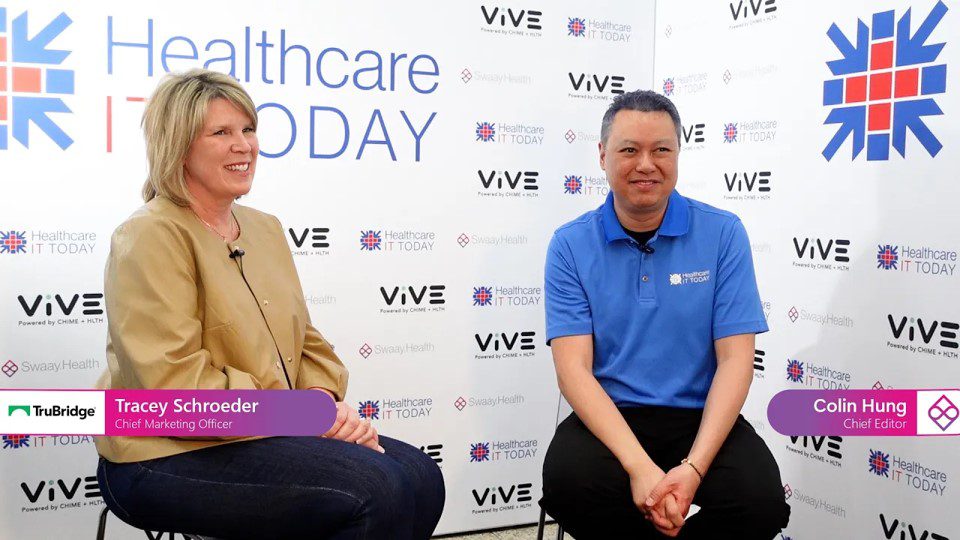
The public campaign appeared across the places where healthcare technology buyers gather: ViVE, HIMSS, regional client meetings and a national client conference. The Nasdaq bell supplied the ceremonial photograph. Earned coverage and paid placements did the slower work of repetition. Executives were prepared as public voices. Promotion continued after the formal launch because a market does not memorize a strategy on command.
Its calendar shows how deliberately the reveal was staged. The team refreshed the TruBridge revenue-cycle brand and conducted market research in 2022. By spring 2023 it had a brand report, positioning statements and core messages. Summer brought the website work, consolidated collateral, social media changes and renewed public relations. Conference branding arrived in August, followed by an industry introduction at AHIMA in October. The final stretch included the Viewgol acquisition, internal launch planning and lessons about keeping unfinished work confidential. In early 2024, business units aligned, clients were briefed and sales teams got their advance look. February belonged to employees and the external announcement. March brought regional meetings, HIMSS and the Nasdaq ceremony. A launch that appeared sudden to the market had been rehearsed across departments for many months.
Those figures, presented by Schroeder and communications executive Beth Friedman in 2025, give the story a satisfying scoreboard. They also reveal the difference between an announcement and a campaign. Articles, interviews, podcasts, webinars, blogs, mentions, speaking sessions and reposts accumulated around the new identity. The organization did not simply state its new name; it created enough encounters for the name to acquire meaning.
The more telling metric may be the one that cannot fit neatly in a large numeral: coherence. A customer who once had to cross-reference brand names could now begin with one company. An employee explaining the portfolio had a shorter opening sentence. A sales conversation could spend less time on corporate genealogy. Every removed explanation returned a little attention to the problem the buyer had come to solve.
The bridge keeps acquiring traffic
The name change did not freeze the company in place. TruBridge continued to develop its revenue-cycle, electronic-record and analytics business for rural and community providers. In July 2026, IKS Health completed its acquisition of TruBridge, making it a wholly owned subsidiary. The combined organization said it would support more than 2,000 healthcare organizations and more than 150,000 clinicians.
For Schroeder, who remained publicly listed as TruBridge's chief marketing officer in 2026, the development adds another integration to a career already marked by them. She moved from Healthland into CPSI when one acquisition required centralized marketing. She later helped move CPSI and its portfolio into TruBridge when the company's identity required centralizing too. Now the brand sits inside a larger organization while retaining a role in rural and community healthcare.
This is where her work becomes more interesting than a before-and-after slide. A brand operator rarely gets the luxury of a finished object. Companies purchase, divest, reorganize and reconsider. Products mature. Buyers change. The tidy architecture presented one year becomes the inherited complication of another. The discipline lies in knowing which parts of the story should remain stable and which have begun to make the audience work too hard.
Schroeder's public remarks are notably free of designer mysticism. She talks about awareness data, customer perception, internal buy-in, stakeholder alignment and the need to keep communicating. Her story is about names, but her method is operational. Listen until the problem can be stated plainly. Choose with evidence. Prepare the people who must explain the choice. Give loyal customers advance notice. Keep showing up after the banners are packed away.
There is wit in the result, intentional or otherwise. A company called TruBridge became the bridge between its own histories. The old names did not need to win a contest or suffer a public funeral. They only needed to yield their separate burdens to one identity capable of carrying them. In corporate life, clarity is rarely a lightning bolt. More often, it is the reward for removing one unnecessary explanation at a time.