The first clever advertisement produced by Aloysius Butler & Clark may have been Aloysius Butler & Clark. In 1972, three men in Wilmington needed a name for their new agency. They were Dan Mealey and the brothers Ewing and John Hawkins. Instead of arranging their surnames on the door, as respectable professional firms do, they used their middle names: Aloysius, Butler and Clark. The result sounded like a trio of old partners who might have lunch at a club with leather chairs. None of those partners existed.
The trick was not merely playful. The founders wanted the client's name to matter more than theirs. Half a century later, that origin story reads like an operating instruction. AB&C is an independent, full-service marketing communications agency, but the interesting noun is not agency. It is action. Its work is designed to make somebody call, visit, apply, schedule, join, buy or reconsider.
The phone number that picked a fight
Consider a digital billboard placed near Arrowhead Stadium in Kansas City before the 2025 championship game. It offered Chiefs fans a “pep rally in your pocket” and a local number to call. The line answered with “Fly, Eagles, Fly.” This was advertising as a whoopee cushion, deployed in enemy territory.
But the numbers reveal the machinery beneath the joke. During seven days, the line received 333,487 calls, peaking around 1,000 an hour. The campaign generated 19.6 million media impressions and 107 news stories. AB&C attached a $5,000 combined donation to the Eagles Autism Foundation and Kansas City's Hunt Family Foundation. In June 2026, the stunt won a national Gold ADDY after moving through local, district and national judging.
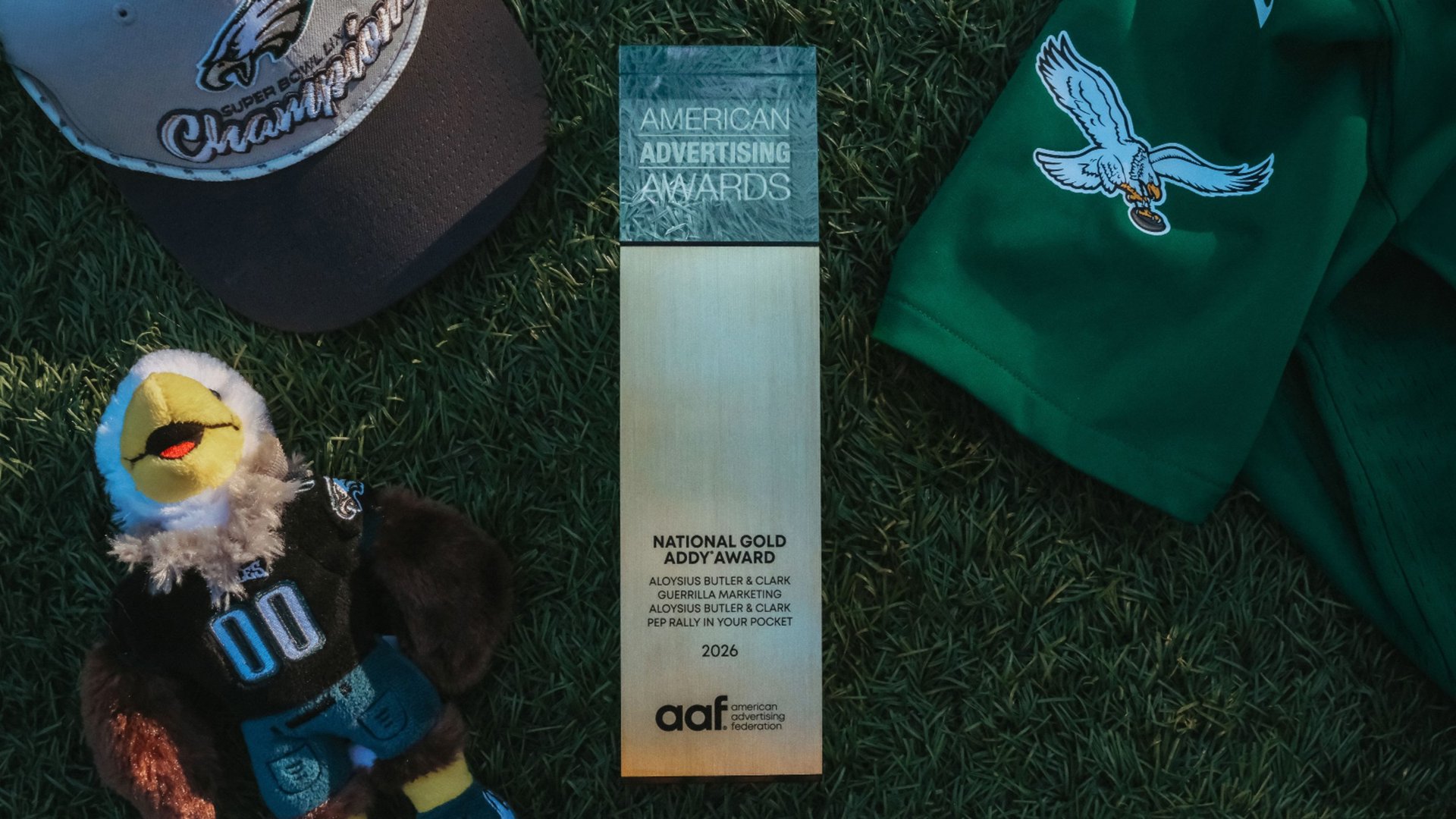
The cost of the media campaign has not been publicly disclosed. The charitable component has: $5,000. That distinction matters. A neat case study can tempt marketers to copy the visible object - buy a billboard, write a joke, wait for virality. What AB&C actually assembled was a loop. Outdoor created curiosity. The call delivered the reveal. Social spread it. Public relations supplied a larger stage. Charity made the provocation generous enough to travel. Creative, media and PR were not consecutive departments. They were parts of the same sentence.
Five specialist doors, one shared workshop
AB&C sells research and strategy, branding and design, advertising, paid media, public relations, social, web development, analytics and video. This is the familiar full-service list, the agency equivalent of a diner menu. Its more consequential design choice is organizational: the company concentrates expertise in five hubs - healthcare, behavior change, recruitment marketing, consumer and specialty B2B - then connects those specialists to shared channel teams.
That arrangement answers an old agency problem. A generalist can buy every medium but miss the peculiarities of a hospital, a public-health mandate or a long industrial sale. A specialist understands the market but may solve every problem with the one tool it owns. AB&C's bet is that vertical memory and broad execution belong together.
Name the behavior, not the deliverable. “Increase ordinary weekday visits” is more useful than “make a summer campaign.”
Find the audience's native tension. Football loyalty, fear of running out of money and distrust of betting tips each contain their own creative energy.
Build one idea that survives every channel. If outdoor, PR, social and video need separate explanations, the idea is carrying too much luggage.
Measure the act closest to the problem. Calls, referrals, memberships and completed views beat a vague claim about awareness.
The ad is not always the thing that failed
Adventure Aquarium already had famous sharks, hippos and a waterfront address. Its problem was ordinary time: how do you persuade families to come on a random Tuesday? Before making ads, the client and agency held a discovery session to define audiences and benefits. “Make today an adventure” turned the attraction from a special occasion into an available impulse. A 25-day membership push exceeded its enrollment goal by more than 66 percent and anticipated revenue by more than 85 percent.
For St. Mary Medical Center, the stale element was category language. The hospital's brand felt old while competitors spoke in the same polished healthcare vocabulary. Research surfaced “devotion” as the distinguishing idea. In the six months after launch, call volume increased more than 30 percent, Google referral volume rose 110 percent and online video completion reached 85 percent.
For the Delaware Council on Gambling Problems, the first constraint was money. A nonprofit with a modest budget was competing for attention in a market fueled by private-equity-backed betting platforms. A standard warning would arrive dressed as homework. AB&C instead invented Don Ciccenowski, a fast-talking salesman offering supposedly unbeatable gambling tips. His younger counterpart, Dickie, targeted 18- to 24-year-olds. The promise pulled gamblers toward a reveal: if a “sure thing” from this man seemed appealing, perhaps the behavior deserved examination. Impressions, clicks, video views and visits to help resources doubled year over year.
Do not imitate the costume. Borrow the sequence: enter through a belief the audience already holds, then use the reveal to change what that belief means.
Independence, with a New Jersey annex
AB&C is privately held and describes itself as the largest independently owned ad agency in the mid-Atlantic. It has offices in Wilmington, Philadelphia, Bloomsburg and Lambertville, with remote work extending its reach. Independence is a business model as much as a personality: client fees and retained or project work pay for the operation, without a public parent dictating quarterly priorities.
In July 2025, the agency acquired Oxford Communications after a decade of expanding its New Jersey business. Oxford brought a Lambertville office, a 39-year history and clients across packaged goods, manufacturing and retail. It continued operating and serving its clients, now with access to AB&C's PR, social and expanded paid-media capabilities. The acquisition made the specialist network larger without pretending that a familiar local name had no value.
The company says average client and employee tenure exceeds nine years. That is an unusually revealing paired statistic. Long employee tenure preserves the memory of why an old decision was made; long client tenure gives the team permission to challenge it. In 2025, AB&C refreshed its own brand around “Never the same,” launched a new website and adopted a unicorn mascot. The animal is whimsical. The strategic claim is sober: stability should fund variation, not sameness.
What the reader can steal
The most copyable part of AB&C is not a style. Its portfolio moves from children's hospitals to shore tourism, banking, industrial equipment and public safety without a recognizable house look. Copy the discipline of translating a business problem into one observable action. Copy the discovery session before the design. Copy the insistence that a central idea should be sturdy enough for paid media, earned coverage and a phone call. And report the number nearest the client's pain.
There are conditions where this approach weakens. Provocation needs a real cultural permission slip; without the Eagles-Chiefs rivalry, the prank is merely deceptive. Humor is hazardous when the audience needs dignity or the subject carries trauma. A hub model earns its keep only when specialists have genuine authority and shared teams communicate early. And integrated execution cannot rescue a shapeless proposition. More channels multiply clarity, but they also multiply confusion.
The old fictional partners would recognize the final rule. Make the audience remember the client, not the technique. Aloysius, Butler and Clark were invented to disappear. Their agency has lasted by turning that disappearance into a method.