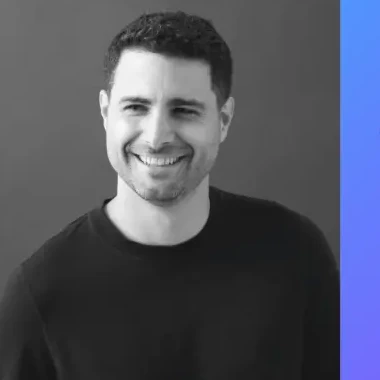
A designer who never stopped asking hourly workers what they actually needed
Tito Goldstein learned about shift work the way most people do, from the inside. As a teenager he spent summers working at In-N-Out, driving an hour each way for a shift that sometimes lasted only a few hours. He did not know it then, but that commute and that clock-in ritual would sit at the center of the company he built two decades later.
Goldstein was introduced to technology around the age of eight and started building on the web as a kid. He studied at the University of Southern California, kept designing, and eventually landed at Uber as one of its first principal product designers. There, working across the rider app, the driver app, and Uber's internal and enterprise tools, he and a colleague named Arjun Vora did something that would define the rest of their careers: they went out and talked to drivers. Thousands of them, across the United States, Brazil, Mexico, India, Singapore, and Australia.
One answer kept surfacing. Drivers often chose Uber even when the pay was lower somewhere else. The reason was not money. It was agency. The app let them see their options, pick their work, update their own information, and run their day without asking a manager for permission.
Drivers were choosing Uber despite lower pay because of the agency and self-service the app gave them.
That insight nagged at Goldstein. Roughly 60% of the global workforce is hourly and shift-based, and most of them were still stuck on software that felt nothing like the Uber app. Clocking in, claiming a shift, updating a bank account, messaging a manager, none of it was self-service. He and Vora decided to fix it, and in 2017 they co-founded Teambridge.
Two years of almost nothing
The founders started the way many do, by knocking on doors. They walked into movie theaters, cafes, restaurants, and retail shops to see the technology gap firsthand. They compressed their seed raise into two concentrated days of back-to-back investor meetings and closed a $3 million round at a $15 million valuation, leaning heavily on their Uber credibility.
Then came the part nobody puts on a highlight reel. Their first product was a scheduling tool, and for roughly two years it generated close to nothing. Customers kept telling them the same thing in different words: they did not want cookie-cutter software. Every staffing business ran a little differently, and a rigid template could not bend to fit them.
Customers kept telling us they needed differentiation, not cookie-cutter software.
So they scrapped it. Instead of one fixed product, they rebuilt Teambridge as composable building blocks, configurable pieces a business could arrange like Lego to match its own workflows. The bet was that giving customers roughly 20% customization on top of a solid core would be the unlock.
It was. The new product outsold two years of prior effort in its first month, then went through repeated cycles of tripling. When COVID arrived, medical and healthcare staffing companies became the first strong fit, scaling from bare-bones admin operations into multi-million-dollar businesses on top of Teambridge's automation. The pandemic also killed door-to-door selling overnight, forcing two design-first founders with no formal sales background to teach themselves outbound email, cold calling, and paid lead generation from scratch.
Growth after the pivot
The composable rebuild did not just find product-market fit, it compounded. Revenue tripled in the year after launch, more than doubled again in the first half of 2024, and the company doubled its headcount around the Series B.
From hospitals to a packed stadium
Today Teambridge serves more than 200 enterprise customers and over 500,000 workers, spanning healthcare, light industrial, staffing, events and venues, and physical security, with expansion into retail and international markets. One of its more visible deployments runs game-day staffing for the San Francisco 49ers at Levi's Stadium, coordinating thousands of event workers per game.
In 2025 the recognition caught up with the work. Goldstein was named one of Forbes' Top AI Founders to Watch, credited for his impact on real-world AI. That fall, Teambridge unveiled a new AI platform built specifically for frontline and shift-based workforces, extending the composable idea into automation that can source candidates, enforce compliance, and run scheduling with less manual overhead. Goldstein holds five granted utility patents from his work at Uber and Teambridge.
Discovery precedes demos. Hold the insight until the product aligns with the pain the customer names.
The philosophy underneath it all is unglamorous and consistent. Goldstein talks about grit and curiosity as the founder traits that matter, about entering new markets while openly admitting what he does not yet know, and about the discipline of listening before pitching. The willingness to throw away two years of work, he has said, was not a detour. It was the whole point.
The tinkerer behind the founder
The same hands-on instinct shows up away from the office. Goldstein homebrews his own beer and makes soap. He does paper crafting. He has been converting a Mercedes Sprinter van into a camper, a project that never quite ends. He has written fiction and nonfiction since childhood, and he shares his home with a German Shepherd and Husky mix named Callie. He is the kind of builder who keeps building after hours, which is probably the point.