Consider the old phone in a kitchen drawer. It still works. Someone would buy it. Its owner knows both things and nevertheless leaves it beside the spare keys. The obstacle is the afternoon between deciding to sell and actually selling: photographs, a listing, a stranger’s questions, a parcel. Tiptop’s proposition began in that afternoon. What if the phone could become payment before its owner had to become a shopkeeper?
- The idea: trade an eligible old item toward a new purchase, across product categories.
- The bargain: less selling work in exchange for accepting a quoted trade-in value.
- The catch: someone still has to price, collect and resell the item.
Founded in 2022, Tiptop was led by Bastian Lehmann, the Postmates co-founder. Its documented story runs from a resale app in 2023 to merchant checkout integrations in 2024. Today it needs a date stamp: as of October 2026, its main website redirects to Mother Computer. The launch remains an interesting experiment in how to make possessions spendable.
The purchase had already happened
The first public product, Tiptop Cash, launched in the United States in September 2023. It looked backward. By connecting to Gmail or Amazon purchase records, the app could identify eligible things a customer had bought and make offers for them. Instead of asking someone to construct an inventory, it began with an inventory that already existed: receipts.
This was a practical choice with a practical price. The customer gave a service access to purchase information. In return, an object could acquire a visible cash value and a route out of the house. Forbes reported that Tiptop would resell collected goods through wholesalers or third-party markets. The promise to the owner was simplicity; the company inherited the paperwork.

Early speculation had cast Tiptop as a crypto venture. Forbes reported that Lehmann considered a ledger approach for combining purchase records, then dropped it. The public product had no crypto component. That abandoned direction matters because it distinguishes a fashionable technical possibility from the more ordinary problem the company actually chose to address.
Then the drawer met the checkout
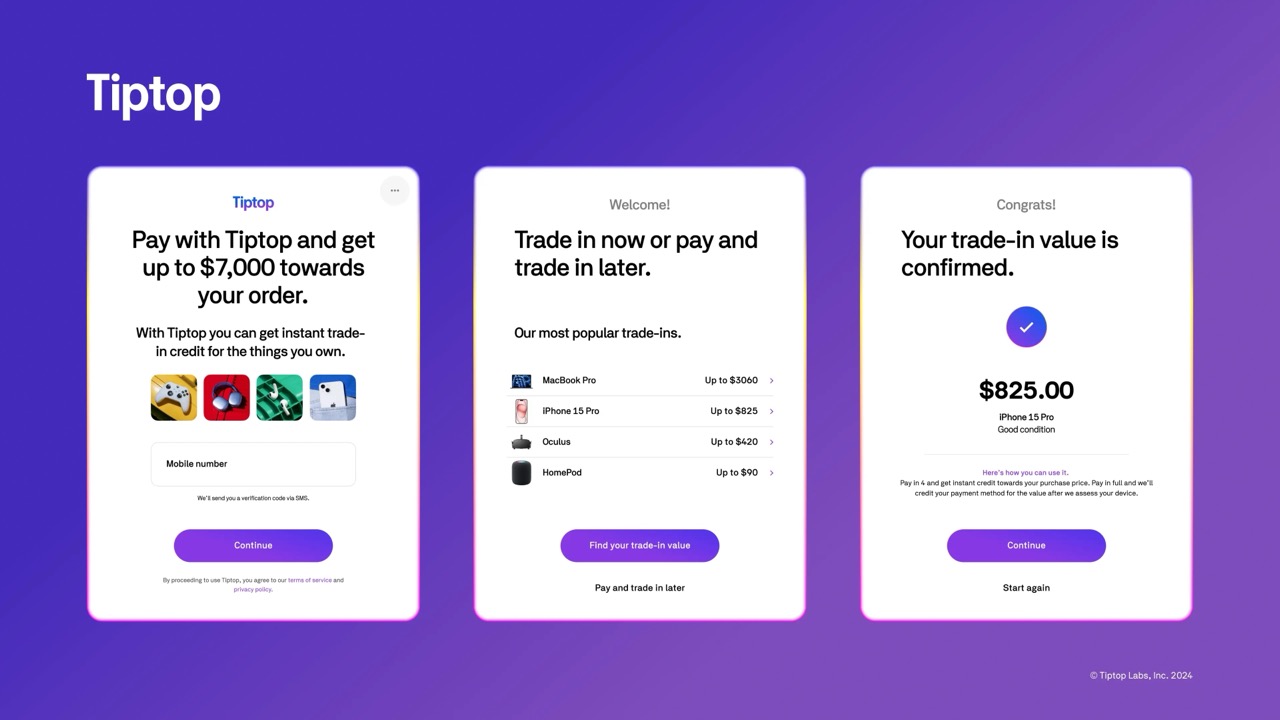
The next move changed the moment of usefulness. In June 2024, Tiptop introduced trade-ins inside participating merchants’ checkout flows. A shopper chose an owned item from a catalog, supplied details, received a quote and applied the value toward a purchase. The old thing and the new thing did not have to belong to the same category.
Look at the launch partners: Nothing, Cradlewise, Backbone, Phone Daddy and King of Christmas. A phone brand, a smart crib, a gaming controller, used handsets and artificial trees make an odd dinner party. Together they explained the product more clearly than a slogan could. The trade-in belonged to the payment process, rather than to one manufacturer’s upgrade program.
“Sell more, faster with trade in at checkout”Tiptop’s historical merchant website
For a retailer, this offered a different answer to a hesitant customer. Instead of reducing the sticker price, the merchant could help the shopper use value already held elsewhere. Tiptop handled the trade-in, payments and shipping. Its launch material claimed better conversion and larger orders. Those were commercial claims, rather than an independently established performance benchmark.
Four payments do not make a phone free
Tiptop paired trade-in credit with an interest-free Pay in 4 option. The two features did different jobs. A trade-in exchanged an asset for credit. Installments divided the remaining payment over time. Combining them could make the first cash payment smaller, but the arithmetic still included the object surrendered.
That distinction is useful beyond Tiptop. Someone comparing offers should count both the cash and the trade-in. If the old device could fetch more elsewhere, convenience has an opportunity cost. If selling it independently would never happen, the relevant alternative might be another year in the drawer. Neither customer is being irrational. They are pricing their time differently.
In the documented checkout flow, customers could send goods using prepaid shipping, with a courier option also reported at launch. The interface removed the need to find a buyer. It could not remove the physical handoff. An item still had to travel, arrive in the stated condition and retain enough resale value to justify the journey.
The button had a business behind it
Tiptop raised a reported $23 million Series A in 2022, led by Andreessen Horowitz, with investors including Sam Altman and Naval Ravikant. Funding gave the experiment room to develop. It did not settle the economics. WIRED reported merchant fees of 5% to 12% at the 2024 launch. That historical range describes a meaningful cost for retailers considering the proposition.
The company’s expertise sat between software and used goods: quoting an item, accepting a payment, managing an order and arranging its return journey. Surviving developer documentation describes a Shopify payments app and direct integrations, alongside Salesforce and Adobe guides. A few visible checkout screens sat on top of several systems that needed to agree about money and merchandise.
The Shopify onboarding guide is revealing. A merchant needed business and bank information, submitted an application, waited for review, then installed and activated the payment provider. That is more consequential than pasting a decorative widget into a storefront. A payment option needs to fit the merchant’s operations as well as its visual design.
The lesson that still fits in a drawer
The copyable idea is the timing. Tiptop moved an inconvenient task beside a purchase that made doing it worthwhile. Product teams can borrow that approach: identify where a customer’s hesitation occurs, then put a concrete remedy there. The remedy must carry its operational costs with it, or a pleasant interface merely relocates the inconvenience.
This approach depends on goods with recognizable models, credible prices and manageable shipping. It becomes less attractive when resale margins shrink, freight consumes the value, or customers prize the highest possible payout over speed. The old phone is easy to understand. Making it behave like money requires an entire business to stand behind the button.
Follow the experiment
Original website · LinkedIn · X · Developer repository
Product documentation · Historical newsroom · 2024 launch video · Founder’s checkout demo · Disrupt interview