A building can be full of information and still keep secrets. The power meter ticks. A room warms after everyone has left. A pump runs harder than it did last Tuesday. An occupancy sensor counts a crowd that never arrives. Each machine says something; almost none of them volunteer an explanation. Tim Howard has spent years trying to make the conversation less awkward.
Howard is both a software veteran and a facilities operator, an unusually useful pairing in a business where code eventually meets concrete. At Clemson University, he works as facility manager at the Watt Family Innovation Center. At CarbonCents, the company he co-founded in early 2022, he is CEO. The two roles share a concern: how to turn the untidy signals inside a building into a decision somebody can make today.
CarbonCents did not arrive as a clean diagram on a venture capitalist's whiteboard. Its own account begins in a basement. The deeper roots run through Clemson's Energy Visualization and Analytics Center, or CEVAC, where Howard worked with Snowil Lopes, David White, Carl Ehrett and waves of students on the stubborn mechanics of campus data. They connected utility feeds, weather, building systems and sensors. They built alerts. They developed dashboards and a 24-hour power forecast. The campus was classroom, customer and laboratory at once.
The bills knew too much, too late
The ordinary utility bill is a peculiar management instrument. It is authoritative, expensive and late. It says what happened after the chance to intervene has passed. Howard's work moved the question upstream: if an institution could see power, temperature, water, indoor air quality and occupancy together, could it catch waste while it was still happening?
That “together” is the important word. Buildings are frequently a parliament of unrelated systems. The HVAC controls may not know the room schedule. A utility feed may not know the weather. Sustainability staff may be assembling annual reports while facilities staff answer hourly comfort calls. More data can add more noise unless someone gives it context.
“Once connected to all systems, we collect relevant data and display it in context with an easy-to-use application.”Tim Howard
Howard's pitch is practical: use the systems already in place, connect their signals and let leadership see which decisions can cut indirect costs. CarbonCents packages that approach across products for buildings, sites, carbon management and sustainability reporting. It is climate software with dirty fingernails. The appeal is not a more decorative chart. It is catching the schedule that drifted, the silent sensor, the unexplained peak and the reporting gap before each becomes a more expensive story.
A long apprenticeship in useful software
CarbonCents describes Howard as bringing more than 30 years of software-development experience. Earlier chapters included Datastream Systems and Infor, where his work touched quality management, plus product leadership at ISS. Professional recommendations from former colleagues describe him as energetic, self-motivated and unusually good at keeping teams fixed on quantifiable problems. One called out his ability to preserve the big picture without letting a project dissolve into process.
Those are not glamorous traits, which is precisely why they matter. A smart-building project can fail in a hundred uncinematic ways: a vendor changes a field name, an interval goes missing, a controller stops reporting, a beautiful dashboard answers nobody's actual question. Quality work teaches suspicion. Facilities work teaches consequence. Howard's career put both lessons in the same room.
By 2018, he and David White were presenting Clemson research under the disarmingly direct title “How Smart is Your Building?” The work examined HVAC, lighting, occupancy and other systems inside the Watt Center, using real-time databases and visualization tools. In 2020, Howard, White and Lopes published their account of forecasting campus power use. Their student team had built pipelines across facilities databases, emailed attachments and third-party feeds. It was not merely a model. It was plumbing.
This is the part of Howard's story worth stealing: the product began close to the inconvenience. He did not need to imagine how a campus operator thinks because he was one. The Watt Center offered enough technical complexity to be useful and enough daily accountability to prevent abstraction from floating away. When CarbonCents emerged, it carried those operating habits into the company.
The company leaves the laboratory
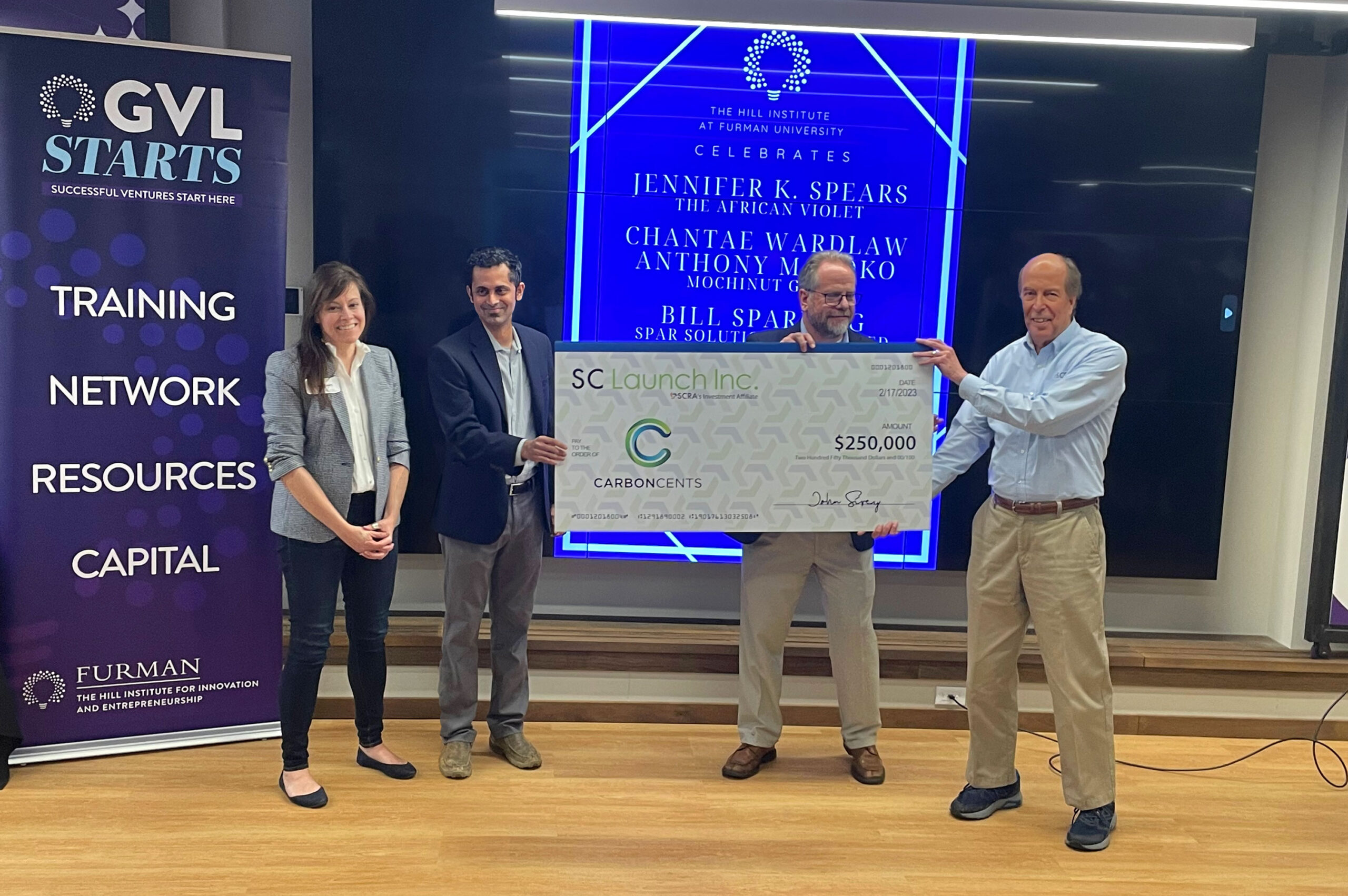
In 2022, CarbonCents became an SCRA Member Company. A $25,000 academic startup grant and a $50,000 acceleration grant followed. In March 2023, SC Launch announced a $250,000 investment. The numbers gave the basement idea room to become a business, but the strongest part of the case was already operating: more than 32 Clemson buildings, over 190,000 observations a day and an initial beta project credited with estimated energy savings of 17 percent.
Howard framed the company around a double dividend: reduce carbon footprints and reduce costs. It is a helpful discipline in a market where environmental ambition often meets an operations budget. A ton of avoided emissions may satisfy a target; a lower utility bill can keep the target funded. CarbonCents tries to make the same intervention legible in both languages.
The customer work gradually widened. CarbonCents partnered with farms and manufacturers on carbon management and reporting. Titan Farms published its first sustainability report in January 2026 after nearly three years of work with the company. International Vitamin Corporation extended a carbon-management project into 2026, adding support across multiple reporting frameworks.
Then came a campus test at a larger scale. After an initial University of South Carolina pilot grew to five buildings, USC signed a four-year extension announced in February 2026. The site-wide deployment covers roughly 12.8 million square feet on the Columbia campus, connecting with the existing building-management system and supporting energy, space-utilization and building-control work. A university-born product had found another university willing to widen the door.
“We are honored that USC has chosen to extend and broaden its relationship with CarbonCents.”Tim Howard, February 2026
Seventy-five apprentices and a shared dashboard
There is another number in the story, smaller than the daily data count and more revealing: 75. By November 2024, more than 75 students had worked with CarbonCents and CEVAC. Howard marked the milestone publicly, writing that he had enjoyed watching them grow while helping Clemson with its goals.
That arrangement gave students a rare assignment. They were not polishing a disposable case study. Their pipelines and models sat near real equipment, real budgets and real institutional promises. A faulty alert could waste an operator's time. A useful forecast could change a schedule. The work made the distance between education and consequence pleasantly short.
It also suggests something about Howard's temperament. His public comments are more likely to praise a team, a student milestone or a client outcome than to stage a founder mythology. In April 2025, he celebrated CarbonCents' highest-value quarter of signed contracts to that point by congratulating the team. The sentence began with pride in the group, not possession of the result.
CarbonCents says it intends to create jobs in South Carolina. Howard continues to speak to the facilities community, including scheduled 2026 appearances at regional campus-operations conferences. That is a fitting route to market. The people who understand a building's oddest moods often gather far from the main technology stage, comparing notes about deferred maintenance, staffing and equipment that refuses to retire.
When the building finally answers
The phrase “smart building” has carried a faint science-fiction perfume for decades. Howard's version is more grounded. Intelligence appears when an operator sees a problem early, when leadership can compare cost and carbon on the same screen, when a reporting team stops hunting through incompatible files, or when an occupied room is comfortable without an empty one being conditioned all night.
There is no single heroic sensor in that picture. The work is connective. It respects the old systems enough to listen to them and mistrusts them enough to check their stories against one another. It treats context as infrastructure.
That may be Howard's clearest contribution. He has spent a career around software, then placed it inside buildings where every abstraction receives a monthly invoice. CarbonCents is his attempt to shorten the distance between a signal and a sensible response. The building was always talking. Someone simply had to arrange the conversation.
Keep the conversation going
Explore the company, Howard's professional profile, the radio interview and the technical paper behind Clemson's early energy-forecasting work.