The least glamorous room on a university campus may contain the most persuasive climate pitch. Somewhere behind a locked door, chilled-water readings, electric meters, thermostats and occupancy systems are recording what a building is doing. Usually, each speaks its own dialect. CarbonCents, a small software company born from Clemson University research, wants to translate the chatter into two things administrators understand immediately: what is going wrong and what it costs.
That order matters. Carbon software often begins with an abstract obligation - count emissions, assemble a disclosure, promise a distant reduction. CarbonCents begins closer to the boiler room. Its platforms connect data sources an institution already owns, place them in a common view and look for wasted energy, faulty meters, strange baselines, empty space and uncomfortable rooms. Carbon accounting comes along for the ride.
The company escaped from a campus lab
CarbonCents was co-founded in 2022 by Tim Howard and Snowil Lopes. Howard worked on facility solutions at Clemson's Watt Family Innovation Center; Lopes directed technology and research at the Clemson University Energy Visualization and Analytics Center, known as CEVAC. They formed the company to commercialize a platform developed with Clemson researchers David White and Carl Ehrett. The origin story is refreshingly literal: people who had spent years dealing with institutional systems built software for institutional systems.
By early 2023, the technology was operating in more than 32 Clemson buildings and collecting over 190,000 observations each day. SC Launch, South Carolina Research Authority's investment affiliate, said an initial beta with industry partners produced an estimated 17 percent energy saving after mitigation measures. That figure needs its qualifier - estimated, early, and tied to a beta - but it gave the young company something climate startups badly need: proof that could be translated into an operating budget.
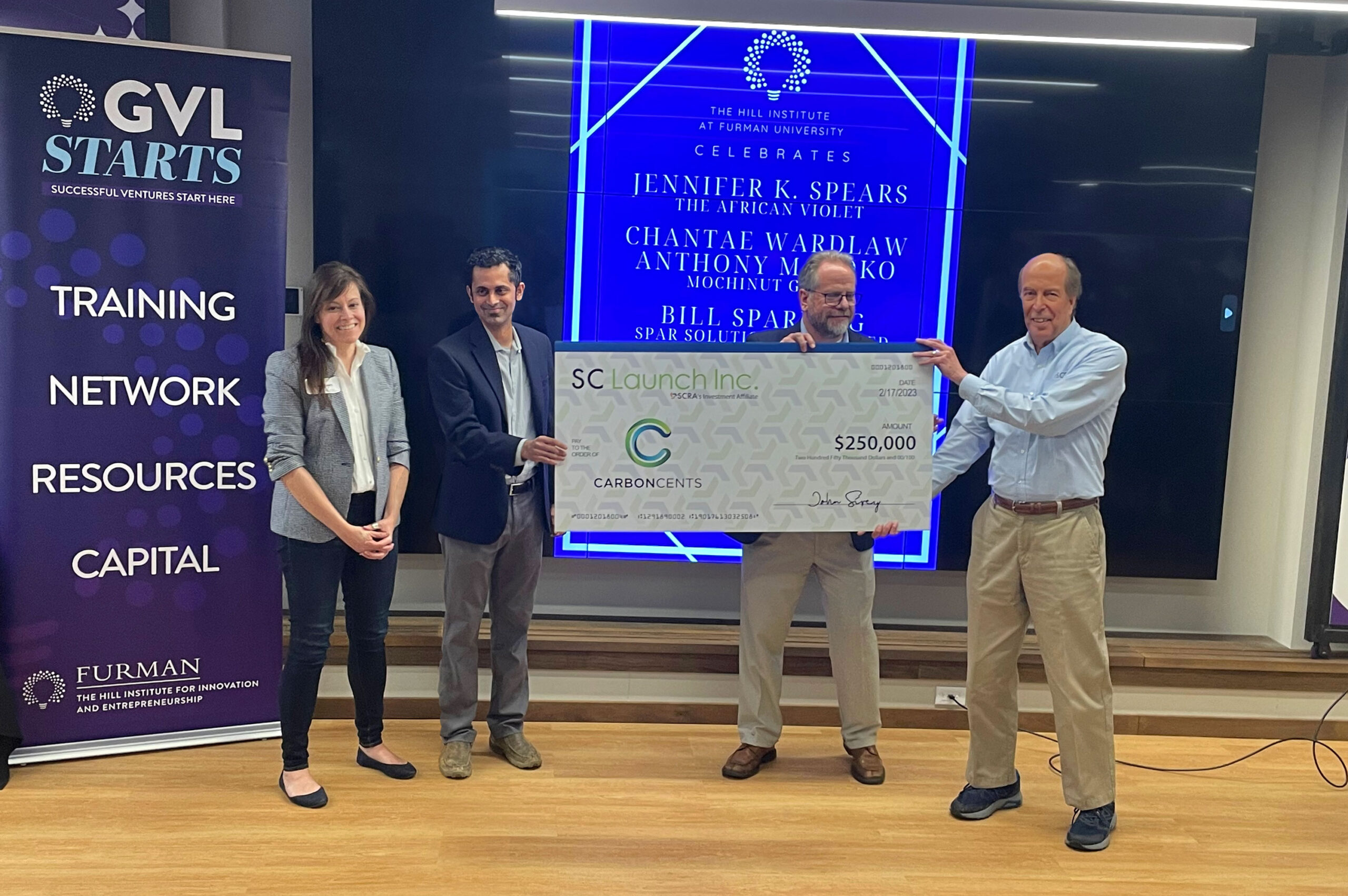
The financing matched that pragmatic progression. CarbonCents first received a $25,000 academic startup grant and a $50,000 acceleration grant from SCRA. In March 2023, SC Launch announced a $250,000 convertible-note investment. The company has never disclosed a valuation or revenue. Its scale is easier to read through contracts: a South Carolina procurement record shows a five-year Medical University of South Carolina agreement beginning in August 2025 with a target value of $322,000.
Four products, one recurring headache
The product names are cheerfully uncomplicated. BuildingBI pulls together building controls, energy, occupancy, indoor-environment, space and health information. SiteBI moves up a level, comparing utilities and infrastructure across a property portfolio. CarbonBI converts activity data into Scope 1, Scope 2 and exploratory Scope 3 footprints using the Greenhouse Gas Protocol. StarsBI serves universities completing the Sustainability Tracking, Assessment & Rating System administered by AASHE.
Around those platforms sits a services layer: system integration, remote monitoring, energy reporting, carbon consulting, offset feasibility work and, more recently, ASHRAE Level II energy audits. This makes CarbonCents less like a pure software subscription and more like a compact facilities-intelligence practice with reusable software. Pricing is not public. The MUSC contract suggests configured enterprise engagements, not a credit-card plan purchased by an office manager at lunch.
The CarbonCents operating loop
Its customers sit wherever facilities are complicated enough to produce both data and confusion: higher education, manufacturing, health care, hotels and municipalities. Publicly named relationships include Clemson, MUSC, Titan Farms and International Vitamin Company. CarbonCents has celebrated Titan Farms' first sustainability report and an IVC contract extension into 2026. At MUSC, the selected BuildingBI suite covers energy monitoring, space management, building controls, indoor environment and building health.
What failed first was the report
The clearest product lesson comes from Clemson's sustainability reporting. A CarbonCents case study says the university's previous STARS report required months of collection, analysis and communication. It recorded work but offered limited guidance about what stakeholders should do next. The document was close to being set aside. That was the failure: not bad intent, but a large reporting effort that struggled to produce momentum.
Clemson changed course because it wanted a more adaptable format that could reveal credit criteria, explain where points were lost and track improvement. CarbonCents built StarsBI, an interactive layer over the report, and used Microsoft Teams folders to coordinate evidence from campus liaisons. A compliance exercise became a navigable operating backlog. The clever bit was not a dazzling chart. It was reorganizing who supplied data, where it lived and how a department could see its next move.
Where the pitch gets practical
That approach separates CarbonCents from carbon ledgers that begin and end with emissions inventories, and from traditional building controls that stop at equipment. Competitors range from Watershed in enterprise carbon accounting to Brightly in facilities software and Verdigris in energy analytics. The everyday alternative is less glamorous and more dangerous: spreadsheets, utility portals, vendor dashboards and the institutional memory of one facilities veteran.
CarbonCents' difference is breadth across those layers, plus the willingness to consult. Breadth creates risk too. A company of roughly ten people is offering four named platforms, building services, audits, carbon consulting and offset-project development. Cross-selling can turn one campus foothold into a valuable portfolio. Product sprawl can turn the same team into a custom-development shop. The next stage will show which description fits.
The playbook worth stealing
The reusable move is to start with the workflow the customer already resents. Connect existing systems before proposing a rip-and-replace project. Choose one measurable pain - a faulty meter, an energy baseline, an annual report - and build a common view around it. Put the relevant operators in the data-collection loop. Then turn the first proof into adjacent modules. CarbonCents did not ask Clemson to imagine an entirely new institution; it made the institution's own information easier to act on.
Sell a short path from existing data to one budget-relevant decision. Document the baseline, assign an owner to the change, and expand only after the customer can verify the result.
This model will not work everywhere. Software cannot rescue inaccessible legacy controls, missing sub-meters or data whose timestamps and units never agree. Forecasts require enough history to establish a credible baseline. An alert is worthless if nobody owns the response, and a carbon footprint is weak if activity data is guessed. Buildings with little operational flexibility may reveal waste that a tenant or facilities team lacks authority to fix. In those conditions, integration and governance come before optimization.
CarbonCents is responding by staying close to implementation. Its recent addition of Level II energy audits moves the company further into the physical diagnosis of facilities, while conference talks pitch a broader definition of the smart building - one that includes cleaning schedules, room use and maintenance disruption as well as kilowatts. That is a sensible expansion if each new signal leads to a decision. It is less compelling if the dashboard becomes a museum for charts.
The company now sits in a crowded but durable market between building automation, energy management, carbon accounting and sustainability consulting. It has local credibility, real institutional deployments and a public contract that carries the experiment beyond Clemson. Its question is no longer whether buildings create enough data. They create far too much. The question is whether CarbonCents can keep turning that abundance into a short list of actions someone will fund on Monday morning.