In February 2024, a building in the Boston area was obeying the wrong instructions. At BXP’s Weston Corporate Center, incorrect exception schedules in the building automation system were driving unnecessary energy use. Measurabl’s Optimize software flagged the problem. The building team deleted the schedules. The company’s case study puts the verified savings at $16,000.
There is something pleasingly undramatic about this. No gleaming replacement building. No ceremonial ribbon. A schedule was wrong, someone noticed, and someone changed it. For a company selling sustainability software, it is a useful little test: can the information travel far enough to alter what a building actually does?
- The job: collect and check building sustainability data, then make it useful for operators and investors.
- The shift: portfolio reporting expanded into energy operations, planning and capital-market data.
- The price of entry: foundational software is free; advanced products and services are paid.
- The lesson: an alert earns its keep when a person can act on it.
A building with the wrong diary
The Weston incident offers a miniature of Measurabl’s proposition. A monthly utility bill can show that energy was consumed. Interval readings can help reveal when it was consumed. That difference matters when the question is whether equipment ran on the wrong schedule.
BXP had already invested in the infrastructure needed to ask those questions. Its published Measurabl case describes 308 commodity meters across 107 sites, with building teams using the information to tune operations. The software belongs inside a working system of meters, engineers and decisions.
From Measurabl’s 2025 BXP case study. Different revenue and cost categories, not a single annual savings figure.
Demand response rewards participation in programs that adjust electricity demand; it should not be casually relabeled as avoided energy spending. The distinction is the point. A useful sustainability argument has to survive ordinary accounting.

The problem hiding inside the portfolio
Measurabl occupies the space between a property and the people trying to understand it. Owners need portfolio comparisons. Operators need clues about waste. Investors need information they can compare across companies. The same utility reading may have a job in all three conversations.
The trouble is getting it there. A portfolio contains buildings with different meters, billing systems and reporting practices. Missing readings and duplicates can make an apparently tidy dashboard misleading. Measurabl’s Data Manager collects and centralizes records, identifies gaps and outliers, and can lock readings after third-party assurance.
Its Navigate suite divides the work into recognizable tasks. Data Manager tends the records. Insights provides customizable analysis and dashboards. Disclosure prepares information for frameworks including GRESB and SFDR. Decarb models projects and pathways, including CRREM alignment. Quantum Cloud supplies the shared data foundation beneath the products.
For multifamily and affordable housing, Comply concentrates on utility collection, benchmarking and reporting, including green-financing workflows. Optimize addresses building operations. The product range makes more sense when viewed as a set of jobs for different people than as an invitation to buy everything.
Buying a route from reports to operations
In April 2022, Measurabl offered a candid explanation for acquiring Hatch Data: its existing Core software worked at the portfolio level, but did not serve building operators. It needed detailed, real-time building information and tools for acting on it. The acquisition supplied a route into that work.
That September, it bought WegoWise from AppFolio, adding utility-data automation and residential real estate capabilities. The two purchases attacked different bottlenecks: interpreting operational information and obtaining the underlying records.
Expansion needed capital. Measurabl announced a $50 million Series C in September 2021 and a $93 million Series D in May 2023. Energy Impact Partners led the former and co-led the latter with Sway Ventures. Those sums financed the company’s development; they say nothing about what a customer must spend on software or metering.
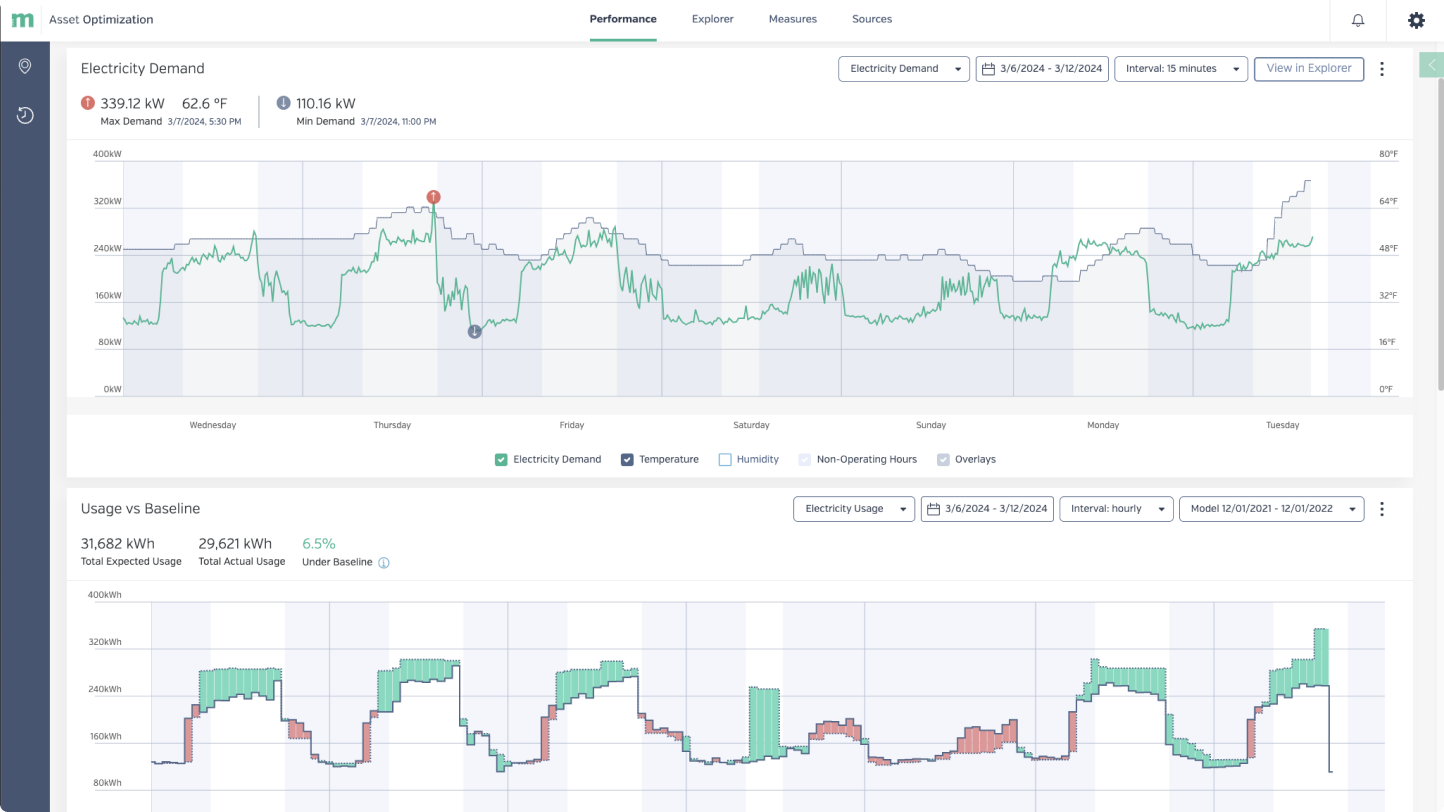
Optimize can begin with interval data supplied by a utility where that connection is available. More detailed monitoring can use onsite meters and system integrations. The practical choice is how much resolution a particular decision needs, and what the building can supply.
The founder who reconsidered the scoreboard
Matt Ellis’s earlier career included tenant-representation brokerage at CBRE during the financial crisis. He and Lance Onken founded Measurabl in 2013. Years later, Ellis revisited the purpose of the business. In a July 2025 essay, he argued that measurement had become too much of an end in itself, while financial outcomes and everyday transaction decisions remained insufficiently connected to sustainability data.
“Paywalls must fall, the ecosystem must integrate, and focus must shift to outcomes.”
Matt Ellis · July 2025
The business-model change was concrete. Measurabl introduced free foundational software for tracking energy, water, waste and carbon, comparing performance and collaborating on data. Premium capabilities remained paid. By December 2025, it reported adoption across 14,000 buildings in 47 countries.
Free entry changes the buyer’s first question. A team can begin organizing its information before committing to a more elaborate product. Commercially, Measurabl still sells advanced capabilities and services. The wager is that broad participation makes the data foundation more useful and gives customers reasons to pay for what comes next.

Co-founder; Executive Chairman.

Appointed CEO in December 2025.
One dataset, several very different customers
A facilities team and a pension investor may never discuss the same piece of equipment. They can still depend on information about its building. PGGM uses ESGx Securities to assess listed real estate, where buying a company’s shares means inheriting exposure to its underlying properties. Building-derived estimates help it compare that exposure.
Estimates deserve their own label. Standardization can make a comparison more useful without turning a modeled number into a meter reading. FTSE Russell also uses Measurabl data in real estate indexes, connecting environmental performance measures with index construction. This is where the company’s market position extends beyond the sustainability department.
Its alternatives depend on the task. Deepki also centralizes real estate sustainability data and supports energy, climate-risk and investment decisions. Yardi’s energy offerings connect utility and ESG functions to property-management software. Buyers should compare data access, workflow fit and implementation support against the problem they actually have.
Measurabl’s August 2026 Inveniam announcement reported more than 28 billion square feet tracked across 97 countries. Its proposed document-intelligence integration addresses another problem: preserving a number’s connection to its original document, with governed access. Scale is useful; a traceable record is useful when someone challenges the number.
The people between an alert and a saving
The industry’s least glamorous requirement is someone with the time and authority to act. Measurabl expanded its service-provider network in July 2026, adding specialists in verification, planning and implementation. That is an acknowledgment that software alone cannot perform every job between a finding and a completed improvement.
The repeatable lesson from Weston is modest. Inspect the schedule. Assign the alert to someone who can change it. Check the result against a suitable baseline. For a portfolio with inaccessible utility records, weak data coverage or operators unable to alter controls, those steps become harder. A convincing graph does not remove those constraints.
Start with one building and one decision that can be checked. The appeal of Measurabl lies in making that kind of work easier to organize across a portfolio. Somewhere, a building may still be following an expensive diary. The useful question is who has permission to edit it.
Explore Measurabl, Navigate, Optimize and the free solution announcement. Read Ellis’s business-model essay or browse the news and blog.
Watch the Optimize energy-savings demonstration and visit the official YouTube channel. Follow on LinkedIn, X and Facebook.