Robert Salmons had reached an inconvenient conclusion for a man raised around real estate: he wanted out. The housing downturn had made the business feel like a wager with too many concealed cards. In 2009, a conversation with Martin Kay, another father in his daughter’s social circle, offered a different possibility. Perhaps some of those unknowns could be measured. The eventual result was Entera, a company built around making residential investment decisions easier to repeat.
- Entera helps professional investors source, evaluate, buy and sell single-family homes.
- Software is paired with brokerage and coordinated local services.
- The company reports 34 U.S. markets; investors still choose the assets and bear the risk.
A landlord loses his appetite
The first experiment involved actual houses. Kay began buying Texas rental properties in 2010, bringing a background in data platforms to an industry accustomed to local knowledge and intuition. Later, he and his partners sold houses to help fund the move into software. As Wall Street Journal coverage described it, their specialty was data rather than collecting rent. Owning the asset had helped them understand the process. Selling the process offered a different business.
That distinction explains Entera better than a futuristic picture of a house covered in glowing circuitry. A rental investment contains several businesses disguised as one purchase: finding inventory, estimating income, anticipating repairs, negotiating, checking title and arranging a closing. Repeat those tasks across cities and the coordination becomes a substantial job of its own. Entera sells help with that job.
The buy box meets the street
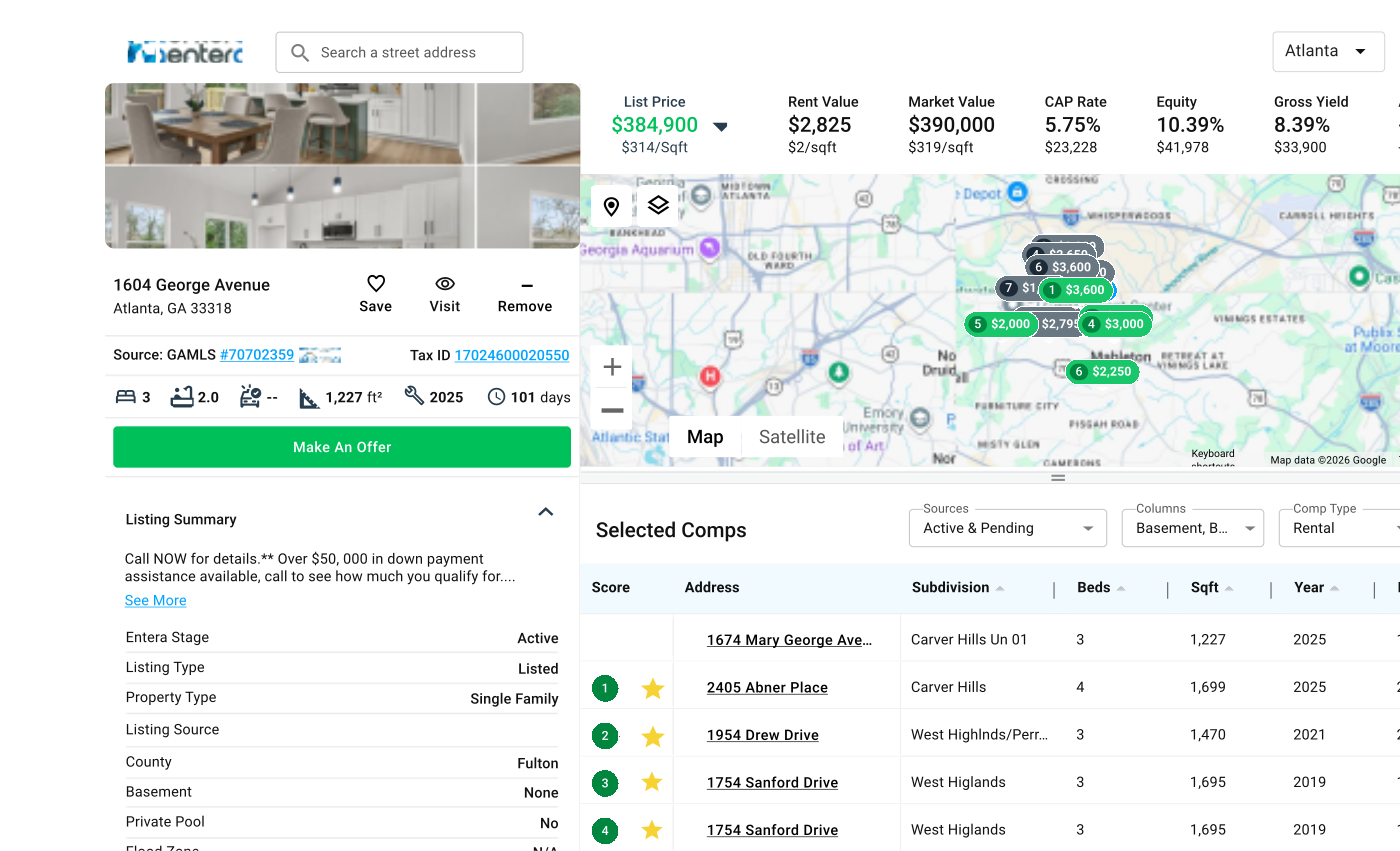
Its acquisition platform starts with a “buy box”: the investor’s rules for acceptable properties. Geography, price, expected rent, renovation assumptions and return thresholds narrow the search. Entera brings together on-market and off-market opportunities, then uses matching and analytics to surface candidates. A listing website answers where the houses are. An investor needs to know which ones deserve attention.
The acquisition modules let teams compare markets and scenarios, review comparable sales and rent estimates, and move selected properties toward offers. The practical attraction is a shorter queue of relevant decisions. In an early InnovationMap interview, Kay likened the matching approach to Netflix. The analogy was about learning preferences, though choosing a disappointing house has rather less forgiving consequences than choosing a disappointing film.
“All residential real estate is a consumer product.”
Martin Kay, in InnovationMap
A recommendation needs a closing
The next steps are where Entera’s proposition becomes more distinctive. An offer must be approved. Documents must arrive. Someone must inspect the property. A title question can hold everything up. Entera combines transaction workflows with brokerage and independent service providers, giving acquisition and transaction teams a shared place to follow progress.
Its advisory services also help investors refine strategy and expand operations. This is an asset-light pitch to the customer: use an existing network rather than build every local relationship from scratch. It still depends on real people doing competent work. A predicted repair bill has limited charm when nobody has checked the roof.
- 01DefineMarkets + buy box
- 02EvaluateMatch + underwrite
- 03ValidatePeople + diligence
- 04ExecuteOffers + closing
The customers are professional operators and funds, including single-family rental and fix-and-flip investors. Builders are another constituency; service providers are another. Entera’s marketplace connects these groups, while its software and services organize the work between them. The business model is described as SaaS plus services, with brokerage attached. That combination asks customers to buy execution support as well as access to information.

The company’s stated culture reflects that mixed workforce. Its careers materials emphasize curiosity, integrity, customer advocacy and outcomes. The current leadership includes Kay, co-founder and CTO Greg Morrison, and co-founder and brokerage leader Salmons. Data science and brokerage sit inside the same organization because the product must survive both a financial model and a visit to the property. That is a useful organizing principle for a company selling investment decisions.
The exit gets its own machinery
Buying a house creates a second question: when, and how, should it be sold? Entera’s disposition tools cover pricing, buyer targeting, sales channels and offer comparison. A higher bid can carry contingencies or timing that make it less attractive. The platform treats those details as part of the decision, then tracks the route to closing.
New construction adds another supply channel. In its August 2023 award announcement, Entera described a module packaging builder inventory from land to finished homes for rental investors. The same announcement reported more than 15,000 homes transacted, worth $5 billion, across 29 markets. Those were transaction figures, not houses owned by Entera.
Capital for the coordinators
The expansion required outside capital. A $7.5 million round announced in 2019 was led by Bullpen Capital and Craft Ventures. Goldman Sachs Asset Management led a $32 million Series A in 2021. Entera then reported nearly $1 billion transacted across 24 markets. Its current website puts total funding at approximately $60 million.
Company-reported markets at each snapshot. Geographic coverage measures availability, not investment performance.
The cost of building Entera and the cost of using it are separate questions. Capital raised is not a spending ledger. Its public pages route prospective customers to an expert. For a buyer, the useful calculation is whether software, brokerage and service charges are justified by time saved and better execution. The answer depends on transaction volume and the work already handled internally.
Copy the sequence, keep the judgment
Entera competes with an assembled process as much as a named company: brokers, data subscriptions, spreadsheets and an internal team. Roofstock also offers sourcing, underwriting and execution. Entera’s case rests on how well its pieces work together, rather than on exclusive possession of the idea that housing needs better data.
A reader can borrow the sequence: define buying rules before searching, test assumptions, check the property locally, and follow every handoff through closing. The limitations follow naturally. Bad rent estimates survive a polished dashboard. Markets outside the service footprint need other arrangements. Small transaction volumes may not justify a professional operating platform. Entera can organize decisions; it cannot make a weak investment sound.