A golf scorecard is an economical place to put a business plan. It discourages appendices. The idea that became Redi-Direct began there, after a round played by three men, before the company’s first holiday party at a pizzeria in Wayne, New Jersey. Thomas Buckley was one of the founders. The eventual software business was still several revisions away.
“I didn’t know what it was going to look like when we started it.” Buckley’s recollection has an attractive lack of retrospective prophecy. Entrepreneurs are often invited to describe the future as something they recognized immediately. His version allows for discovery. Direct mail came first. Mobile software and the grocery shelf would follow.
A scorecard leaves room for revision
Redi-Direct’s company history dates its founding to 1990, just after that late-1980s beginning. Buckley founded StayinFront in 2000. The two businesses remain connected: Redi-Direct is the parent, and Buckley chairs its board while serving as StayinFront’s chief executive. A modest piece of paper became the beginning of a much longer organizational story.
The interesting part is the revision. A direct-mail business delivers information to an audience. Retail software can place information in someone’s hands while a decision is being made. The distance between those jobs contains a change in technology and a change in timing. A message sent yesterday and an answer needed now make different demands on a business.
Buckley described a practical opportunity: a delivery visit could become a chance to sell. Somebody already at the store could suggest a better display. A routine stop might contain another transaction.
- 1990Redi-Direct’s stated founding year
- 2000Buckley founds StayinFront
- 2016Writes about technology training
- 2024StayinFront acquires SAS Augment
The accountant enters the aisle
Buckley began his professional life as a public accountant at KPMG, where he spent five years. He studied accounting at Montclair State University, later earned an executive MBA in finance at NYU Stern, and has taught at Montclair. Before mobile sales tools came accounts, audits and operations. His biography is unusually well supplied with reasons to ask what an investment earns.
That background offers a useful way to read the business, without pretending that a degree explains a personality. Software for a field team has costs beyond its purchase. Someone must learn it, carry it and consult it. An answer arrives at a particular time. Its value depends partly on whether the person receiving it can still act.
The international work started early. In 2002, StayinFront expanded its European operation by acquiring its implementation partner FrontApps and opening an office in Antwerp. Buckley’s comments emphasized configuration, implementation and adaptation to changing business needs. The vocabulary belonged to enterprise software, but the underlying promise was recognizable: a customer should be able to change something without beginning again.
That announcement also lived in the age of Pocket PCs, Windows CE and GPRS-enabled devices. The product names included Pocket Elk. Technology ages with very little regard for the dignity of its marketing department. Yet the practical problem outlasted the hardware: put useful customer information within reach of a person working away from a desk.
Please translate the instructions
For a more personal glimpse of Buckley’s approach, consider an assignment he gave technology teams in 2016: reread the training material and have somebody without technical expertise flag the confusing language. Then rewrite it. This is the sort of management advice that becomes more demanding the moment someone actually follows it.
“So simplify the process.” His short instruction came with a sequence: connect unfamiliar tools to something the employee already knows, introduce the next layer from there, and keep communication open after the formal training ends. Familiarity with a smartphone could provide a starting point. The instructor’s understanding was only part of the job.
The piece makes room for an employee who needs a different explanation. That person is easy to overlook in a launch meeting, where everybody has seen the demonstration several times. Buckley’s advice moves attention to the first encounter. An explanation has to cross the distance between the expert’s vocabulary and the user’s working knowledge.
There is a certain discipline in this. Rewriting a document produces less theater than unveiling a feature. Following up after training has none of the glamour of announcing it. Both activities ask the business to stay interested after its own most exciting moment. The person using the tool still has a day’s work ahead.
“So simplify the process.”
Thomas Buckley · on technology training, 2016
A chief executive asks the questions
Buckley has also made a public place for listening. His Leadership Perspectives series brings together conversations with people working across retail, technology and management. Introducing it, he describes the value of hearing people who approach things differently. His stated hope is that the interviews encourage readers to reflect on their own experiences and share what they have learned.
The guest list moves between the shop floor’s concerns and the systems intended to support them. It includes technology leaders, commercial executives and industry observers. Such a format gives a software chief executive an unusual public role: he gets to ask for an explanation. The company’s products may supply answers, but the conversation begins with somebody else’s work.
In an exchange with Amazon Web Services executive Ben Schreiner, Buckley describes using AI tools to help build project plans and deliver products. He asks how to balance that acceleration with the user’s responsibility for managing the result. The question is specific enough to be revealing. Faster production still leaves somebody accountable for what has been produced.
Schreiner’s answer keeps human judgment in the process. Read alongside Buckley’s training advice, the conversation suggests a continuing interest in the point where capability becomes responsibility. A tool offers possibilities. A person must decide which ones belong in the job. That handoff deserves more attention than a successful demonstration can give it.
Other conversations bring the subject back to everyday detail. Kellanova’s Florence Bateson discusses reducing administrative work and turning store observations into actions during the visit. Editor Peter Breen’s interview makes room for advice to younger writers about questions and experience. The series has space for working methods as well as commercial strategy, which gives its questions something to attach to.
The display that arrives before the delivery
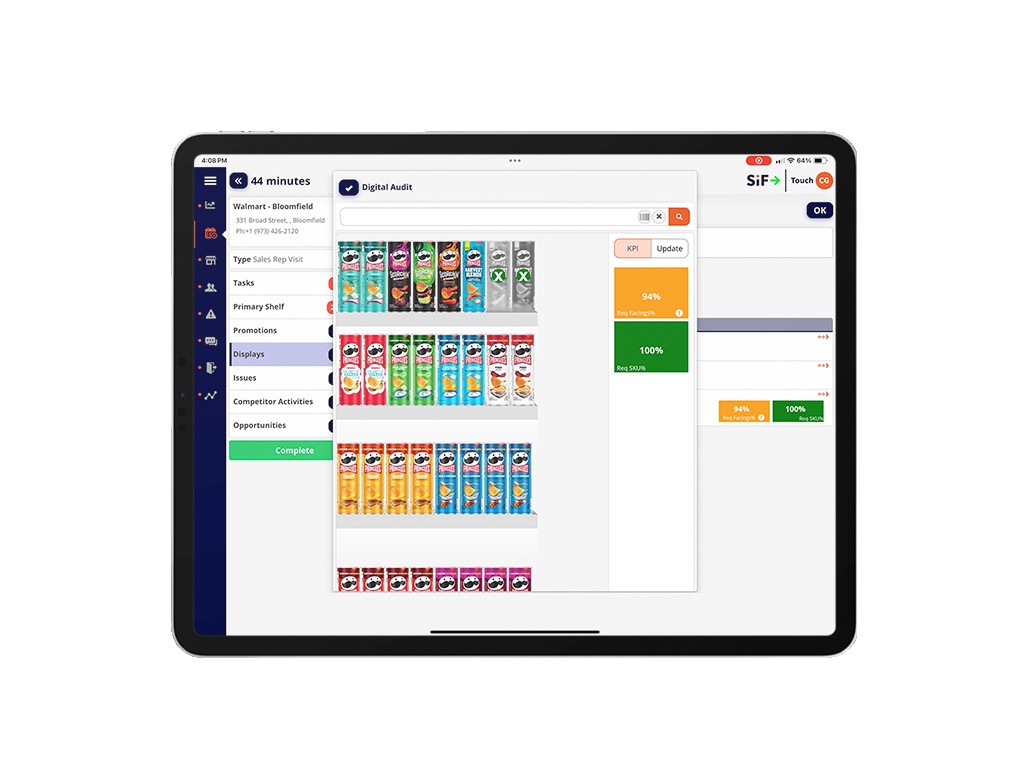
In May 2024, StayinFront announced its acquisition of Paris-based SAS Augment. The software lets a representative show a proposed display inside a retail environment through a phone or tablet. It was already integrated with StayinFront’s Pitchbook module. Buckley was acquiring a tool that had an existing place in the company’s sales process.
The attraction is easy to picture. A manager can consider a display at scale in the place where it would stand, before the physical object arrives. An abstract proposal acquires dimensions. The technology has a futuristic label, augmented reality, but the conversation it supports is as practical as deciding whether a piece of furniture fits.
This is a recurring feature of Buckley’s business story: sophisticated systems meet ordinary decisions. The proposed display needs a place. The representative needs a persuasive explanation. The manager needs enough information to judge. A visual tool earns its role by helping those people discuss the same object, rather than imagine several different ones.
An editorial sketch of the decisions supported by retail software.
A seat beyond the software business
In February 2017, the James A. Michener Art Museum announced Buckley’s appointment to its board of trustees. The Doylestown institution collects and exhibits American art. His appointment placed a software entrepreneur and finance professional within the governance of a cultural institution preparing for its thirtieth anniversary the following year.
It is a useful detail because a career acquires texture through its other rooms. The museum’s announcement does not require a grand theory about art and algorithms. It records a concrete commitment, at a particular institution, alongside his business leadership. There is room in this story for a board table where the agenda concerns a different kind of collection.
What did the visit earn?
By 2026, Buckley’s public comments continued to stress the result of field work. In May, StayinFront announced multi-year agreements with two contract sales organizations, one based in Mexico City and the other in the UK. In September, it announced an agreement to support a household goods company’s retail operations in Mexico.
His company’s October explanation of its platform, written by chief growth officer Sam Barclay, describes a cycle: identify opportunity, inspect conditions, coach, pitch, then measure and set goals. The final stage informs the next visit. The design gives each action a consequence beyond the completion mark on a daily schedule.
Barclay’s next installment takes aim at the inherited call schedule: a store receives a visit because it has always received one. Its proposed replacement begins with the potential value of an opportunity at that outlet. That makes the route itself a commercial decision. Travel and effort have to be considered alongside what a representative might accomplish.
It also gives the founder’s concern with outcomes a sharper setting. The question starts before anybody reaches the shelf. A well-executed visit to an unpromising store can consume the time another store needed. For a business built around field work, deciding where to send attention becomes part of the product.
For Buckley, the distance traveled from an accountant’s desk to a store aisle has produced a persistent question about usefulness. A plan can be elegant. A screen can be full. A visit can be finished. The person doing the work still needs to know what to do next, and whether doing it helped.
The scorecard left room for that question. Several decades of changes in the business have kept it open.