At the White House Diwali celebration on October 21, 2025, Timmy Cheedala had a business to introduce. President Donald Trump had a hat to discuss. Before the Natsoft founder could get through his miniature company history, the president interrupted to compliment his headwear. The room laughed. Cheedala returned to the business: he had been running it for 21 years.
It was a short exchange, with the slightly untidy timing of an actual conversation. A company founded in 2004 had reached an occasion at which its founder could describe two decades of work in a few words. He mentioned AI products. The president asked whether business was going well. Cheedala answered yes. Twenty-one years, compressed into a moment between a compliment and the next speaker.
The longer version is more interesting. Cheedala began with staffing, then added software services, products, research partnerships and acquisitions. His career raises a practical question for anyone who starts a service business: when a customer's needs change, how much of your own company are you prepared to change with them?
One office. A much longer conversation.
Natsoft's beginnings were modest in scope. There was one office in the United States, and staffing was the offering. Based in Somerset, New Jersey, Cheedala built a business around supplying people before expanding what those people, and eventually the organization around them, could deliver.
“We started with one office in US only and staffing as an offering.”
Timmy Cheedala
That early description is refreshingly free of hindsight. It does not pretend a staffing office was secretly a complete technology group waiting for the stationery to arrive. There was a service to sell and a relationship to establish. The additional capabilities came later.
By 2021, Natsoft was describing a portfolio that included software development, systems integration, enterprise applications and newer technology products. Its ambitions had widened considerably. The useful thread running through that expansion was the customer relationship: find more of the work a client needs done, then develop the capacity to do it.
The first customer gets a different answer
One early engagement makes the change unusually concrete. A client that began working with Natsoft on staff augmentation in 2004 later bought automation services from the company. The relationship survived while the assignment changed. For a founder, that is an appealing sort of continuity: the customer stays, and the invoice acquires new vocabulary.
Shyam Mamidi, who led Natsoft's products and solutions work, described the company's development through a neat play on the abbreviation PaaS. The first P stood for people; the later one stood for platform. Beneath the wordplay was a change in responsibility. Providing workers and delivering a technology solution ask different things of a company.
Mamidi also described a habit of building capabilities in response to client requirements. This gives Cheedala's expansion a recognizable business logic. A request can become an occasion to recruit, collaborate or invest. An existing relationship becomes a place to learn what the company ought to offer next. The danger, naturally, is promising faster than the organization can learn.
A founder who makes room at the table
Cheedala's response included bringing experienced executives into the business. Natsoft describes him as personally selecting leaders with different skills. Their previous employers included IBM, Motorola, Accenture, AT&T, Vodafone, ADP, Dell International and Perot Systems. The backgrounds span consulting, operations, finance, modernization and emerging technologies.
There is a practical point beneath that collection of corporate names. Each additional business line needs someone who understands its work. A founder may open a door; somebody must then know how to run the room. Cheedala's company presents its management team as part of the explanation for its broader range of services.
A colleague's account supplies a more personal detail. Sujesh Pulikkal, associated with Cheedala and Natsoft since 2004, credits him with giving people room to pursue opportunities. Pulikkal describes growing into vice-president and chief strategic officer roles during that association. It is one person's assessment, but it identifies a specific experience behind the praise: professional latitude accompanied by greater responsibility.
That is a revealing compliment for an entrepreneur to receive. An employee remembers the room he was given to develop. The founder's influence appears in another person's career, rather than only in the founder's own job title.
Acquiring the work, keeping the people
The CorpOne acquisition expanded that table substantially. Natsoft's announcement welcomed more than 1,100 employees from the customer-service and transaction-processing business. Cheedala emphasized the experience the incoming company brought with it. The acquisition added a business that already knew its customers and its daily work.
The division of responsibility was explicit. Natsoft president and managing director Srinivas Cheedella led the transaction. CorpOne founder and managing director Venkata Giri Yandamuri and his team would continue leading the operation, which would also serve as Natsoft's global customer-support back office.
That arrangement helps explain Cheedala's method of expansion. Expertise could enter the organization with its own management intact. CorpOne gained access to Natsoft's wider geographical reach; Natsoft gained an established operation. The announcement described offices across the United States, India, Australia, Singapore, Mexico and Canada. A service relationship could now involve more places and more kinds of work.
There is a human scale to a number such as 1,100. Integration means bringing together managers, employees and existing obligations. An acquisition announcement occupies a page. The organization it describes must continue answering customers the following morning.
Perth supplies a laboratory
Another route into new work led to a university. In August 2019, Curtin University announced a Blockchain Research and Development Lab in partnership with Natsoft. Based at its Perth campus and led by Dr Vidy Potdar, the laboratory would work on industry problems while connecting academic research with commercial applications.
The arrangement included opportunities for research students to experience the full implementation cycle. That detail gives the partnership substance. Students could encounter the movement from a research question to an application, while the company could work alongside people investigating the technology more deeply.
For Cheedala's business, the laboratory represented a different way to obtain capability. Recruiting brings experience inside a company. A research partnership creates a place where experience can develop jointly. The university described training, mentoring and collaboration with industry and government as part of the laboratory's remit.
A cryptocurrency may attract the conversation at dinner. The less glamorous questions - who will use a system, what information it records, how it fits existing operations - help determine whether there is useful work behind the conversation.
Experienced functional leaders
University research and enterprise collaboration
Established specialist operations
Old code, seeds and the next assignment
Natsoft's acquisition of Updraft took it further into application modernization. The work involves moving older software towards newer languages and platforms. It is a field in which the customer's past remains very much present: an old system can still be carrying an important business process.
The company's service portfolio includes automated modernization, testing, enterprise software and data work. Such assignments put a particular demand on the founder's broader ambitions. New technology has to enter an organization that already owns systems, employs people and has customers waiting for things to function.
Cheedala's own public posts offer a glimpse of the applications that interest him. He has promoted an integrated seed-traceability platform combining blockchain, connected devices and AI, with regulation, compliance and data security among its stated purposes. He has also discussed retail analytics, inventory management and the connection between different shopping channels.
In August 2023, Intense Technologies announced a partnership with Natsoft covering enterprise transformation, customer experience, AI and legacy modernization. The announcement put data management and complementary expertise at the center of the collaboration. Once again, expansion involved another organization with capabilities of its own.
The obligations grow, too
The company's development has also brought scrutiny. In January 2026, Natsoft reached a settlement with the US Department of Justice over citizenship-status restrictions in recruitment advertisements. The agreement required an $18,440 civil penalty, employee training and changes to recruitment practices. These were obligations of the company.
A separate dispute concerned intellectual property. On June 9, 2026, an Illinois federal court dismissed Natsoft and Updraft's patent-infringement claims against Hexaware with prejudice, finding the asserted claims ineligible for patent protection. Related state-law claims were dismissed without prejudice. The order allowed a proposed amended action limited to a federal trade-secrets claim and supplemental state-law claims.
These developments belong in the account of an expanding business. Building capabilities brings responsibilities in hiring, management and the claims a company makes about its technology. Growth does not retire those obligations. It gives them more places to appear.
Back to the table
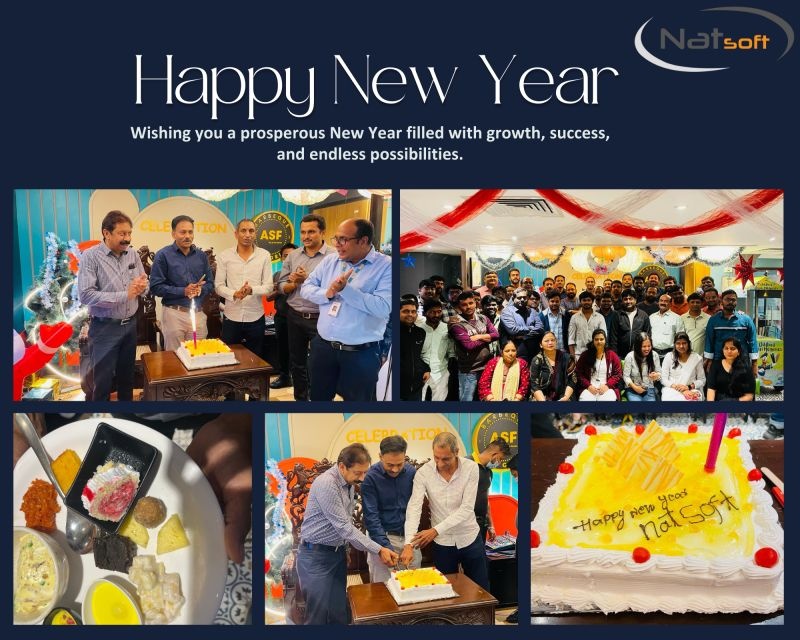
For a less formal view of Cheedala's working world, there are the photographs from Natsoft's New Year 2024 gathering. Colleagues pose together, gather around a cake and sit down to dinner. The company thanked Cheedala, Srinivas Cheedella and Lenin Kumar for their part in the celebration. Even an organization devoted to automation occasionally requires everyone to assemble in person.
Natsoft's stated mission includes developing an empowered team, pursuing innovation and using mergers and acquisitions to broaden its work. Its community initiative, NatCares, also describes school mentoring and distributing blankets and other necessities. These are company commitments, with people required to carry them out.
Cheedala's story keeps returning to that practical dependence on other people. The office acquired colleagues. The staffing assignment acquired new forms of work. The founder acquired partners with expertise he could bring into the business. By the time a president paused to admire his hat, he had a rather longer company history than the occasion could accommodate.
Follow the work
- Natsoft · Company website ↗
- Timmy Cheedala · LinkedIn ↗
- Timmy Cheedala · X ↗
- The staffing origins · CIOReview conversation ↗
- Curtin University · The laboratory announcement ↗
- White House Diwali celebration · October 21, 2025 ↗
- Natsoft recruitment settlement · January 2026 ↗
- Natsoft and Updraft v. Hexaware · June 9, 2026 order ↗