Somewhere inside a large company, a cloud resource is still running. Finance can see the charge. Engineering can see the machine. The application owner might recognize its purpose. Getting those three views into the same conversation is the interesting part. This is the territory EverestDX has chosen: the relationships between technology, money, and the people permitted to change things.
- EverestDX sells enterprise software alongside consulting and engineering.
- VantageX connects business context; four products use it to explain, optimize, observe, and act.
- The practical prize is a shorter path from a disputed cost or service problem to an approved response.
Founded in 2018, the company operates in a crowded market of cloud specialists, software vendors, and transformation consultancies. Its current proposition is unusually easy to understand once you put aside the product names. A bill, an incident, and a business service describe different pieces of the same enterprise. Connect the pieces, and decisions should become more useful.
A map before a machine
VantageX is the foundation. EverestDX describes it as a shared context layer joining financial, operational, technology, business, data, cloud, and AI information. The important word is relationships. Knowing that a server exists is useful. Knowing which application depends on it, who owns that application, and what it costs makes a proposed change easier to judge.
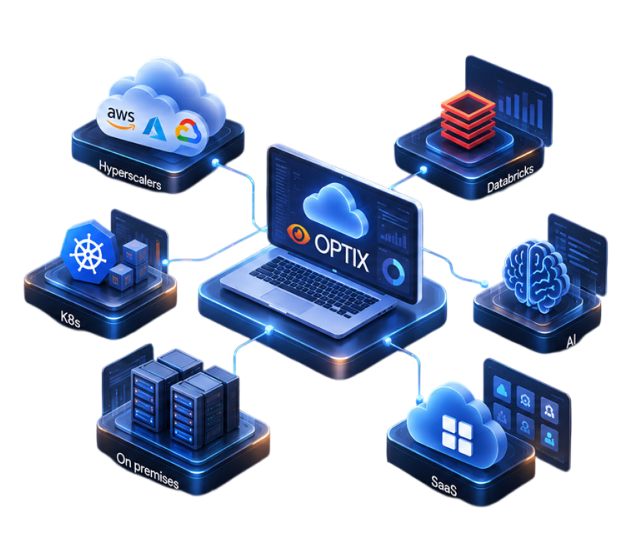
Four products sit around that foundation. CORA is the conversational entry point for questions, analysis, reports, and recommendations. OPTIX tackles technology spending and optimization. InsightONE connects service health, incidents, configuration relationships, and operational measures. BotX handles agents, workflows, approvals, and execution. Each can address a particular need; the company says customers can begin with one product.
One set of relationships. Four ways to use it.
Consider the company’s published AI-cost scenario. OPTIX identifies an expensive workload. CORA explains the drivers. BotX starts an approved optimization workflow using VantageX context. This is a representative workflow, rather than a named customer result. Its appeal is the sequence: discovery has somewhere to go after the dashboard.
The customer behind the acronym
The clearest named example comes from CI Financial. In a public post around FinOps X 2025, Ravi Kishore Guntur thanked EverestDX for its partnership and described plans to implement OptiX and BotX within CI Financial’s infrastructure. He connected cost visibility and allocation with automation, governance, and proactive remediation. That pairing explains the sales proposition better than another list of features.
EverestDX also displays organizations including PepsiCo, Thermo Fisher Scientific, Freepoint Commodities, and Western Midstream among companies it has worked with. The website explicitly cautions that a logo establishes neither a particular product deployment nor a quantified outcome. Read that distinction carefully: a customer relationship and a measured software result are different kinds of evidence.
The intended buyers are enterprise technology and finance leaders, FinOps practitioners, operations teams, and AI or data leaders. They face overlapping responsibilities. Finance needs allocation and forecasts. Engineers need reliable systems. Procurement sees licenses and renewals. OPTIX’s stated scope reaches across public cloud, Kubernetes, SaaS, data platforms, AI, and enterprise infrastructure, following expenditure beyond the cloud invoice.
“Turn enterprise complexity into business value.”
EverestDX’s stated proposition
Software with people attached
There is a reason consulting remains in the picture. Mapping costs onto an organization requires choices about ownership, shared services, and allocation. Connecting operations requires integrations and service relationships. EverestDX sells engineering and consulting across cloud, data, AI, and modernization alongside its software. The commercial proposition includes the work needed to make the products useful inside an existing enterprise.
The services extend beyond cost control. Application modernization addresses legacy software; cloud and platform engineering address the environment it runs in. Data integration and governance provide foundations for analytics and AI. These disciplines matter together because an assistant’s answer depends on the information it can reach, while an automated workflow depends on the systems it can safely touch. For a buyer, the question is which part of that work needs outside help and which capabilities the internal team already possesses.
Its three co-founders divide those responsibilities at the top. CEO Vijay Anand leads strategy, growth, and customer partnerships. COO Venkateshwar Reddy Madadi covers operations, product strategy, and execution. CTO Prabhu Rangasamy leads technology and AI strategy. The company’s own culture material emphasizes mentorship, certifications, collaboration, and wellbeing. These are stated priorities, rather than an independent verdict on employee experience.

Procurement follows familiar enterprise routes. VantageX is offered as SaaS through AWS Marketplace; OPTIX and BotX have Microsoft Marketplace listings. EverestDX lists alliances with AWS, Microsoft, Databricks, Google Cloud, Snowflake, and ServiceNow. A marketplace contract is one route into the purchase. Buyers still need a scope that covers integrations, deployment responsibilities, support, and the services around the software.
The competitive choice depends on the problem. A cloud provider’s own tools may handle a narrow billing question. A specialist FinOps platform may suit a dedicated cost team. A large consultancy may lead a broader modernization program. EverestDX’s proposed advantage is combining delivery expertise with products that share context across those boundaries. Whether that combination earns its keep depends on the customer’s complexity.
That makes the initial buying conversation quite specific. Which systems supply the data? How are shared costs divided? Who can authorize a change, and who checks that it worked? A demonstration organized around those questions is more revealing than a tour of attractive charts. It tests whether the proposed connections match the way the organization actually operates.
Give the automation a brake pedal
That complexity creates a practical constraint. An apparently idle resource can still support a critical process. EverestDX’s current architecture emphasizes policies, role-aware access, approval workflows, and auditability. Its trust material also makes responsibility depend on the deployment and integrations selected. Savings and service reliability have to be considered together before an agent changes production.
One accountable owner.
One approved change.Measure the result before expanding the scope.
A buyer can copy the sequence without copying the entire stack: choose one costly workload, establish ownership, connect service dependencies, and measure an approved change. Poor inventory, unclear permissions, or teams unable to implement recommendations will limit the benefit. A small, simple environment may need much less machinery. EverestDX’s proposition becomes compelling where the connections themselves have become expensive to maintain.
EverestDX website ↗ · LinkedIn ↗ · Perspectives & guides ↗ · Product workflows ↗ · VantageX on AWS Marketplace ↗