Consider the perfectly ordinary invoice. It arrives as a PDF, perhaps an image, carrying information that somebody must move into an accounting system. Repeat this hundreds of times a day and a clerical task becomes an engineering problem. In one Kairos customer account, a refrigeration and transportation equipment dealer had reached precisely that point. The software existed. The people existed. The connection between them was exhausting.
- Kairos sells enterprise testing, modernization and automation expertise.
- Its own tools turn recurring testing and data checks into reusable workflows.
- The buying question: what happens when your application changes?
Kairos’s response was specific: map the invoice process, use Microsoft’s Power Automate and SharePoint, extract information with AI Builder, and automate the route from receipt to approval or rejection. The company reports 90% processing accuracy and a 20% reduction in annual costs. Those are vendor-reported results. The interesting detail is the sequence: understand the work, then build the machinery.
The work behind the screen
That sequence helps explain Kairos Technologies. Founded in 2003, the company works in digital quality engineering and digital transformation. Its customers need applications tested, data reconciled, old systems modernized and repetitive operations automated. Much of this happens beneath the visible interface, where one system hands information to another and a small mistake can travel surprisingly far.
Its published client roster includes Hertz, Frontier, Quest Diagnostics, National Grid and MassMutual. These are businesses with substantial operational baggage: existing applications, specialized workflows and obligations to keep functioning while something changes. Kairos fits into that enterprise services market, selling technical judgment and delivery capacity alongside its tools.
A bank’s mobile application illustrates the problem. Kairos describes a customer whose inadequate regression testing and sequential processes threatened its digital experience. The intervention combined cloud device testing with automation and parallel execution. The account reports a 20% testing-cost decrease and a 30% reduction in regression and functional testing time. The useful comparison is against the customer’s previous process, rather than an imagined universal benchmark.
A sentence from 2022
The company’s strategic turn appears in an employee newsletter. CEO Sudhakar Pennam wrote that Kairos had begun moving beyond a pure services go-to-market model toward services complemented by its own solutions. That sentence explains the present business more clearly than a catalogue of fashionable technologies.
“We’ve begun transitioning from a pure services-based Go-to-Market (GTM) model”
Sudhakar Pennam · Company newsletter, 2022
A consultancy accumulates knowledge whenever it solves a customer’s problem. Some knowledge stays with the people doing the work. Some can become a framework, a test library or a product. Kairos’s strategy is to package more of that knowledge so the next engagement can begin further along.

The leadership page identifies Sapna Pennam as founder and places her on the advisory board. Sudhakar is president and CEO. The company’s stated culture emphasizes collaboration, inclusion and employee development. Its newsletter gives those aspirations some texture: counselling, sports activities and a Solunus partnership to launch Salesforce testing services. The people business remains part of the product story.
Three places for quality to go wrong
Kairos’s portfolio separates three related problems. Does the application behave correctly? Is its data trustworthy? Do its APIs exchange the right information? Those questions sound similar until a release works beautifully on screen while quietly passing the wrong record between systems.
KiTAP, now presented as Zyrix Test Autopilot, addresses application testing. Its product proposition includes generating tests, running them across different application types and adapting test flows when interfaces change. DQGateway now links to Zyrix Data Copilot, which profiles data and supports validation and reconciliation. API TestEasy points to Zyrix API Copilot, which imports specifications or Postman collections and supports reusable API tests.
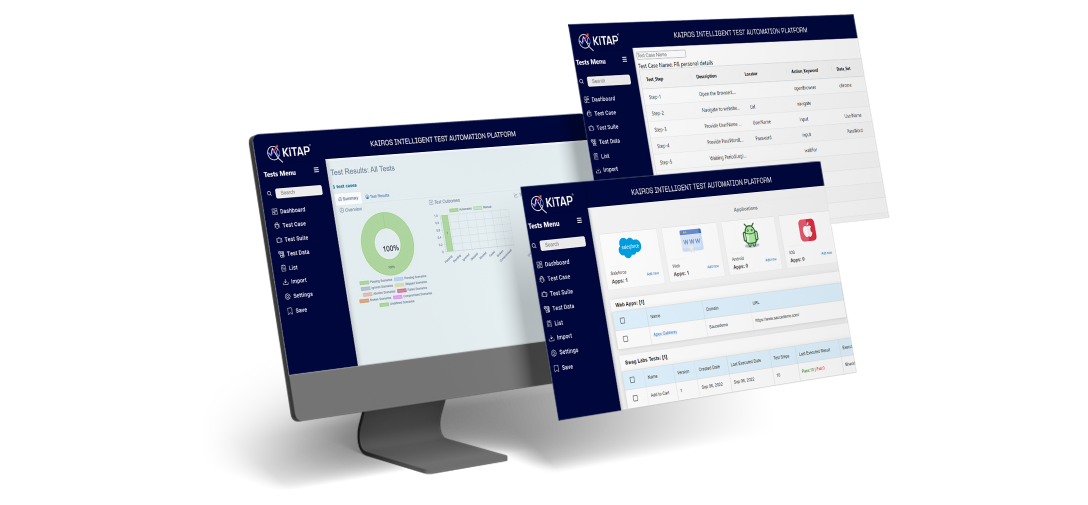
The distinction matters for buyers. A data team chasing duplicate patient records needs different machinery from a developer checking an API contract. Kairos also offers AI model evaluation, Salesforce testing and performance engineering. The common thread is validating systems as they change, including the parts ordinary functional tests may miss.
Before faster, make it consistent
In an anonymous healthcare engagement, the initial weakness was organizational: no standardized validation process, insufficient automation and inadequate tools. Buying more tools risked creating another layer of fragmentation. Kairos says it established a quality engineering center of excellence in 180 days, combining frameworks, automation and integration with development pipelines.
The lesson readers can copy is procedural. Establish a baseline. Decide which workflows matter. Standardize test data, execution and reporting. Then compare outcomes. Kairos’s own engagement descriptions include capability assessments, gap analysis, targets and continuous improvement. Automation becomes easier to judge when everyone agrees what a successful run means.
The price includes the work around the tool
Kairos offers several commercial arrangements: individual test cases or scripts, hourly or daily work, advisory engagements, automation centers and testing-as-a-service. Zyrix lists subscriptions, annual licenses, perpetual licenses for on-premise or private-cloud use, and professional services. Buyers can therefore purchase different combinations of software, implementation and ongoing responsibility.
The practical cost comparison should include setup, test-data preparation, maintenance, training and failure investigation. Ask a supplier to demonstrate your workflow with your exceptions. If requirements are unstable, data access is restricted or failures require extensive human interpretation, automated execution alone cannot settle whether a release is safe.
The engineer gets a different job
A March 2026 Kairos account describes Rahul Tavva connecting SharePoint, Power Automate, Terraform and Ansible Tower for a multinational network rollout. Kairos reports reducing per-site work from six hours to under one hour. The tools already existed; the intervention connected them into a repeatable process.
That is the proposition worth examining at Kairos. Put experienced people close enough to the work to recognize a pattern. Turn the pattern into something another team can run. Keep the people available for the exceptions. The invoice still arrives. Someone simply has a better job to do than type it all again.
Follow the work
Explore Kairos’s website, customer stories, company blog and Zyrix Test Autopilot.
Connect on LinkedIn, X, Instagram and Facebook. Watch Pennam’s conversation with Nikki Haley or his dialogue with Sadhguru.