An enterprise software conference is an unlikely place to look for a DJ with a day job as chief executive. Yet there he is: sAchin cHoudhari, headphones around his neck, hands on the controls, a hat doing considerably more expressive work than the average conference lanyard. For a May 2024 gathering in Dallas, he offered to supply the music himself. The customers could discuss their systems all day. That evening, he proposed giving them something to dance to.
The detail suits a career spent among people whose work depends on other people’s complicated software. Choudhari is co-founder and CEO of Circular Edge, based in Somerset, New Jersey. The business works across consulting, support and enterprise applications. His public life, however, has room for classmates, brothers, colleagues, customers and a user community that occasionally needs the volume turned up. The professional title is accurate. It leaves rather a lot out.
A work visa, then a family business
Choudhari arrived in the United States in 1999. In his account, the early years involved an H-1B visa, renewals and the gradual work of establishing trust. Permanent residency followed, then citizenship. He describes a life assembled over time, with each administrative step feeling substantial while he was taking it. The neatness of a retrospective timeline can conceal how long its individual entries took to live through.
In 2003, he and his brothers built Circular Edge. He credits his parents and wife alongside the brothers who became his business partners. His recollection begins with a small group willing to believe before the company had a record to offer. There is something appealingly concrete about that beginning: an idea needs encouragement, but it also needs people prepared to stay in the room while the work becomes real.
“My brothers, who became partners in every sense of the word, not just on paper.”
sAchin cHoudhari · July 2026
He puts a house and children into the same recollection. These quieter milestones matter to his telling of the story. A company provides the dates; a life supplies the reasons those dates are remembered. His July 2026 reflection returns to gratitude and the obligation to give back to the country where he built his career and family.
The education that came after the company
The business was already years old when Choudhari completed the Rutgers Executive MBA in 2014. He had served as class president. This puts a useful twist in the usual education-to-entrepreneurship sequence: the classroom entered an established working life. Questions about strategy and colleagues had a business waiting for them, rather than remaining pleasantly hypothetical until graduation.
A Rutgers alumni account in 2017 described an executive interested in coaching and developing colleagues. It also recorded his view that the program had helped Circular Edge move into another phase of growth. The description adds a people-management dimension to a career otherwise easy to bury beneath product names. Enterprise software requires technical knowledge. A growing services business also requires people who can pass that knowledge on.
The same account listed cloud, AI and blockchain among the company’s initiatives at the time. Those subjects have since experienced very different changes in fashion. The dated detail is useful because it places Choudhari’s interest in emerging technology well before the current AI event circuit. It records an interest at a particular moment, rather than pretending every early exploration became a finished product.
The customer still has work tomorrow
By April 2024, Choudhari described his personal association with JD Edwards as spanning more than 25 years. He compared the software’s staying power to a Rambo film. Enterprise applications rarely receive action-hero casting, so one should appreciate the effort. Beneath the joke lies a professional attachment to systems that continue to evolve while their customers continue to operate.
Circular Edge’s Smart Help offering shows the less cinematic side of that attachment. It provides continuing technical and functional assistance, with different ways of buying support. The published options include on-demand work without a minimum-hour requirement and a retainer beginning at 40 hours a month. These are practical distinctions for a customer whose requirements do not arrive in identical monthly parcels.
Another example is Smart Scheduler, a tool built within the JD Edwards environment for batch-job processing. Its version 4.0 achieved Oracle Validated Integration with EnterpriseOne 9.2, following validations for earlier releases. Choudhari’s announcement emphasized additions shaped by customer feedback. The achievement belonged to the team and product; his explanation tied it to an ordinary discipline of listening and revising.
His work also appears in the educational side of the ecosystem. An Oracle conference program listed him with KIND’s Gilbery Jbeily for a returns-management automation session. Circular Edge’s webinars have credited him for material on electronic data interchange and achievable application projects. These subjects make modest promises in plain terms: handle returns, connect information, finish a project. Their usefulness depends on what happens after the presentation ends.
A wider circle in 2022
In June 2022, Circular Edge joined the NetSuite Solution Provider Program. Choudhari framed the move around the pressures facing small and midsize businesses and the value of better operational visibility. It extended the company’s work into another part of Oracle’s applications business, bringing a cloud ERP practice into a company already associated with JD Edwards.
That December, Circular Edge announced its acquisition of Innovus Partners, a business specializing in Oracle Cloud enterprise performance management implementation and support. The announcement connected the deal to planning and information needs across finance and operations. Choudhari described the expansion as part of a flexible approach to supporting customers’ cloud moves. It was a change in the company’s capabilities with a specific set of people and expertise attached.
In his own December 2022 writing about AtomIQ, he laid out a broader ambition: technology that could adapt across platforms. His list included deployment, security, integration, training and continuing support. It is an executive’s list with an operator’s concerns inside it. A new interface can attract attention quickly; the surrounding requirements decide how comfortably it settles into a working business.
“It is important to me and our businesses that we find solutions that are not constrained.”
sAchin cHoudhari · December 2022
The CEO takes another kind of request
The user community offers a setting where those professional relationships become less formal. In 2019, Circular Edge arranged for Sienna the Sloth to visit its booth at COLLABORATE in San Antonio through the animal-outreach organization Zoomagination. Attendees could take photographs. The business connection was a joke about moving slowly. A sloth may have limited opinions on enterprise applications, but it does give people a reason to stop walking.
Choudhari’s comments about the event emphasized small details, entertainment and making attendees smile. The spectacle was attached to an existing community relationship. It also demonstrated that a software gathering can accommodate a little eccentricity without the applications immediately ceasing to function. Nobody should have to choose between understanding a business process and enjoying an evening.
For the RUG Social at BLUEPRINT 4D in Dallas on May 6, 2024, his contribution was more personal. He announced that he would volunteer as an open-format DJ, blending American and international music. The invitation placed him among regional user groups, vendors and other volunteers. Here was a CEO accepting a job whose success would be judged by a room full of people with perfectly serviceable legs.

His accompanying article linked to a remix on YouTube. The musical interest had an output beyond a charming biographical line. It also gave the professional community another way to know him. A customer may first encounter the executive in a discussion about an upgrade and later recognize the same person selecting music. Familiarity accumulates through such small changes of setting.
A practical question for the AI years
By July 2026, Choudhari was inviting that community to a different sort of session. AI Week ran from July 28 to 30, with a program covering warehouse work, accounts payable, NetSuite, chatbots and system administration. He was listed for the closing fireside discussion on JD Edwards and AI, with Oracle’s Paul Houtkooper also named on the event page.
The published agenda emphasized implementations and working examples. It brought colleagues with different responsibilities into separate sessions, allowing the discussion to move through actual business tasks. For a chief executive, convening those voices is itself revealing. His current public work keeps returning to the relationship between a new technical possibility and the people expected to use it during an ordinary working day.
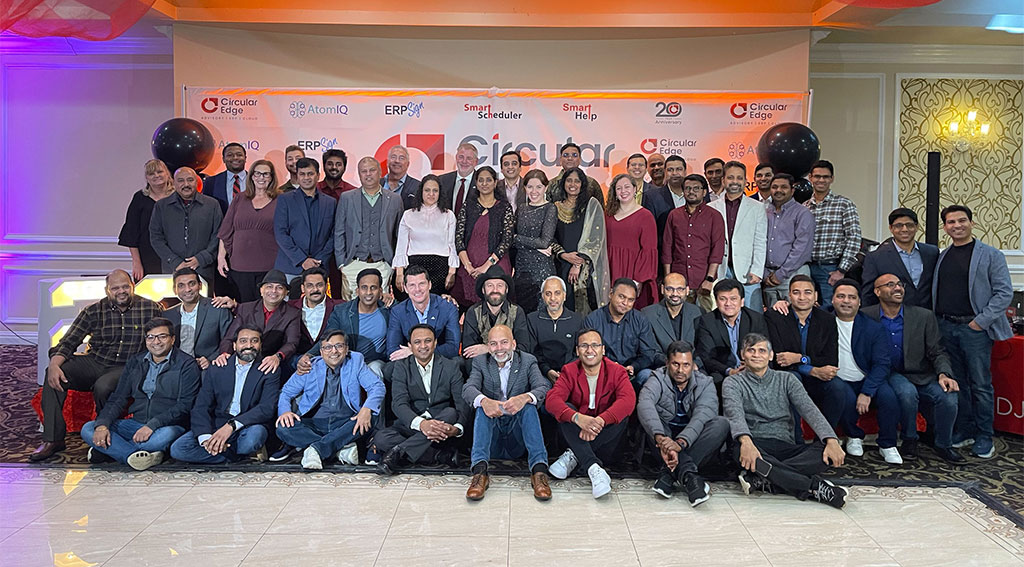
The company he co-founded now reports more than 300 customers worldwide. His account of getting there remains populated by other people: family at the beginning, classmates along the way, colleagues doing the work, customers returning. At the DJ controller, the arrangement is unusually visible. Choudhari can choose the next track. The room still has to want to stay.