An invoice looks like a simple thing to move. Take the customer, the amount, the due date. Put them in the new system. Count the records. Declare victory. At Summit Companies, a fire-protection and life-safety business growing through acquisitions, that approach would have carried a rather expensive misunderstanding into Oracle Cloud.
The missing ingredient was history. Summit’s contracts could run for three or four years. Construction billing needed to remember what had already been billed and how much money was being held back. An open invoice, by itself, could not tell that story.
- Rite combines Oracle implementation with its own migration and operations software.
- Its revealing specialty: preserving the business rules behind the records.
- The practical lesson: rehearse with real data, then check what the business can actually calculate.
The invoice with a memory
Rite’s published Summit case study describes a plan that would have loaded invoices directly into receivables. That would have left Oracle unable to calculate retention correctly for each contract. The design was wrong before the transfer began.
Rite changed what traveled. Historical billing events went into Oracle Contracts, allowing the new system to generate invoices from the underlying history. ConvertRite handled the migration; AIA Workbench handled retention and progress-billing documents. The distinction matters: the target had to reproduce a working financial process.
According to Rite, the five-month project covered 17,000 projects and 200,000 open receivables invoices. Validation happened in staging before each load. For an acquisitive business, the resulting pipeline also offered something useful beyond launch: a method to absorb the next purchase.
Conceptual view of the Summit approach. A migration is a chain of dependencies.
Practice the switch
A different dependency appeared at CSC, the corporate, legal and tax services company. Moving from Workday to Oracle HCM Cloud meant transferring compensation information without jeopardizing payroll. Missing the agreed date would also mean paying for two HR systems.
Rite describes three full-data cycles, culminating in cutover, within eight weeks. The first exposed errors. Corrections and balancing followed. Before sign-off, all 5,200 worker records were reconciled against Workday. The reported saving was approximately 40% of migration effort compared with manual work.
The useful detail is the rehearsal size. A tidy sample can conceal the strange records that accumulate in a real organization. A full load gives those exceptions somewhere to appear before the deadline. Reusable extraction and mapping made repeated cycles practical.
Test what the business can calculate, as well as what the database can hold.
The lesson from Rite’s published cases
Build the missing pieces
This is where Rite sits in the enterprise software market: between Oracle’s broad applications and a customer’s particular way of operating. It sells consulting, implementation and ongoing support, alongside software developed to close recurring gaps. The products make that positioning easier to understand than the usual transformation vocabulary.
ConvertRite prepares legacy data for Oracle Fusion, with reusable mappings, more than 250 advertised validations and reconciliation after loading. AI-assisted field matching proposes connections; ambiguous matches still need review. RiteSync addresses the continuing problem of keeping enterprise data synchronized for reporting.
CloudMiner is the desktop tool in the family. Analysts and developers can query Oracle data, inspect results and export them without building a custom report for every question. Version 7.7, released October 2, 2026, adds native macOS support and a REST client alongside SQL. Rite offers a 21-day trial.
The industry applications are more specific. AIA Workbench manages construction retention and G702/G703 progress billing. EquipRite connects equipment requests, usage, inspections and charges to Oracle. In Rite’s Oceaneering case study, that means following subsea equipment, including remotely operated vehicles, across business units.
It is an appealingly concrete problem. Equipment can be working, idle or undergoing maintenance; its cost should reflect the difference. Oceaneering’s published case describes automated costing by state and inspection records with photographs linked to the ERP. The spreadsheet has acquired an audit trail.
The people behind the plumbing
Founded in 2006, Rite is led by founder and CEO Krishna Bendapudi and co-founder and CFO Indu Bendapudi. Its published values favor expertise without ego, sustained customer care and building missing capabilities. Those are stated intentions; the more tangible evidence is a portfolio of named, narrow operational tools.
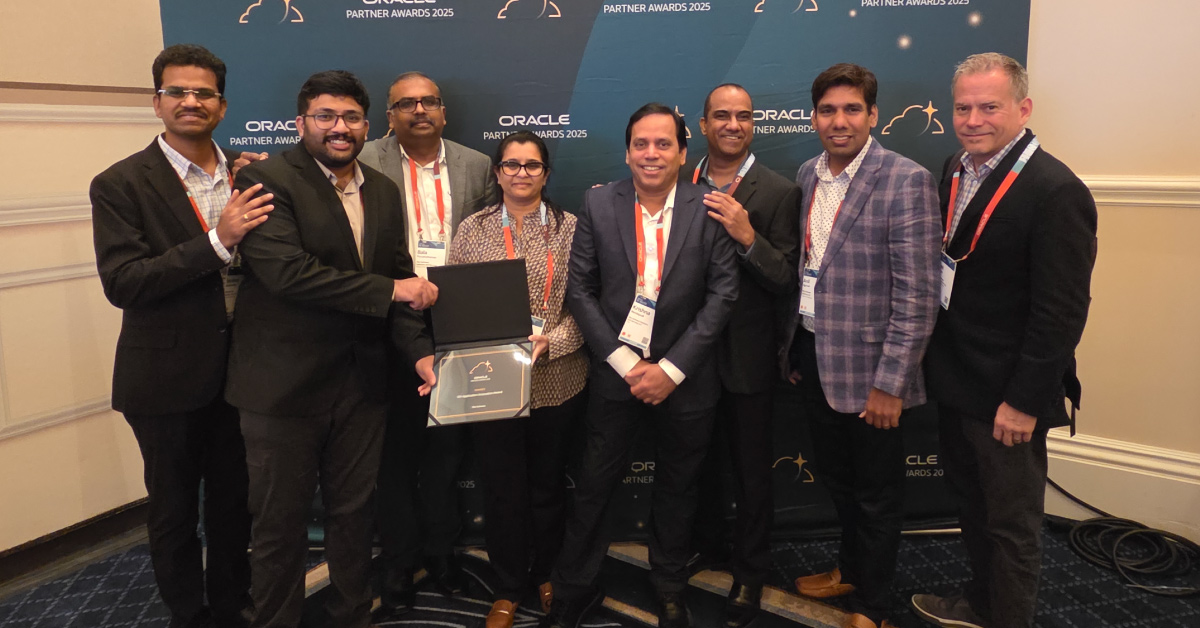
Oracle named Rite its 2025 North American ISV Application Innovation Award winner. The recognition concerned its Engineering & Construction suite. Earlier, Rite placed No. 1,162 on the 2018 Inc. 5000. In October 2026, Indu was named a Rising 10 Awards recipient.
In the award announcement, Krishna offered a useful test of the product strategy: “innovation is meaningful only when it simplifies life for our customers.” The test is demanding precisely because the work is so unglamorous. A retained payment calculated correctly is unlikely to attract applause. A wrong one attracts attention immediately.
Who owns Monday morning?
Rite’s commercial proposition runs beyond cutover. Consulting defines the fit; implementation builds and connects the system; managed services handles support and continuing changes. Software licensing adds another relationship. Against large integrators and internal teams, Rite’s pitch is specialist Oracle knowledge paired with tools it can also operate.
The buyer could be a finance leader protecting billing continuity, an HR team checking compensation, or an analyst trying to answer a question without another reporting project. Rite names Wood and Sakura among its customer testimonials, alongside its detailed migration cases. Its sector focus includes engineering and construction, oil and gas, healthcare and professional services. The common thread is operational detail: money, people and equipment whose relationships need to survive a change of software.
The economics need care. CSC’s reported 40% reduction concerns migration effort, not a published reduction in the whole project bill. Avoiding overlapping HR systems is a cost mechanism, not a disclosed dollar saving. Buyers should ask for scope, licensing, integration work and continuing support to be priced separately.
The approach fits enterprises committed to Oracle, especially where project costs, contracts or workforce rules make generic workflows awkward. It depends on usable history and people who can confirm the mappings. Automation cannot reconstruct a missing agreement by wishing harder.
What can another team copy? Preserve the inputs behind important calculations. Validate before loading. Repeat the whole move. Give someone responsibility after launch. Summit’s lesson is easy to remember: when you move the invoice, bring along the reasons it says what it says.