Consider a bag of groundnut seeds. In Malawi’s Kulera landscape, a livelihood program described by Terra Global Capital began with 25 kilograms given to a farmer. The intended harvest was 125 kilograms. The farmer would pass 30 kilograms to someone else, then sell or eat the rest. A carbon-finance story, it turns out, can begin with lunch.
The arithmetic has a purpose. Help households produce more food on existing farmland and there is less pressure to clear forest. Support that work with carbon revenue, and protecting trees begins to have an economic constituency. The bag of seeds connects a household’s next harvest to a distant buyer’s climate budget.
- Measure: establish what a landscape can credibly reduce or remove.
- Prepare: build the agreements and operating capacity investors require.
- Finance: fund the work before verified carbon revenue arrives.
The forest has a cash-flow problem
This is Terra Global’s territory: the awkward interval between a good conservation idea and something an investor can finance. A community needs people, equipment, training, and workable alternatives to forest clearance. Carbon buyers want verified results. The spending comes early; the evidence and revenue come later.
Founded in 2006 by Leslie Durschinger, the company combines technical advisory with climate-finance investment management. Durschinger came from financial services, including derivatives, investment management, and risk management. Her previous employers included JPMorgan, Merrill Lynch, Barclays Global Investors, and Charles Schwab. The unusual combination here is a team that can discuss both forest measurements and a financing structure.
Governments, NGOs, community organizations, and private program owners use that combination to develop projects. Investors use it to identify and support potential investments. Carbon buyers sit downstream. Terra Global occupies the connective tissue between those groups, with experience the company reports across more than 40 countries.

A spreadsheet with roots
Terra Global helps assess commercial viability, establish carbon accounting, and prepare programs for validation and verification. Its expertise stretches across remote sensing, forestry, agronomy, rural development, and finance. The work can involve protecting existing forests, restoring tree cover, or changing agricultural practices.
Those activities have different economics. Terra’s own investment materials describe forest protection as capable of producing large reduction volumes, while increased tree cover accumulates carbon slowly and carries higher costs. Agricultural programs may need substantial scale to become financeable. A hectare is a unit of area; it tells you very little about the business model.
Look at the investment-readiness requirements. There are implementation budgets, community engagement plans, benefit allocation, gender action, environmental safeguards, and investment models. These documents answer questions that a satellite cannot: who receives the money, who authorizes spending, and who is responsible when the work slips?
- 01Rights &
agreements - 02Credible
measurement - 03Upfront
finance - 04Work &
verification - 05Carbon
revenue
In Malawi, Terra works alongside the Department of National Parks and Wildlife and community associations NVA and NAWIRA. Terra supplies technical and financial support; local institutions carry governance and implementation responsibilities. In July 2026, the company reported that the Kulera partnership had generated more than 3.3 million verified carbon units and mobilized over $22 million in climate finance. Those are program totals, not Terra’s revenue.
Climate finance mobilized by the Kulera partnership, according to Terra Global’s July 2026 update.
Colombia offers another version of the coordination problem. Terra supports COCOMACIA, an Afro-Colombian community organization, with greenhouse gas quantification and climate finance. COCOMACIA leads governance and implementation; the environmental authority CODECHOCO provides regulatory collaboration. The program links forest protection with livelihood activities such as cacao and other forest-compatible production. In March 2026, Terra reported the completion of public comment for the community program and a Chocó jurisdictional baseline. That was a development milestone on the route to credits, with issuance still described as an expectation. Local ownership and technical readiness have to advance together.

The map needs witnesses
The software is called Terralytics. It brings together field data, geospatial tools, and models. Its Nested Program Manager organizes information across geographic levels, while a Collaborative Classifier combines local expertise with machine learning. Other components handle land-cover interpretation, land-use forecasting, and verification documents.
The useful detail is the human input. Communities can contribute geotagged observations; regional experts help classify land. That gives local knowledge a specific job inside the measurement process. A map becomes more useful when someone can explain what is happening underneath its colored patches.
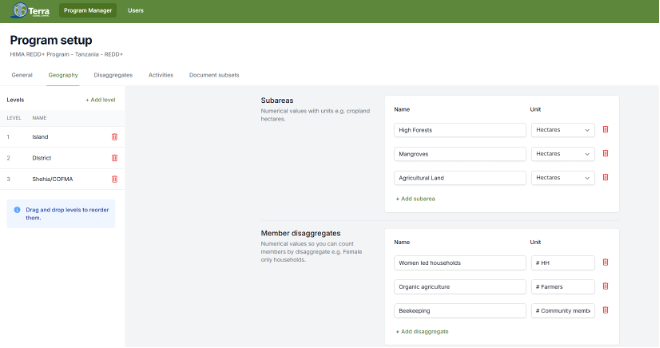
Owning software does not mean building every tool. In May 2026, Terra announced it had selected BlueLayer after reviewing providers and narrowing the field to two finalists. It needed credit tracking, order management, registry integration, and delivery oversight. Measurement and sales inventory are different operational problems.
Read the small words beside the big number
In January 2023, Terra announced up to $640 million from Anew, allocated between company equity and an anchor commitment to a carbon investment pool. “Up to” matters. The headline figure should never be read as cash already received by the operating company.
The relationship later reached court. A November 2025 Delaware opinion describes a $10 million minority equity investment and a dispute involving Anew and Terra subsidiaries. The court dismissed the action in favor of arbitration. It decided the forum for the dispute, rather than establishing that the alleged contractual failures occurred.
A separate 2025 Terra Bella investor brief sets a $300 million fund target and a $10 million minimum investor commitment. It offers elections for cash or verified emission reductions and removals. These are financing terms and targets, not a price list for advisory work or evidence of achieved investment returns.
This puts Terra in a particular part of the market. A buyer seeking issued credits, an owner seeking development support, and an institution allocating long-term capital bring different problems. Terra’s proposition is to connect the technical and financial work across that chain. The Green Climate Fund’s directory records its accreditation in March 2024, another institutional route for its climate-finance activity. Accreditation itself does not establish that a particular program has received funding.
The useful thing to steal
Terra’s approach suggests a practical lesson: put implementation capacity beside the carbon estimate. Secure rights, agree on benefits, budget the work, and establish credible monitoring before treating projected credits as dependable revenue. Disputed tenure, weak consent, shifting standards, or an unreliable route to buyers can undermine that sequence.
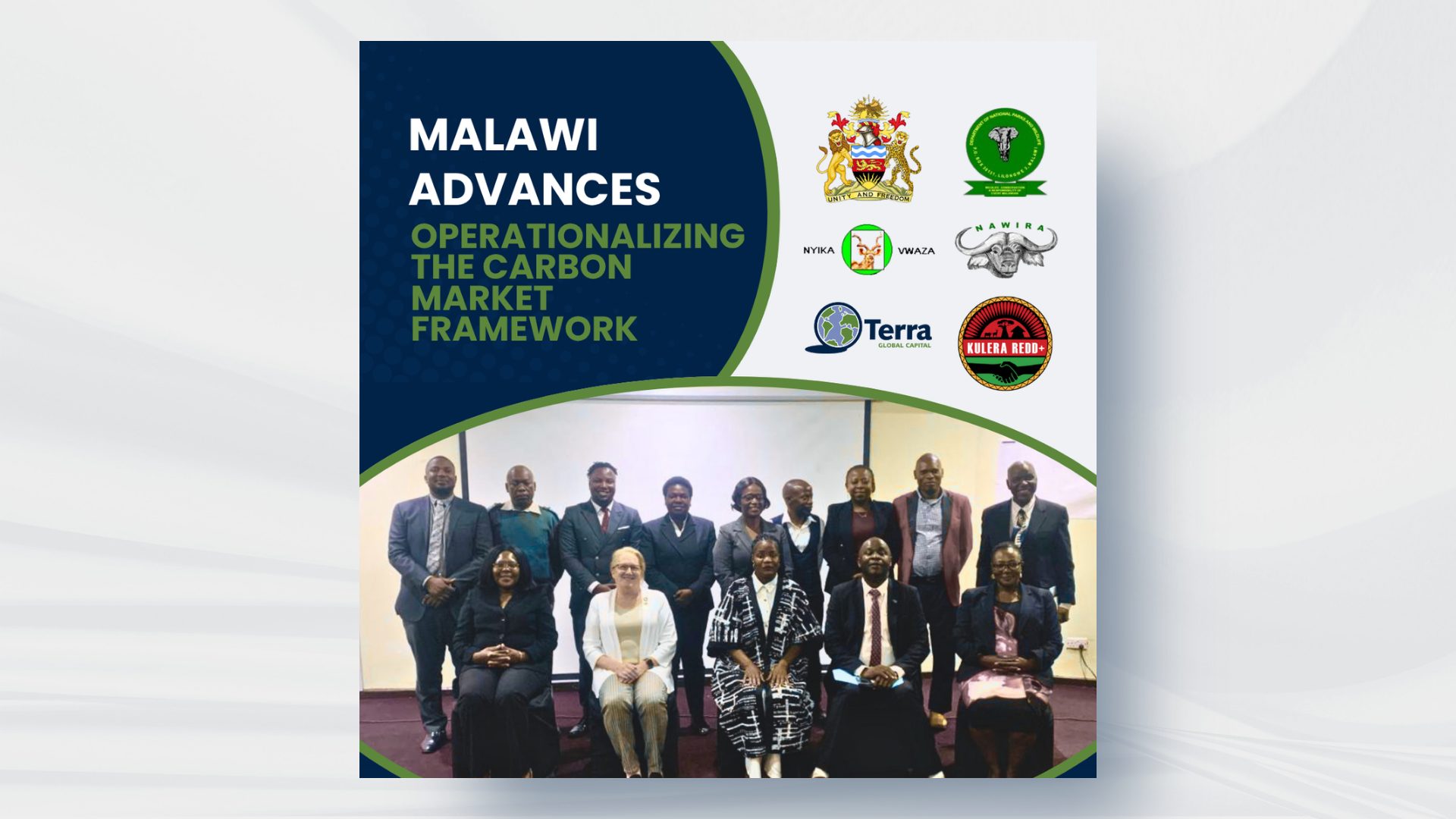
“We have worked in Malawi since 2009”Leslie Durschinger · July 2026
The company’s September 2026 workshop with Verra and ART tackled nesting: fitting project-level forest protection into jurisdiction-wide accounting and governance. That is where the next layer of coordination sits. The bag of seeds still matters. So do the institutions capable of making its modest promise last.