The most photogenic moment in reforestation is also the most misleading: a person kneels, lowers a seedling into fresh soil and pats the earth around it. Cameras click. Everyone goes home. The tree, meanwhile, has entered the part of the story where most promises get expensive.
It may need protection from cattle, invasive plants, drought, pests, fire or the person who owns the next parcel. It needs the right species in the right place, not simply whatever sapling was cheap. Its survival must be measured for years. If carbon credits are supposed to finance the work, the project needs land agreements, community consent, a credible baseline, a monitoring plan and an auditor willing to sign off.
Terraformation is building a company around that unphotogenic list. Founded in Hawaiʻi in 2020 by former Reddit chief executive Yishan Wong, it does not behave like a conventional tree-planting charity or a pure software startup. It behaves like an accelerator, project developer, forestry consultancy, seed-infrastructure supplier and carbon-finance shop sharing one cap table.
The first thing to fail is the shortcut
Wong began looking at gigaton-scale climate solutions in 2017. Forests won his attention because photosynthesis already works, at room temperature, on every continent. But the cheap unit in the popular imagination - “a tree” - turned out to be the wrong unit for the job. A functioning ecosystem is a portfolio of species, people, water, land rights and time.
Terraformation's early work on the dry side of Hawaiʻi made the bottlenecks unusually vivid. Degraded land was available, but fresh water and native seed were not guaranteed. The company developed off-grid seed banks, nurseries, solar systems and desalination equipment. The hardware mattered, but it also changed the diagnosis: no single machine could fix a fragmented restoration market.
In 2022 the company interviewed 230 forestry organizations across 63 countries. Ninety-five percent identified funding as their leading obstacle, followed by seed and sapling supply and team training. That finding shifted the center of gravity from Terraformation planting every forest itself to equipping local groups that already understood their landscapes.
“The world doesn't need another promise about trees. It needs proof that reforestation can be done right, at scale, and under real scrutiny.”Yishan Wong, founder and CEO
The result is the Seed to Forest Accelerator, a program that borrows the shape of Y Combinator but discards its clock. Accepted teams receive a feasibility study, early finance, tools, infrastructure and two years of technical support. Terraformation helps prepare the project design document, monitoring system and forward carbon sales that can carry the work toward verification. The program is free to forestry teams; funders get access to future credits.
The filter is intentionally severe. Applicants need an experienced local team, long-term rights to the land and a tropical or subtropical site. Current criteria call for at least 3,000 hectares in Colombia, Ghana, Kenya or the Philippines, or 15,000 hectares elsewhere. Projects must plan for at least 40 years. This is not a weekend volunteer outing with better branding.
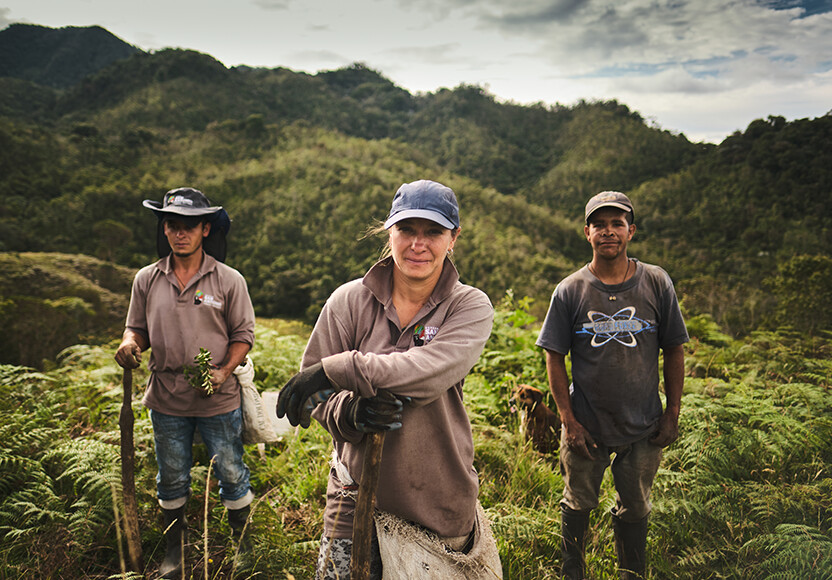
Software for people with mud on their boots
Terraware is the quiet connective tissue. The free, open-source web and mobile platform tracks seed collection, storage, nursery inventory, planting locations, mortality, growth and carbon-accounting records. It works offline in the field. A funder portal added in late 2025 shows hectares restored, survival rates, jobs and gender representation alongside financial progress.
By December 2025, Terraformation said more than 1,140 organizations in 104 countries used the system. It had recorded 4.7 million plantings, 15.6 million seedlings and nearly 1.2 billion seeds. Those counts are not the same as verified climate impact, but they solve a basic problem: a restoration project cannot manage what it never recorded.
Keeping the software free is more than philanthropy. It expands the pool of teams that can produce legible projects. It also makes Terraformation's commercial proposition stronger: carbon buyers are not purchasing a vague green feeling; they can inspect an operating record built from seed bank to field plot.
The customer sits on both sides of the forest
On one side are local forestry organizations, landowners, nonprofits and governments. They have ecological knowledge and land access but often lack early capital, specialized carbon staff or software. On the other are corporations, foundations and investors looking for future carbon removals with evidence of biodiversity and community benefit. Terraformation's product is the bridge.
Its filings describe a flexible business model: upfront payment for services and technology, a share of future carbon credits or project revenue, or a combination. Terraware itself is not the paid SaaS wedge. Project development, finance coordination and future credits are where the economics are meant to accumulate. In 2026, Terraformation added a consumer layer with tree subscriptions from $5 to $50 a month. At $25, it says a subscriber funds a native Hawaiʻi tree from collection through years of monitoring; smaller contributions accumulate until they fund one.
In Hawaiʻi, a native seedling can spend six to eighteen months in a nursery before planting. A missed collection window can mean waiting another year. The $25 subscription price is not a hole-and-sapling fee. It includes seed work, nursery care, hardening, planting and follow-up.
This is where Terraformation differs from donation platforms that optimize for tree counts, drone companies that specialize in dispersal, and carbon marketplaces that begin with finished credits. The company integrates project formation from seed supply through certification. That can reduce handoffs, but it also leaves Terraformation carrying more operational and financial risk.
The numbers are promising. The economics are young.
Terraformation's 2025 update reported 5.4 million native trees planted across active projects, more than twice 2024's 2.3 million. It counted 447 native species and 2,155 hectares restored. Three projects were moving through validation under Verra's carbon standards by early 2026. These are company-reported operating figures, not issued credits.
The financial picture supplies necessary friction. Terraformation reported $1.9 million of revenue and a $12.5 million net loss in its unaudited 2023 statements. It held $23.4 million in cash at year-end after raising $25.36 million in Series A-1 preferred stock. Earlier rounds included $5.1 million in seed preferred shares, a $30 million Series A led by Sam and Max Altman's Apollo Projects, and a $5.1 million crowd SAFE.
That gap between revenue and expense is not proof that the model fails. It is proof that the forest clock and the startup clock disagree. Money goes out for feasibility, staff, nurseries and planting years before verified carbon can come back. Terraformation itself warned that its revenue-sharing formulas were still being developed and profitability was uncertain. Patient capital is not an inspirational phrase here. It is a survival condition.
A forest lasts only when somebody wants it to
The more convincing projects make community benefit part of risk management. In Ghana's Keta Lagoon, Terraformation and local partner ReDAW are restoring mangroves in a landscape where people fish, gather shellfish, graze cattle and harvest wood. Telling families to stop using the lagoon would be easy and useless. The project instead combines nursery and monitoring jobs with aquaculture, beekeeping, leases and community trust funds.
By March 2026, Keta Blue reported 79 full-time-equivalent jobs and 181 trainees. Its design directs at least 32 percent of carbon revenue back to communities through work, livelihood programs, land payments and locally governed funds. In Cameroon, the planned Iroko project mixes native forest with more than two million cacao trees, with a proposed revenue split that retains most agroforestry income for farmers and channels the rest to local councils.
This is also the best answer to the carbon-market trust problem. Credits are vulnerable when a project overstates carbon, ignores land rights or disappears after the first payment. A biodiverse forest with local income, transparent records and independent validation has more reasons to endure. It is still exposed to fire, politics, weak markets and bad measurement, but the incentive structure is less brittle.
“Forests persist when communities are full partners in their success.”Jad Daley, president
What to copy - and when not to
The copyable idea is not “launch a forest accelerator.” It is to fund the boring middle. Diagnose the first constraint before buying the visible output. Share operating tools. Put local organizations in charge of execution. Design the revenue model and the community benefit model together. Track survival, not just planting. Admit that a healthy forest is a long-duration asset and finance it accordingly.
It also should not be copied everywhere. Terraformation focuses on tropical and subtropical restoration and notes that darker tree cover in some boreal regions can absorb enough heat to weaken the climate benefit. Some landscapes regenerate better without planting. A site with no secure tenure, no native seed, no credible local operator or no plan for fire is not an opportunity waiting for a pitch deck. It is a future write-off.
Terraformation's wager is that forests can become infrastructure without becoming interchangeable commodities. That is the tension in the company and its market. Standardization attracts money; ecology resists standardization. The way through is not to make every forest identical, but to make the work around each one inspectable.
A seedling in a staged photograph asks for belief. A seedling with a collection record, a nursery history, a local steward, a survival plot and a 40-year financing plan asks for something more useful: attention.