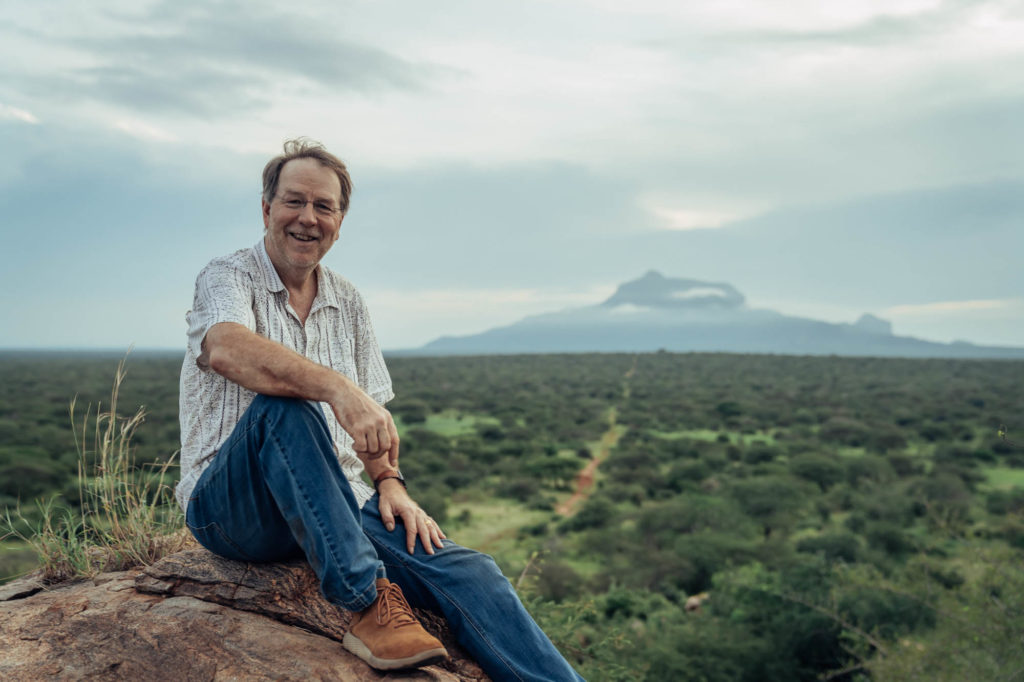
An elephant makes a splendid holiday photograph and a rather inconsiderate neighbour. It can wander through a field in a night and undo months of somebody else’s work. Mike Korchinsky went to Kenya in 1996 hoping to see the animals he had loved since childhood. He returned preoccupied with the people who had to live beside them.
He had recently sold a management consulting business. A comfortable second act was available. Instead, he started asking why wildlife protection so often appeared to require keeping local people at a distance. The questions eventually produced Wildlife Works, a sanctuary in southeastern Kenya, and an unusual accessory for a conservation project: a clothing factory.
There is a pleasing absurdity to the itinerary. Chemical engineering, corporate consulting, organic cotton, carbon accounting. Yet the thread through Korchinsky’s career is quite plain. If a community is asked to preserve something valuable to the rest of the world, how does that value reach its kitchen table?
The holiday that acquired a payroll
Korchinsky was born in Ontario and studied chemical engineering at Birmingham. His working life took him into consulting, including jobs in London, Chicago and San Francisco. He co-founded Axiom Management Consulting, sold to Cambridge Technology Partners in 1995. He had learned how businesses changed their operations; now he had the means to reconsider his own.
The Kenyan trip put a complication into his affection for elephants. The visitor’s pleasure and the farmer’s interests could point in opposite directions. Crop damage and lost livestock made wildlife expensive company. Admiration from abroad offered little compensation to the household bearing the cost.
His response was to treat coexistence as an economic design problem. Wildlife Works, founded in 1997, established its first conservation area at Rukinga, between Tsavo East and Tsavo West National Parks. The location mattered: a corridor lets animals move through a landscape whose usefulness extends beyond any single protected boundary.
“You have to see people as the part of the solution.”
Mike Korchinsky, Wildlife Works origin film
The name carried the proposal. Wildlife would have to work for its neighbours. That meant employment tied to its continued presence, giving local households something more tangible than an invitation to admire the scenery. A conservation promise would need a wage attached.
Sewing a reason to keep the forest
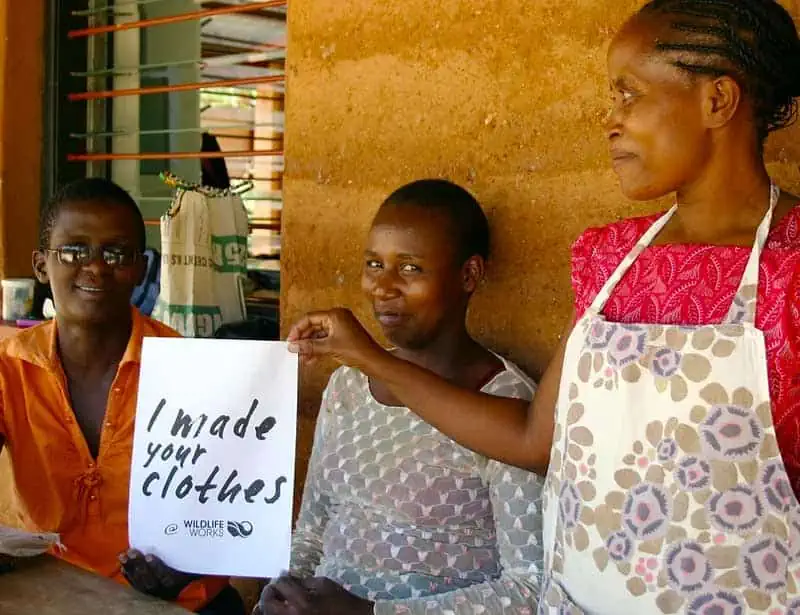
The first job-creation activities included an unarmed ranger team and construction of the eco-factory in 1998. Building the factory and training its initial ten seamstresses took two years. The first collection of organic cotton T-shirts appeared in 2001. Conservation, in this version, required patience with a production schedule.
The factory gave the idea a practical shape. People could learn a skill and earn money through an enterprise connected to protecting the surrounding landscape. Rangers could patrol the corridor and explain the project locally. The arrangement joined habitat protection to ordinary working lives.
It also exposed Korchinsky to the difference between an appealing proposition and a solvent business. Gerald Prolman, who became involved with Wildlife Works, later recalled years of investment and salaries supported by Korchinsky. Public attention arrived more readily than profit. Selling a worthy story and financing a lasting operation turned out to be separate occupations.
Prolman’s account of those years is a useful corrective to the easy founder narrative. There was no tidy moment when everybody recognised the idea and the economics obediently followed. The clothes had to find customers. The sanctuary still needed money. During the financial crisis, raising funds for retail became harder.
For Korchinsky, the factory had demonstrated a way to connect work with conservation. The next task was to find a source of income large enough to support the ambition. A good T-shirt could carry a message. It could carry only so much of the budget.
When standing trees became an asset
Forest carbon finance offered another route. Korchinsky launched Wildlife Works Carbon in 2008, seeking to expand the conservation model through REDD+, the framework concerned with reducing emissions from deforestation and forest degradation. A protected forest could earn revenue linked to emissions avoided by keeping it standing.
In February 2011, the Kasigau Corridor Phase I project issued the first REDD credits under the VCS Program. Wildlife Works had developed a methodology for calculating the emissions reductions. The transaction gave the conservation experiment a new financial instrument, with a registry and verification requirements behind it.
The initial monitoring period generated approximately 1.45 million credits. About 20 percent went into a pooled buffer account against potential losses; nearly 1.2 million were issued to the project’s account. Those distinctions matter. Carbon finance is made of accounting choices as well as forest photographs.
Kasigau Phase I issues the first VCS REDD credits.
Korchinsky subsequently founded Code REDD in 2012. Its work included Stand for Trees, a consumer initiative intended to make forest protection accessible to people outside the technical market. The salesman of conservation had moved from garments to something less easily folded into a shopping bag.
A market has to earn its trust
Being early creates an achievement and an obligation. Forest carbon projects must establish what would have happened without their intervention, then measure the difference. The unseen alternative is central to the credit. It is also a source of dispute.
Verra has described difficulties with matching project reference regions and reconciling project estimates with national accounting. Its newer approach moves toward centrally allocated baselines and more consistent data. These are consequential changes for developers trying to establish project economics and for buyers trying to understand what they are purchasing.
Korchinsky remains an advocate for the market, with sharp views about its failings. In his 2025 interviews, he argued that standards should take responsibility for quality, monitoring should improve, and communities should share fairly in decisions and value. Wildlife Works helped establish Equitable Earth, subsequently acquired by Ecosystem Restoration Standard.
“The market has spent 15 years building supply.”
Mike Korchinsky, This Week in Carbon, 2025
Demand, he argued, needed attention too, including credible claims that buyers could make. His position is pragmatic and interested: he has built a business around these mechanisms. The work of making them credible cannot be separated from his work of persuading people to use them.
Accountability also reaches beyond carbon calculations. In February 2024, Verra completed a review of Kasigau allegations involving sexual offenses, reporting mechanisms and employment practices. It said Wildlife Works had demonstrated required remedial action, including dismissals, training and new grievance procedures, and kept the projects active subject to further requirements.
Wildlife Works later described a global gender rights task force, anonymous reporting and revised workplace processes. These measures belong in the same story as the jobs. An enterprise built on benefits for communities must also answer for how employees and neighbours are treated. The promise becomes meaningful in its administration.
A price for what has survived
A newer strand of Korchinsky’s work starts with a problem in the incentive itself. What about communities that have already maintained an intact ecosystem? If finance is organised around a threatened loss, long stewardship can struggle to receive the recognition its practitioners seek.
Wildlife Works, Associação Sociocultural Yawanawá and Forest Trends co-created a methodology for Biodiversity Stewardship Units. The published design records more than 60 consultative meetings and workshops over two years. It identifies the Yawanawá association as owner of the methodology’s intellectual property.
The approach links ecological monitoring with community authority, Indigenous knowledge and cultural practices. It aims to reward the maintenance of intact biodiversity. Its rules explicitly prohibit using the units as offsets. A buyer would be supporting stewardship, rather than purchasing permission to balance destruction elsewhere.
Keep it intact.
Recognise the work.
Community governance + biodiversity monitoring + funding for continued stewardship
BDSUs cannot be used as offsets.In September 2025, Korchinsky joined Chief Tashka and Laura Yawanawa in a Climate Week NYC discussion about this work. The partnerships are part of the substance. Designing a market around communities requires their participation in its rules, its ownership and its definition of value.
The consultant still asks questions
There is a dry humour in the way Korchinsky describes his first profession. His 2025 recollections make consulting sound like a prolonged exercise in asking questions before the client notices the gaps. Yet curiosity was the habit that travelled with him to Kenya. He wanted elephants; he began noticing fences.
He has been candid about personal contradictions too. In a 2013 public conversation, he described being vegetarian, living in a solar-powered house, driving an SUV to accommodate four dogs, and flying around the world to forest projects. The environmentalist had luggage, dependants and an inconvenient travel schedule.
The latest chapter continues that public argument. In May 2026, Wildlife Works reported his participation in a Stanford discussion on nature-based emissions reductions and removals. The instruments and vocabulary keep changing. The question behind them remains recognisable from Rukinga.
A forest may be admired from almost anywhere. Looking after it happens somewhere particular, among people with bills, ambitions and the right to shape their future. Korchinsky’s career keeps returning to that address. The elephants can remain the attraction. The neighbours need a reason to stay in the picture.
Follow the conversation
Wildlife Works founder biography · Mike on LinkedIn · Wildlife Works journal
Watch: the origin story ↗
Watch: This Week in Carbon ↗
Watch: Earth Live interview ↗
Listen: 4Nature on valuing intact nature ↗
The 2011 credit milestone · Kasigau review · Biodiversity stewardship methodology