A contractor needs a price for roof trusses. The manufacturer knows how to make them. Yet between the request and the answer sits a small obstacle course: a spreadsheet, a freight calculation, a customer discount, another phone call. Multiply that routine across four plants and an ordinary quotation becomes a coordination problem. This is the sort of work that makes TekRevol interesting.
- TekRevol builds custom apps and business software, from fitness products to industrial tools.
- Its revealing projects turn working rules into interfaces customers and staff can actually use.
- Client fees support an engineering business that also underpins Revol Ventures’ ambitions in owned software companies.
The quote that needed a phone call
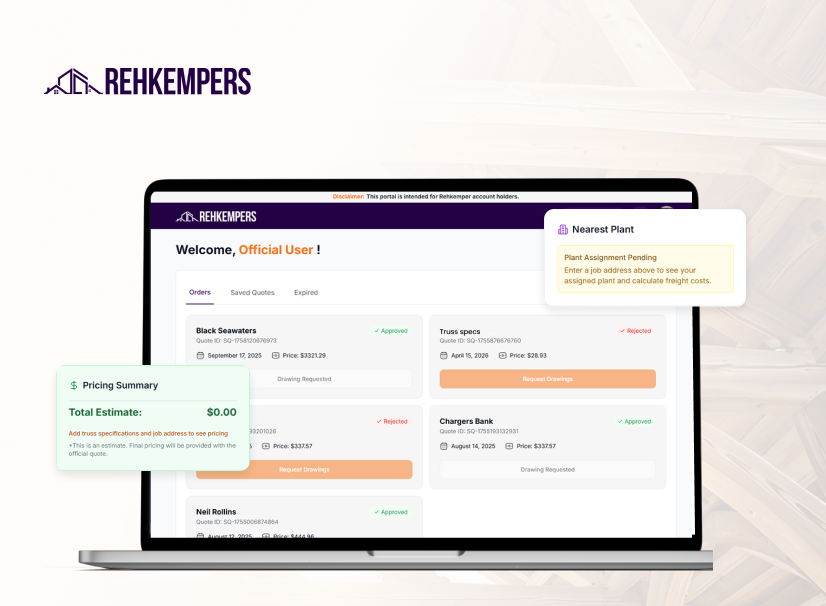
In TekRevol’s account of its work for Rehkemper & Son, pricing lived in spreadsheets and freight required manual calculation. Contractors depended on calls or email. The manufacturer’s expansion had made that arrangement cumbersome. The difficulty was keeping the rules consistent as requests moved between people and plants.
TekRevol built a customer quote builder and an administrative portal. The details are wonderfully prosaic: freight calculated at $3.50 per mile, a warning for deliveries beyond 100 miles, quotes valid for 30 days. Staff could manage pricing and tariffs. A returning customer could renew a quote using existing information. Those exceptions explain the assignment better than any promise to transform an industry.
Two founders, two kinds of work
Abeer Raza and Asim Rais Siddiqui founded TekRevol in 2018. Raza is the co-founder and chief marketing officer; Siddiqui is the co-founder and chief technology officer. The company describes a self-funded beginning. Their division of responsibility makes intuitive sense for a development business: someone must understand the customer’s intent, and someone must make the resulting system behave.
By 2022, TekRevol had reached No. 769 on the Inc. 5000. The following year it ranked No. 66 on Inc.’s Southwest regional list. Rankings provide a useful timestamp. They establish that the business grew quickly enough to attract recognition, while leaving the more practical question open: what happens inside a project after the sales conversation ends?


In a 2022 interview, Siddiqui described a move from mobile applications toward enterprise software and consultancy, alongside expansion into the Gulf. He also described encouraging employees to bring forward startup ideas. That is an appealing proposition for technical staff: learning a client’s business might eventually help you build your own.
“We encourage our workforce to come forward with their business ideas and establish their startups”Asim Rais Siddiqui · SuperbCrew, 2022
A more concrete expression of the company’s interest in developing talent appeared in 2023. TekRevol announced a six-month program with CodeGirls, the women’s coding initiative in Pakistan, covering Flutter and PHP. The published plan combined online instruction, collaboration and practical assignments. It gives the culture claim something specific to stand on: a curriculum and a duration.
The screen is only the beginning
TekRevol’s portfolio moves from manufacturing to energy to exercise. Its Kinder Morgan case study describes an internal mobile application for accessing operational information, reports and metrics. The stated problems included cumbersome reporting tools, low-bandwidth access and the need to restrict sensitive information by role. Those are familiar frustrations to anyone who has tried to do office work away from an office.
The described implementation used React Native and existing enterprise APIs, with role-based access and downloadable reports. The consequential design decision was where information became available. A field worker looking at a phone has different needs from a manager sitting at a large monitor. Useful software respects that difference before adding another dashboard.
An editorial reading of the published projects.
Pure Plank supplies the consumer version of the same problem. TekRevol describes tutorials, challenges, progress tracking and purchasing features around a home exercise routine. A plank is simple to explain. Getting someone to repeat it requires guidance and a reason to return. Here, the engineering serves habit and commerce rather than freight and reporting.
What the invoice buys
There is no single TekRevol product to subscribe to and switch on. Customers commission work. The company offers fixed-price, hourly and dedicated-team arrangements, with maintenance after launch. Its service range includes design, mobile and web development, custom enterprise systems, cloud work, AI implementation and technical consultancy. The attraction is having those disciplines available within one engagement.
The spending can be substantial. One client review on Clutch reports investing more than $100,000, with an initial quote divided into smaller payments. The Manifest describes an education-app engagement at approximately $60,000. These are individual accounts, not a rate card. Scope, integrations and the work required after launch determine whether a proposed budget makes sense.
Client account on The Manifest
Client account on Clutch
Different projects and scopes. Neither figure is a standard package price.
A buyer should also compare other agencies, an internal team and existing software. Custom development earns its place when the operating rules matter enough to justify building and maintaining them. If an available tool already handles the workflow, commissioning a new one adds an obligation. Someone still has to own the data, resolve exceptions and decide what changes next.
An agency that wants to own the work
Revol Ventures extends the argument. Its current materials describe a holding company that builds, acquires, operates and keeps vertical software businesses, initially focused on home-based care and behavioral health. It identifies TekRevol’s cash flow and engineering capacity as its foundation. The services business supplies both money and people who know how to ship.
The proposition also changes the responsibility. Delivering a client’s project and operating a company are different jobs. Revol Ventures’ thesis is that some industries require ownership of the service work around software, including integrations and human review. That remains a business thesis to assess, rather than a result guaranteed by an agency’s portfolio.
The useful idea to borrow starts much smaller. Follow one recurring task through your business. Find the person who knows its awkward exceptions. Put that person in the discovery meeting, and decide how success will be measured. TekRevol’s truss project makes a persuasive case for beginning there. Before the interface comes the freight rule.