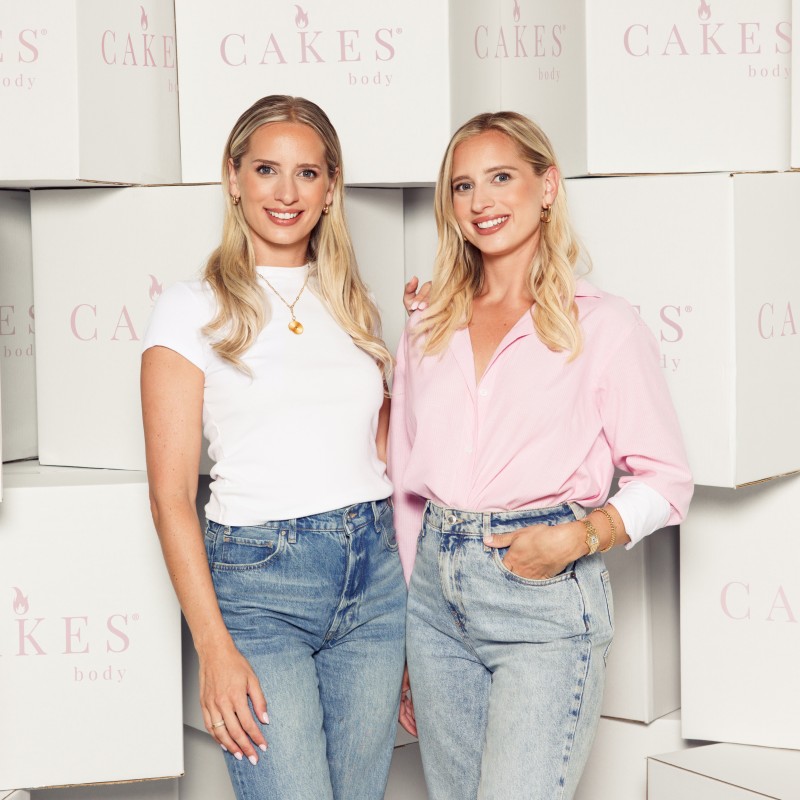
The best business ideas rarely announce themselves. They tend to arrive disguised as small, private embarrassments - the kind most people are eager to forget. Taylor Capuano's arrived on a treadmill, next to her boss, in a moment she and her sister would later christen, with characteristic bluntness, the "NFO": the Nipple Freak Out. Most people would have blushed, adjusted, and moved on. Capuano turned it into a company.
That company is CAKES body, and its origin is almost defiantly unglamorous. In 2022, Capuano was a marketing manager at the apparel brand Life Is Good. She had just had her first child, and motherhood had left her wanting more flexibility than a corporate calendar allows. Her twin sister, Casey Sarai, was a marketing manager weathering pandemic-era instability of her own. The two did what sensible, slightly restless people do: they started a side hustle, each pulling $5,000 from personal savings. Ten thousand dollars, no marketing budget, and no expectation that any of it would replace their day jobs.
What they made was a reusable, adhesive-free silicone cover that grips to the skin using natural body heat. It sounds like a small thing. It was not. The category had been dominated by disposable pads that dissolved after a few washes, and the sisters simply built something better and talked about it honestly - on TikTok, in their own voices, without an agency between them and the customer.
The internet, it turned out, was listening. By the end of that first full year, CAKES body had crossed $1 million in revenue and landed in the top 1% of Shopify stores launched in 2022. All of it earned. Roughly 90% of that early revenue came from organic TikTok traffic - the sort of number that makes seasoned growth marketers quietly put down their spreadsheets.
Then came the tank. In December 2023, Taylor and Casey walked onto the fifteenth season of ABC's Shark Tank asking for $300,000 in exchange for 5% of the business. They left with a deal - $300,000 for 10%, from guest shark Emma Grede, the co-founder of Skims and Good American, who knows a thing or two about scaling a brand aimed at women. The valuation was about $3 million. It would look almost quaint within two years.
Because the growth did not slow. The year 2023 closed near $10 million in sales. By the fiscal year ending June 2025, CAKES body reported roughly $95 million in net sales. The sisters had done it without venture capital, without debt, and without ceding much of anything beyond that single Shark Tank slice. Casey took the CEO seat; Taylor became chief creative officer, the engine behind the brand's voice and its relentless, funny, unpretentious content.
Capuano is refreshingly heretical about the parts of the playbook everyone else treats as gospel. Retail, for instance. When CAKES body finally expanded into more than 1,000 Ulta Beauty stores in 2025, she framed it less as a growth strategy than as a convenience for last-minute shoppers and a stamp of endorsement. "You don't necessarily need retail in today's day and age," she has said. "Digital is just so much more scalable."
There is a through-line here, and it is not really about the product. It is about a founder who trusted her own discomfort enough to build around it - the treadmill mishap, yes, but also the new mother's craving for flexibility. When she and Casey later gave employees remote work and up to $36,000 a year in childcare support, they were not chasing a trophy. They were building the company they had wished existed.
It would be easy to file CAKES body under lucky timing - a viral moment that happened to catch a wave. But luck does not compound for four straight years. What compounds is judgment: the decision to price at a premium when competitors sold for half; the decision to keep the cap table clean when easy money was on offer; the decision to be the face of the marketing rather than outsource it. Capuano built a following in the hundreds of thousands not by gaming an algorithm but by being a person on the other side of it. Vogue noticed. So did The New York Times, Glamour, Vanity Fair, and Women's Wear Daily.
Ask what she wants next and the honest answer seems to be more of the same, only larger: to grow a one-product sensation into a durable women's apparel brand, on her own terms, proving that a couple of sisters from upstate New York can out-build the incumbents with conviction, a camera, and a genuinely good idea. She has already made the improbable look inevitable once. Betting against a second act would be its own kind of freak out.