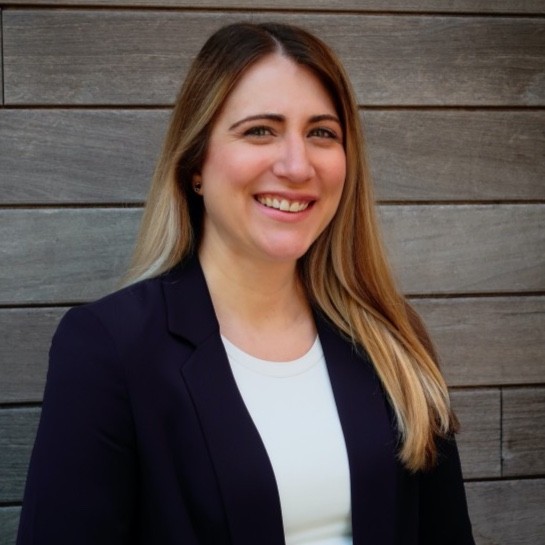
A marketer who follows the customer, not the category
Most marketing resumes read like a straight line down a single aisle. Taryn Rayment's reads like a walk through an entire department store.
She has sold sympathy bouquets and wedding-day orchids at FTD. She has sold the leather carry-on you drag through an airport at TUMI, and the loafers you wear once you land at Cole Haan. She has even sold the phone you forgot in a drawer, running marketing at ecoATM Gazelle, the company that turns old handsets back into cash. Since April 2024, she has been selling something quieter and more durable: the polished, timeless American style of J.McLaughlin, where she serves as Chief Marketing Officer.
It would be easy to mistake all that movement for restlessness. It is closer to the opposite. Rayment is not chasing products. She is chasing a single question that happens to travel well across industries: what makes a person come back and buy again? Flowers, footwear, luggage, electronics, apparel - the merchandise changes, the human behavior does not.
The foundation is unglamorous by design. A Bachelor of Science in Marketing from Rutgers Business School, then a climb through the least photogenic corners of the discipline: customer relationship management, email strategy, data-driven acquisition, retention, and the profit-and-loss math that decides whether any of it worked. She learned the trade at TUMI as Director of Online Marketing, running digital and CRM. She sharpened it at Cole Haan, where as Senior Director of Data Driven Marketing she built a team from the ground up and taught it to track customers in cohorts rather than crowds.
Then came the test that most marketing plans never survive. In 2020, as Chief Marketing Officer and consumer division head at FTD, Rayment sat on top of a carefully built, pre-pandemic media plan. Within weeks it was worthless. Consumer behavior lurched. The old assumptions about who bought flowers, and when, and why, stopped holding. So the plan got blown up and rebuilt on the fly - new digital channels, new customer segments including living-plant buyers and DIY gardeners who had suddenly found their windowsills interesting. She owned the P&L for both FTD and ProFlowers through it, across B2C and B2B. It is the kind of episode that either ends a marketing career or defines it. For Rayment it did the second thing.
The J.McLaughlin job is, in some ways, her hardest brief yet, precisely because it is so calm. Heritage apparel does not want to trend. It wants to endure. The brand has been making versatile, well-cut American sportswear since 1977, and its whole promise is that it will look right in five years, not five seconds. Marketing that in a feed engineered for the next fifteen seconds is a genuine paradox, and it is exactly the sort of problem a retention-minded, data-literate marketer is built to enjoy.
Twenty years, five industries
- 2016 - 2019TUMI - Director of Online Marketing (Digital Marketing & CRM)
- 2019 - 2020Cole Haan - Senior Director, Data Driven Marketing
- 2020 - 2023FTD - Chief Marketing Officer & Consumer Division Head (FTD & ProFlowers P&L)
- 2023 - 2024ecoATM Gazelle - Chief Marketing Officer
- 2024 - nowJ.McLaughlin - Chief Marketing Officer
Where the work has taken her, by consumer category:
Illustrative - based on publicly listed roles, not disclosed budgets.
How she thinks about the work
Retention over reach
The second purchase matters more than the launch-day noise. A brand is built on the customers who come back, not the ones who click once.
Rebuild when the world moves
When 2020 broke FTD's media plan overnight, the answer was not to defend it - it was to blow it up and rebuild around new behavior.
Cohorts, not crowds
At Cole Haan she built a data-driven team to track customers in cohorts and tie channel KPIs to real behavior over time.
Two-sided vision
Time on the agency side at True Action plus years brand-side gives her a view of marketing from both the buyer's and the seller's chair.
Own the P&L
Running the FTD and ProFlowers P&L means marketing is judged on the ledger, not on impressions. Numbers keep the story honest.
Timeless needs translation
A heritage brand that promises to last has to be marketed for the long game inside channels built for the short one.
Quiet by method
There is a certain kind of marketing executive who becomes the story. Rayment is the other kind - the one who lets the customer data do the talking and stays out of the frame. It is a preference, not a limitation. The whole point of a retention-first philosophy is that it works slowly and invisibly, showing up in repeat-purchase curves rather than in press releases.
That temperament suits J.McLaughlin, a brand that has never confused loud with lasting. The label built its name on clothes you reach for again and again - the crewneck, the turtleneck, the wear-to-work dress, the cashmere sweater that outlives the season. Marketing that requires patience and a very long memory for what individual customers actually do. It is, in other words, the exact problem a category-hopping, data-driven marketer spent twenty years learning how to solve.
People also ask
Who is Taryn Rayment?
She is the Chief Marketing Officer of J.McLaughlin, a New York-based heritage apparel brand, a role she has held since April 2024.
Where did she work before J.McLaughlin?
She was CMO at ecoATM Gazelle, CMO and consumer division head at FTD, senior director of data-driven marketing at Cole Haan, and a digital marketing and CRM leader at TUMI. She also spent time agency-side at True Action.
What is her educational background?
She holds a Bachelor of Science in Marketing from Rutgers Business School.
What is she known for as a marketer?
A data-driven, retention-focused approach to direct-to-consumer and omnichannel marketing across multiple consumer categories.
Where is she based?
She is based in Brooklyn, New York.
Links & sources
Profile compiled from publicly available sources including J.McLaughlin, LinkedIn, The Org, and eTail conference listings. Facts limited to what is publicly verifiable; where sources were unavailable, details were omitted rather than inferred.