There is a particular sort of click that interests Tara Robertson. It comes after the search result has already been summarized, compared, and neatly served inside an AI tool. The visitor could leave satisfied. Instead, they choose the link. To Robertson, Chief Marketing Officer at Bitly, that small act carries new weight. The web may be producing fewer visits as answers detach themselves from websites, but the people who still arrive are raising their hands with purpose.
For a company built into the grammar of the internet - shorten, share, measure - this is more than a tidy observation. It is a clue about how marketing changes when the old map stops matching the journey. Robertson's work sits at precisely that awkward intersection: a familiar brand, an expanding product, and buyers who increasingly research in places marketers cannot see.
Her answer is not to commission a grander dashboard. It is to look more closely at the moments the dashboard tends to flatten: a click, a scan, a visit, an action taken before the campaign report turns the living thing into a post-mortem.
“The clicks that do happen mean so much more.”Tara Robertson, on discovery in the AI era
The shop floor came first
Robertson grew up in New Jersey in a family of modest means. She has recalled watching both parents work hard to provide for her and her sister. Her mother owned a retail store, an early lesson in the stubbornly practical business of finding customers, serving them, and opening the doors again tomorrow.
In college, while studying marketing, Robertson became the general manager of a small telesales office. The arrangement sounds like an unusually efficient education: theory by day, targets and people by necessity. She was drawn to the point where psychographic motivation meets the analytics of a creative campaign - why somebody buys, alongside the record of what they did.
There was also a less solemn spark. Watching What Women Want in 2000, she saw Helen Hunt play a formidable advertising creative director and thought the job looked excellent. Cinema has launched careers on flimsier evidence. The useful part is not the film's office fantasy, but the permission embedded in the character: a woman could occupy the creative chair and run the room.
Robertson reached her first vice-president role in her twenties. At TSL Marketing she helped run a multimillion-dollar agency operation, during a tenure that lasted more than a decade. The firm was an early HubSpot partner and grew from roughly ten people to about 300 while expanding beyond North America. Agency life gave her hundreds of businesses to study and no shortage of ways for a strategy to meet reality.
The customer moves to the center
When Robertson left agency work for SaaS, she carried the range but narrowed the obsession. At Hotjar she became VP of Marketing. At Sprout Social she led customer marketing, focusing on what happens after acquisition: onboarding, education, retention, expansion, and the experience that makes any of those outcomes possible. By 2021 she was CMO at Teamwork. The following year Bitly recruited her to lead acquisition and retention, content, brand, communications, product marketing, and the customer lifecycle.
The sequence explains her favorite provocation: marketing is not primarily about generating demand. It is about generating value. Create enough value for the right customer, she argues, and demand follows. Hunt for leads without understanding whom you are bringing through the door, and the growth will not hold.
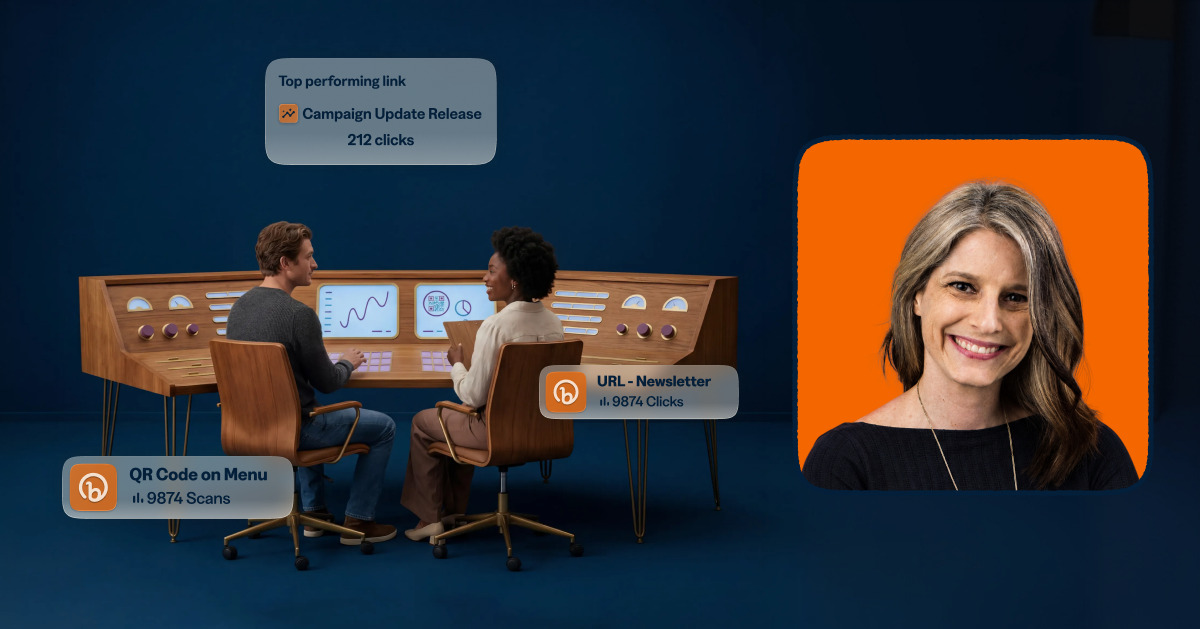
At Bitly, that principle became organizational work. The company was already far more than the free link shortener lodged in public memory. It had QR codes, link-in-bio pages, enterprise tools, analytics, and a vast stream of interactions. Robertson's team used customer research to clarify positioning and to give Marketing, Product, and Sales a shared language. Personas, ideal customer profiles, and jobs-to-be-done could coexist, provided the teams understood what each lens was for and where a niche group might carry disproportionate value.
Measure while there is still something to change
In 2026, Robertson helped interpret a survey of more than 250 marketers about measurement and attribution. Only 18 percent said they had a clear view of what was working. Just 16 percent used AI as part of their standard measurement workflow. The findings described a familiar corporate farce: abundant data, limited visibility, and plans so thoroughly locked that even a useful insight arrives without permission to matter.
The visibility gap, in three signals
Selected responses from Bitly's Marketing Visibility Report, discussed by Robertson in June and August 2026.Her prescription has the agreeable plainness of a kitchen rule. Begin with the strategy, then choose the tools. Audit the software already in the stack. Ask what would genuinely be lost if each product disappeared. Remove overlapping functions, favor tools that integrate with the daily workflow, and preserve enough budget to respond when the evidence changes.
Campaign-level reporting tells a large story late. Interaction-level analysis tells a smaller story soon enough to edit. If clicks are rising while scans stall, or a particular channel produces fewer but more committed visitors, the team can move. Flexibility converts measurement from documentation into management.
“Fewer, better-connected tools will always beat more tools that don't talk to each other.”Robertson's one-sentence stack audit
A brave space, with a calendar
Robertson speaks about teams with the same mixture of humanity and operational specificity. She favors servant leadership: managers exist to serve the people doing the work, not merely issue instructions. People need room to fail, which means leaders must create spaces safe enough for experiments and brave enough for honest judgment.
Empathy, however, is not a decorative cushion placed over a missed target. It is the work of understanding how a person operates, what support they need, and how to build a relationship across the flat little window of remote work. Some people want guidance. Others want autonomy. The manager's job is to notice the difference without turning either style into a moral category.
Her harder-earned lesson was focus. Early ambition made doing everything feel like the route to every opportunity. Over time she learned that results require choosing the outcomes that matter and protecting the team's energy around them. Saying no became a leadership skill. Balance was not retreat; it was how to avoid burning out herself and everyone nearby.
Start with the customer's job, language, friction, and evidence of value.
Give Product, Sales, and Marketing a shared view without forcing every framework to be identical.
Read interaction-level signals before the campaign is over and the money is gone.
Leave room in the plan, the budget, and the team for learning to change the work.
The importance she places on networks follows naturally. When Robertson once asked marketing leader Kyle Lacy to mentor her, he declined the formal arrangement. He suggested they network, learn from each other, and build a relationship instead. They became close friends and kept talking. Robertson also credits former Sprout Social CMO Jamie Gilpin and a group of women leaders known as the Shine Crew. Her version of professional connection is reciprocal rather than ceremonial.
Cookie dough and the useful pun
Soon after joining Bitly, Robertson's team found itself with an Advertising Week New York opportunity. Bitly's then-CEO was appearing with a Marvel Studios marketing executive to discuss QR codes used around Moon Knight. In less than three weeks, an idea became an activation with a popular New York food vendor. Attendees received cookie-dough desserts; each one prompted a charitable contribution. A “dough-nation” wall tracked the giving and invited photographs.
It is the sort of corporate anecdote that survives because the pun is groanable and the machinery worked. The campaign joined a product story, a cultural moment, a physical interaction, and a donation. More importantly for Robertson, it showed how quickly a team could move while enjoying the work.
That combination - evidence, empathy, execution, a little levity - is her career in miniature. Robertson has spent years arguing for customers to remain visible inside the funnel, then for employees to remain visible inside the organization. She has also spoken about making workplaces more inclusive, serving on Bitly's DEI council, mentoring others, and participating in local initiatives. The aspiration is not separate from the management method. Both begin by noticing who is missing from the picture.
The modern web will continue to hide parts of the journey. AI will answer more questions before a brand ever sees the visitor. Attribution will remain an imperfect detective with too many browser tabs. Robertson's response is usefully unsentimental: inspect the signals you do have, ask better questions sooner, and keep enough freedom to act on the answer.
A click is a tiny decision. In Robertson's hands, it is also a management philosophy. Pay attention to the choice. Understand the person behind it. Then do something before the trail goes cold.