The conference table at Ember’s Westlake Village headquarters is 13 feet long and shaped like a boomerang. It is a wonderfully specific answer to the question of what an office should look like. Behind it sits a less photogenic problem: someone must turn an architect’s idea into furniture that can be made, delivered and used. Tangram Interiors works in that space between the drawing and the workday.
For Ember, the temperature-control technology company, Tangram collaborated with Studio Blitz on furniture for a 25,000-square-foot headquarters. Catalog selections sat alongside custom millwork made with Valentine Industries, including executive desks, reception furniture and that sweeping conference table. The point was a coherent environment for a design-conscious business, with different answers for different rooms. One giant shopping basket would not have done the job.
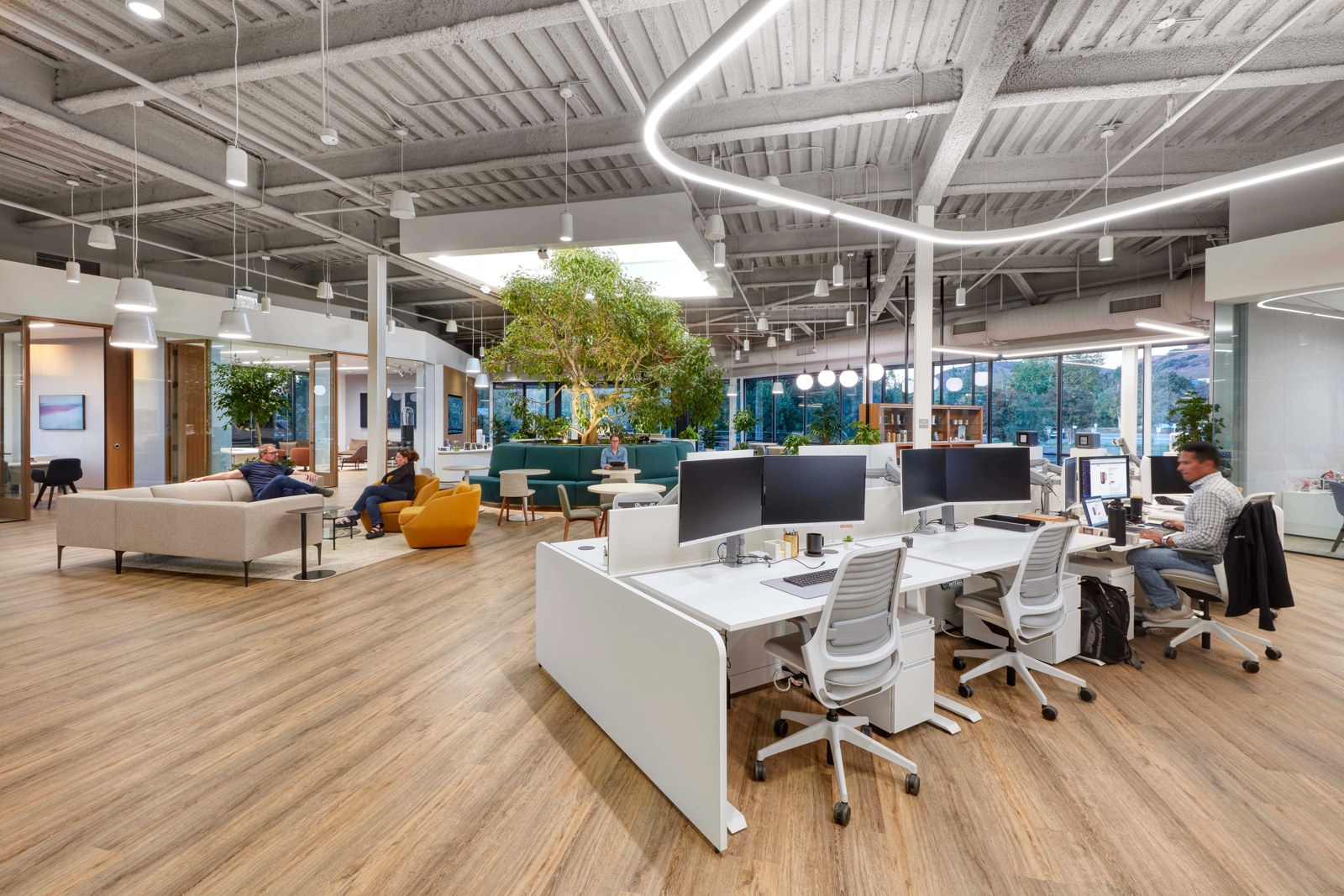
That mix explains Tangram more accurately than the word “furniture” alone. It is a Steelcase dealer with services extending into custom fabrication, audiovisual systems, architectural walls and relocation. Its customers buy objects, certainly. They also buy help making a collection of suppliers behave like a single project. The practical appeal is easy to understand if you have ever occupied a finished room while waiting for the last missing component.
The dealer changed its job description
Tangram’s current business began with an older company in trouble. In a 2022 interview with the Orange County Business Journal, Joe Lozowski recalled a business generating $60 million in sales while losing $5 million annually. Tangram owed Steelcase roughly $22 million. An offer to buy his Michigan business helped make a move west possible. The company dates Joe and Sonya Lozowski’s arrival to 2002.
Lozowski’s response included asking architects, designers and clients what they wanted. A 2017 Building Design + Construction report described a telling request: furniture with a rough, hardware-store aesthetic. He accepted the commission and saw a business in customization. Complaints about coordinating office design and technology suggested another opening. Customer irritation was giving the dealer a map of where to expand.
“Just being a furniture provider was not an exciting story.”
Joe Lozowski · Building Design + Construction, 2017
The first documented failure was financial, in a business that already had customers. The broader commercial insight came from listening to what those customers struggled to get done. Selling additional services made Tangram responsible for more of the outcome. It also made the company useful at more points in a project, from early specifications through the day employees arrived.
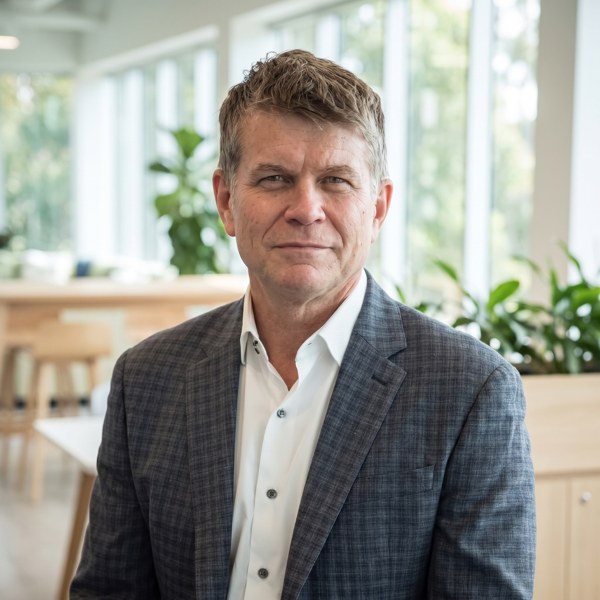
The expanded briefJoe LozowskiTaking on a troubled dealership meant examining both the accounts and the customer’s unfinished to-do list. Portrait published by Tangram Interiors.
Somebody has to own the handoffs
Consider an office project from the buyer’s side. The architect has a plan, the furniture manufacturers have different lead times, the installer needs access, and the IT team needs the room ready. A late finish choice can disturb that sequence. Tangram’s contract furniture practice combines planning, specification, procurement, project management and installation, then offers support after occupancy. That is an operating proposition as much as an aesthetic one.
The business earns its place between manufacturers and organizations buying commercial interiors. Furniture sales sit alongside scoped services and custom work. Its value depends on the complexity it can absorb: coordinating orders, understanding installation conditions and resolving questions before they arrive at the customer’s desk. For a buyer, comparing proposals therefore means comparing responsibilities as well as the furniture schedule.
The contract furniture workflow, condensed from Tangram’s service description.
Another dealer, an independent fabricator and a separately appointed AV contractor are all possible alternatives for parts of that brief. Tangram’s case rests on bringing several of those capabilities together. That advantage is most relevant when the tasks depend on one another. An organization replacing a handful of standard chairs has a simpler decision than one opening a headquarters with custom rooms and a fixed moving date.
Curved desks, very practical reasons
The custom business took the name Studio Other in 2019, with Charlotte Wiederholt continuing as president and creative director. The independent brand gave an established Tangram operation a clearer identity for national work. Its process runs through collaborative planning, conceptual design, prototyping, engineering, fabrication and installation. “Custom” describes a production method here, with decisions to validate before anyone makes the full order.
At Boston Consulting Group’s Chicago office, Studio Other worked with Tryba Architects on curved workstation units that could form reconfigurable clusters. The irregular floor plan gave the curves a purpose. White oak planters occupied spaces between desks; sit-to-stand surfaces added another kind of adjustment. The published scope included 60 workstations, 10 planters and four conference tables for a 100-person office.
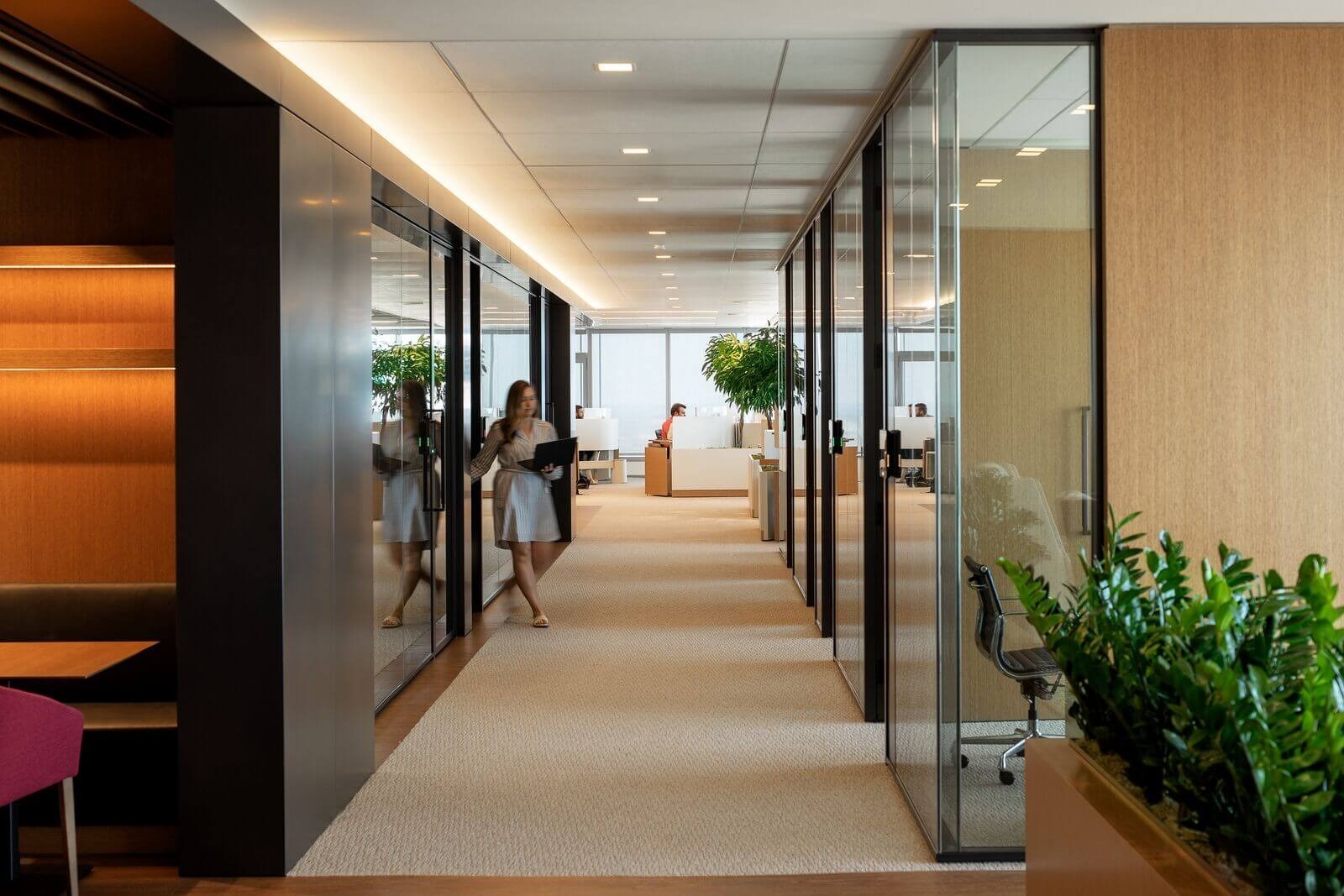
The lesson is useful well beyond furniture. Start with the constraint that makes the standard answer awkward. Then decide whether the extra design and fabrication effort earns its place. A curved workstation is interesting because of the floor it must occupy and the groups it must serve. Without those conditions, its shape is merely a preference. A prototype gives the buyer a chance to distinguish the two.
The meeting starts before the screen turns on
Tangram’s AV Technology practice covers collaboration systems, unified communications, room scheduling, sensors and data infrastructure. Its service description begins with an audit of problems and moves through design, integration, testing and ongoing support. The room becomes the unit of work: its acoustics, its users and the remote participants who must hear and be heard.
For a customer, the useful test is an ordinary meeting. Invite someone remotely. Sit at the far end of the table. Change presenters. Try the booking process. These are practical implications of Tangram’s emphasis on real workflows, rather than reported results from a particular installation. They turn an abstract promise of better collaboration into things a buyer can observe before signing off.
The same attention to coordination extends into Falkbuilt architectural systems, including demountable walls, glass fronts and walls incorporating power, data or displays. Tangram announced a Dallas-Fort Worth Falkbuilt operation in November 2025. It followed the company’s acquisition of BKM Total Office of Texas in October 2021, extending an existing regional business into another part of the interior build.
Beyond the corporate coffee machine
Offices provide Tangram’s most familiar setting, but its customer base also includes education and healthcare. At Cate School’s Inquiry Collaborative in Carpinteria, the furniture brief covered reading, group work, learning labs and outdoor gathering. Working with Blackbird Architects, Tangram combined high tables, lounge seating, booths and modular pieces. A school day asks a room to accommodate different activities, sometimes in quick succession.
Healthcare brings another set of users into the specification conversation. Tangram’s third Health Spaces showcase, held in spring 2026, presented settings for patient rooms, behavioral health, telehealth, laboratories and staff areas. The company reported more than 220 attendees, 50 booked tours and over 30 exhibitors. Small-group tours allowed visitors to examine applications in context. The distinction matters: a chair’s job changes with the person using it and the care happening around it.
booked tours across nine days
Company-reported event figures. More than 220 attendees; 30+ exhibitors.Tangram applies the demonstration idea to its own working showrooms. Employees occupy the spaces prospective customers visit. That lets the company show how furniture, meeting areas and technology coexist during business hours. Its stated culture emphasizes partnership and careful refinement; an occupied showroom makes at least part of that proposition inspectable. Buyers can ask how the space performs after the tour ends.
The budget includes Monday morning
In 2022, Lozowski estimated a sizeable office renovation at around $5,000 per employee. That was a historical rule of thumb, not a current Tangram price list. The same reporting put annual revenue at approximately $250 million. Neither figure should be mistaken for a present-day quote or financial statement.
A revealing procurement example comes from SpectrumVoIP’s AMQ furniture project. Tangram selected products including Kinex height-adjustable benching, Bodi chairs, Revi storage and privacy screens. The case study emphasizes price-conscious matching to an existing location, Steelcase financing and the requested installation date. Standardized products had their own advantages. Custom fabrication is one tool in the kit, with schedule and budget helping determine when to use it.
After installation, move and facility services cover relocation planning, asset tracking, refurbishment, maintenance and storage. Tangram advertises SnapTracker inventory visibility and more than 250,000 square feet of warehouse space. These capabilities address a mundane but expensive question: what happens to everything between the old floor plan and the new one? Keeping usable furniture in circulation also gives buyers an alternative to replacing every item.
For a facilities team, the next step is to put those responsibilities in the proposal. Who checks the existing inventory? Who approves substitutions? Who coordinates access to the building, and who returns to fix an installation problem? These questions make competing bids easier to compare. A low furniture price can be attractive while still leaving considerable work with the buyer. The appropriate scope depends on how much of that work the organization can handle itself.
The reader can copy the sequence without copying the décor. Describe a real workday. Identify where people, furniture and technology depend on one another. Test the awkward moments. Assign responsibility for delivery and follow-up. Tangram’s interesting bet is that an office buyer will pay for those connections to be managed. The boomerang table catches the eye. Monday morning determines whether the project did its job.