There is a peculiar moment at the beginning of a haircut when a stranger asks you to explain the version of yourself you would like to become. The evidence is usually poor. You bring a photograph taken in better light, on a different head, perhaps after an hour of professional styling. Then you say something magnificently imprecise, like “more movement,” and surrender your glasses.
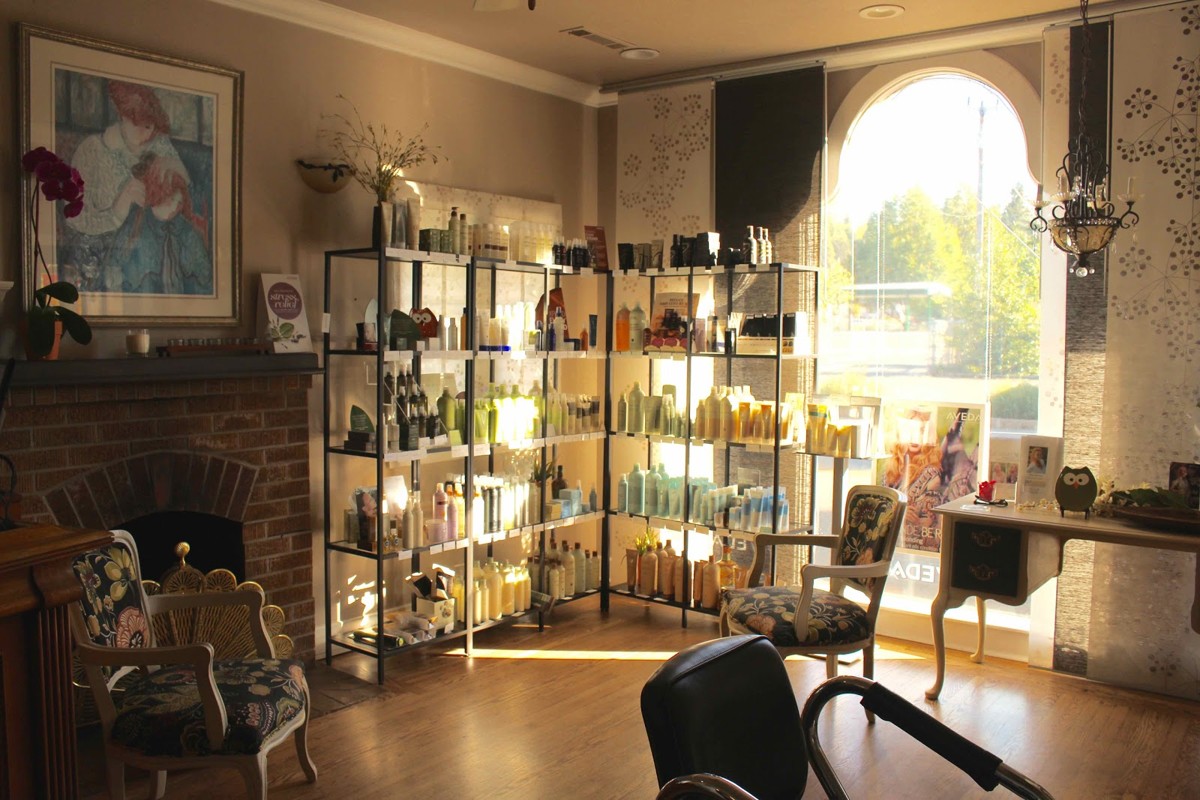
For more than three decades, Panache Aveda Concept Salon has made a business out of that moment. The salon sits at 138 Colfax Avenue in Grass Valley, a Sierra foothills town where the local beauty market includes polished destination salons, independent stylists and another Aveda shop. Panache is the small one. A longtime client once praised it for having “only 2 chairs,” a phrase that sounds less like a limitation than a positioning statement.
The menu is recognizable: haircuts, custom color, highlights, balayage, root touch-ups and treatments. Aveda bottles fill the retail shelves. Anyone can buy them, appointment or not. But a service list explains Panache about as well as a parts catalog explains a watch. The interesting mechanism is attention.
The product is a correct interpretation
Salon customers do not arrive with specifications. They arrive with stories. The last color pulled warm. The layers collapsed. The curl was treated as straight hair. The cowlick won. Good salon work begins by converting those stories into a technical plan without making the customer feel like bad source material.
Panache's reviews are unusually rich in these translation problems. One customer recalled a stylist turning “rather abstract ideas” into a curly cut and then explaining how to care for it. Another praised work on extremely difficult hair. Recent customers mention long layers, thick hair, copper color and gray coverage. These are not glamorous categories. They are high-anxiety ones. That distinction matters.
“I love that the salon is intimate (only 2 chairs).”A customer describing Panache's scale as an advantage
A large salon can advertise breadth: more chairs, more services, more open appointments. Panache's natural advantage is narrower. In a tiny room, the consultation cannot easily become a handoff, and the customer cannot disappear into the day's throughput. The stylist's time is visible. So is the result.
A brand inside a very local room
The Aveda affiliation gives Panache a useful piece of infrastructure. Professional color arrives with training, a broad palette and a clear ingredient story. Aveda describes its current treatment color as vegan and 96 percent naturally derived on average under the ISO 16128 standard. The company also supplies a retail assortment and a rewards system. Panache adds the part a multinational brand cannot manufacture: local memory.
This is the hybrid business model of the concept salon. The service creates trust. The product extends the service between visits. The brand reduces uncertainty for a customer who already knows Aveda. The independent operator supplies the judgment that a bottle cannot.
The small-salon flywheel
The flywheel is easy to copy in outline and hard to copy in practice. Ask better questions. Explain the plan. Stock the products that support it. Give the client a reason to return. None of this requires a vast room or elaborate technology. It does require resisting the temptation to rush the least billable part of the appointment: the conversation.
The useful constraint
A two-chair model works when customers value continuity and bespoke judgment. It works less well for shoppers who want instant online prices, a broad spa menu, many simultaneous appointments or the lowest available cost. Intimacy is not universal convenience.
The handoff
In May 2024, customers began calling Kari the new owner. That small line in a review is the clearest public marker of a major event. Ownership transitions in neighborhood businesses rarely come with glossy launch campaigns. They appear in changed phone numbers, new names in the praise and regulars quietly deciding whether the promise still holds.
The old public trail names stylists including Steve and Kimette. The newer one praises Kari, Autumn and Alicia. The cast changed; the themes did not. Customers still talk about the salon as clean, comfortable and patient. They still mention difficult hair and exact color requests. One recent reviewer thought Kari's prices were fair, but Panache does not publish a dependable current price menu. The cost of a visit remains something to ask about directly, because hair length, condition, color history and the requested change can alter the work.
What did the salon change its mind about? The public record does not say. What failed first? The digital layer, arguably. Old directories still show a previous phone number and a dead standalone domain. The current business is easier to understand through reviews than through its own website, because it does not appear to maintain one. This is common among durable local companies: the work survives more cleanly than the metadata.
The salon opens. Panache begins as an Aveda concept salon in Grass Valley.
Small becomes memorable. A review calls out the intimate two-chair setting.
Relief arrives. Panache receives a $1,250 Nevada County Relief Fund grant.
A new owner. Customer reviews begin identifying Kari as the person in charge.
Continuity earns its verdict. New reviews keep emphasizing layers, color and calm.
What another service business can borrow
Start with the problem customers are embarrassed to describe. For Panache, it is often the head of hair labeled difficult somewhere else. Build expertise around that sentence. Then make the expertise observable: talk through the choice, teach the maintenance and let the client see that the solution was made for them.
Next, treat the physical room as part of the offer. Panache customers remember tea by the fireplace, the quiet, the cleanliness and the number of chairs. None is a patented innovation. Together they form a story that people can repeat. “Good salon” is forgettable. “The little Aveda place with two chairs and a fireplace” travels.
Finally, keep the promise steadier than the personnel. A business founded in 1993 will outlive hairstyles, software, phone numbers and eventually an owner. Panache's most valuable asset is not a particular cut. It is the accumulated expectation that someone in that small room will listen closely enough to get the idea.
Make the appointment make sense
Check current availability and contact details before visiting. The salon's public listings have carried both old and new information during its ownership transition.