clinical-research
(38)
TOBY is following cancer’s chemical trail
A urine sample, a mass spectrometer, and an algorithm: TOBY is betting on a less invasive route to disease detection. Its early prostate results show both the appeal and the difficult business of telling a useful signal from a false alarm.

The Company That Watches the Drug and Runs the Trial
Perceptive can trace a molecule in a scanner, standardize images across hundreds of hospitals, and keep the right study drug moving to the right patient. Its wager is that the handoffs between those jobs matter as much as the jobs themselves.

Komodo Health Bet Tens of Millions on a Map. Then It Had to Teach Customers How to Read It.
The healthcare-data unicorn spent a decade stitching together patient journeys. Its harder problem was turning that expensive map into answers that scientists, sales teams and regulators could actually use.

Verily Bet Billions on Health Moonshots. Then It Learned to Clean the Data.
The Alphabet spinout tried smart contact lenses, surgical robots and a watch built for research. After layoffs and a strategic reset, its real product looks less cinematic - and potentially more useful: turning health care’s unruly data into evidence, decisions and care.
The $10,000 Oil Change for Humans: How Circulate Sold Blood Cleaning Before Longevity Was Proven
Circulate turned a decades-old hospital procedure into a private-pay longevity service, raised $12 million and sold to Viome. Its smartest product may not be plasma exchange at all - it is the operating system that lets clinics offer a complicated treatment while the science catches up.
Conquest Research Found Drug Development's Most Human Bottleneck: The Patients
Drug makers can design a promising study and still lose years waiting for the right people to enroll. Conquest Research built a local, patient-facing machine to make that slow middle move faster - then took it across three states.
THREAD Moved the Clinical Trial to the Patient's Kitchen Table
For decades a clinical trial meant a patient driving to a site. THREAD bet the visit could come to them instead - and then bought four companies to prove it.

The Doctor Who Built a Research Machine Because He Never Had Time to Do Research
Dr Matt Wilson spent 14-hour shifts in emergency medicine with no time to eat, let alone run a study. So he built a platform that makes the research happen without the clinician lifting a finger - and pharma is paying to plug in.
Novartis Cut Away an Empire to Bet on Five Ways of Making Medicine
The Swiss giant spent years shedding businesses until only innovative medicines remained. Now its growth depends on turning five scientific platforms into treatments that health systems will pay for - and patients can actually reach.

The $4.3 Billion Toll Road Beneath the Genome Era
Illumina put DNA sequencing on a repeatable industrial workflow. Now it is trying to turn the machines, chemistry and software already embedded in laboratories into an operating system for multiomic medicine.
The $16.3 Billion Company Quietly Running Modern Medicine’s Back Office
IQVIA sits in the machinery between a molecule and a medicine cabinet - running trials, organizing health data and helping drugmakers decide what happens next. Now it is turning that unusually broad view of healthcare into an agentic AI platform.
The 245-Year-Old Drugmaker Betting Its Next Act on Six Big Swings
Takeda began as a medicine shop in Osaka in 1781. Now a new CEO must turn a sprawling global portfolio, a $30 billion-plus revenue base and six late-stage programs into the company’s next generation of growth.
HCA Healthcare Built a Hospital Network Big Enough to Learn From Itself
The Nashville company turned a 1968 experiment in shared hospital resources into a vast care network. Its real edge is what happens when local medicine, centralized operations and 47 million annual patient encounters begin teaching one another.

Hanger, Inc.
Hanger began with a wooden leg fashioned from barrel staves during the Civil War. Today, its advantage is a 925-clinic feedback loop connecting patients, clinicians, research, fabrication and the supply chain.
UCB
UCB spent decades shedding its industrial past to become a specialist in the brain and immune system. Now five medicines, two ambitious acquisitions and a new Georgia factory are testing whether focus can scale.
HealthKey
HealthKey is an AI-powered patient identification platform for clinical trial sites. It connects directly to a clinic's electronic health record system, reads every patient chart - including scanned and faxed PDFs - and scores each patient against a trial's eligibility criteria. Doctors get a ranked list of likely-qualifying candidates with the supporting evidence highlighted, replacing slow manual chart review. HealthKey charges success fees per enrolled patient, so sites pay only when it works. Founded in 2025 by Josh Sabol and backed by Y Combinator (W25), the company is based in Austin, Texas.

Briya
Briya is a healthcare data company that connects hospitals, health systems, and researchers to life sciences organizations through a secure, privacy-preserving data exchange network. Its blockchain-secured infrastructure standardizes electronic health records and keeps data at its source, while its flagship product, Briya AIRE, is a clinical-grade conversational AI research platform that lets scientists query and analyze real-world medical data in plain language. Founded in 2020 by David Lazerson and Guy Tish, Briya spans a global network of more than 120 million patient records and aims to accelerate medical and epidemiological research without the friction of traditional data integration.
Castor
Castor is a health-technology company that builds a cloud-based eClinical platform for running clinical trials - from electronic data capture (EDC) and eConsent to eCOA/ePRO and real-world evidence. Founded in 2012 in Amsterdam by physician-researcher Dr. Derk Arts, Castor set out to replace clunky, expensive trial software with a self-service, researcher-friendly system. Today it supports more than 15,000 studies across 90+ countries and is used by leading CROs and biopharma companies, while pushing decentralized trials and practical AI (Castor Catalyst, built with Google Cloud) into mainstream research.
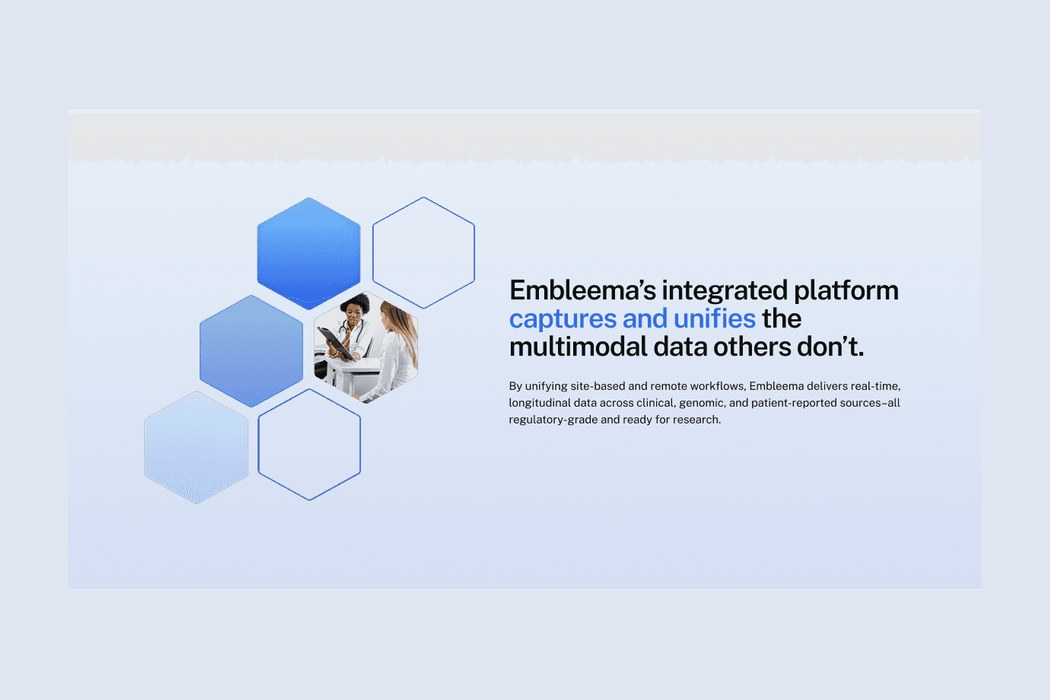
Embleema
Embleema is a New York- and France-based healthcare technology company that builds a unified real-world data and evidence platform for clinical research. It aggregates clinical, genomic, and patient-reported data from electronic medical records, wearables, biospecimens, and patient apps into regulatory-grade datasets, and uses no-code protocol tools plus dynamic consent to help pharmaceutical sponsors, research sites, and patient groups run non-interventional and Phase IV studies faster and at lower cost. Founded in 2017 by Robert Chu, the company started with a patient-driven health blockchain and its analytics stack has been used by the FDA for genomic regulatory review.
IgniteData
IgniteData is a healthtech company automating the transfer of clinical trial data between hospital electronic health records (EHRs) and sponsors' electronic data capture (EDC) systems. Its flagship platform, Archer, is a cloud-based, system-agnostic 'Virtual Research Assistant' that uses HL7 FHIR and SMART on FHIR APIs to move clinically validated data securely and automatically, cutting manual transcription, reducing source data verification, and helping treatments reach patients faster. Founded in the UK and now operating on both sides of the Atlantic, IgniteData works with pharmaceutical sponsors like AstraZeneca and research hospitals including UCLH, Cambridge University Hospitals, and Memorial Sloan Kettering Cancer Center.

MDClone
MDClone is a healthcare data company that lets clinicians, researchers, and analysts explore patient data without touching real patient records. Its ADAMS platform ingests structured and unstructured health-system data into a longitudinal database, then generates statistically faithful synthetic data that carries no risk to patient privacy. That combination turns months-long, IRB-heavy data requests into self-service exploration, letting front-line staff ask their own questions, run analyses, and share results across organizations. Founded in Israel in 2016 and used across the U.S., Canada, and 100% of the Israeli healthcare market, MDClone has raised roughly $112M to expand data-driven discovery in health systems, government, payers, and life sciences.

Revamp Medical
Revamp Medical is an Israeli medical device company building the Doraya catheter, a temporary, adjustable flow-reducing catheter for patients hospitalized with acute heart failure. Deployed in the infrarenal inferior vena cava for up to 12 hours, Doraya is designed to relieve venous congestion and improve response to diuretic therapy in patients who respond poorly to standard drugs - addressing the local mechanism of diuretic resistance rather than relying on systemic drugs or dialysis. Founded in 2016 and based in Netanya, the company won FDA Breakthrough Device designation in 2020 and closed a KCK Medtech-led Series A in 2023 to fund U.S. clinical trials.
Balboa Nephrology
Balboa Nephrology is one of the largest kidney-care medical groups in California, founded in San Diego in 1973 and grown from two physicians to roughly 60-plus board-certified nephrologists across San Diego, Orange County and Imperial Valley. It manages more than 28,000 kidney patients and 6,000 dialysis and transplant patients, runs its own clinical-research arm (Balboa Research, formerly the California Institute of Renal Research), a Vascular Access Center, and the Balboa Institute of Transplantation, and is a national leader in value-based kidney care through a joint venture with Evergreen Nephrology.

Mural Health
Mural Health is a Berwyn, Pennsylvania-based clinical research technology company whose Mural Link platform is billed as the industry's first participant management system. It combines patient payments, travel and rideshare booking, two-way messaging, and real-time experience feedback into one participant-first tool aimed at helping people enroll in and stay in clinical trials while easing the administrative burden on research sites and sponsors. Founded in 2022 by Sam Whitaker - the inventor of the original ClinCard payment technology at Greenphire - the company positions itself against legacy prepaid-card systems, notably by eliminating the inactivity fees that quietly drain participant balances.

Primal Health
Primal Health is a Minneapolis-based molecular biotechnology company reinventing oral care by rebalancing the microbiome instead of nuking it. Founded by Berkeley-trained microbiologist Dr. Emily Stein, the company uses its patented SMMRT (Selective Microbial Metabolism Regulation Technology) to put harmful mouth bacteria on a 'keto diet' - blocking their ability to feed on sugars while feeding the beneficial ones. Its two brands, Daily Dental Care for people and TEEF for Life for pets, deliver clinically studied lozenges and prebiotic powders that support gum health, fresher breath and a healthier oral ecosystem for humans and animals alike.

Wonder Sciences
Wonder Sciences is a Los Angeles-based mental health and research company reengineering psychiatric care through psychedelic medicine, clinical research, and AI. Best known for its consumer brand Wondermed - an at-home, low-dose ketamine-assisted telehealth protocol for anxiety and depression - the company is building an AI-native clinical operating system that fuses medication, therapy, and behavioral data into actionable insights. Founded by Ryan Magnussen in 2022, it raised roughly $4.6M-$5.6M in seed funding from investors including Aubrey Marcus and James Foster.

Medeloop
Medeloop is an AI-powered clinical research platform building an operating system for medical evidence - from grant discovery to real-world evidence generation to point-of-care intelligence. Founded by former surgeon Dr. Rene Caissie, the San Francisco company uses agentic AI to automate biostatistics, study monitoring, and protocol compliance for academic medical centers, health systems, and pharma.

Biorce
Biorce is a Barcelona-based healthtech company building AI-native infrastructure for clinical trials. Its core product, Aika, helps pharmaceutical companies, biotechs and CROs design regulator-ready trial protocols in roughly 90 seconds, drawing on a corpus of more than one million clinical studies and 260,000+ protocols. By cutting protocol design time by at least 50% and flagging regulatory and feasibility risks early, Biorce aims to compress the years and billions of dollars it takes to bring a drug to market - so treatments reach patients sooner. In February 2026 it closed a USD $52.5M Series A led by DST Global, the largest Series A to date in the Iberian healthtech and AI ecosystem.

ClinChoice
ClinChoice is a mid-size, global, full-service contract research organization (CRO) that helps pharmaceutical, biotech, medical device, and consumer health companies run clinical trials and bring drugs and devices to market. Founded in 1995 and headquartered in Horsham, Pennsylvania, the firm employs roughly 4,000 people across the Americas, Europe, and Asia-Pacific, offering clinical development, biometrics, safety/pharmacovigilance, regulatory affairs, post-marketing real-world evidence, and technology services. After rebranding from Fountain Medical Development (FMD K&L) in 2020 and raising a $150M Series E in 2022, ClinChoice has grown through acquisitions to serve six of the top ten pharma companies while focusing on emerging and mid-size biotech innovators.

Curebase
Curebase is a San Francisco-based eClinical software company building an AI-powered platform that runs clinical trials around patients' lives instead of inside hospital walls. Its single system spans study startup to database lock - combining electronic data capture (EDC), eConsent, ePRO/eCOA, patient recruitment, and a virtual research site model - so sponsors can launch decentralized and hybrid trials faster, capture cleaner data, and reach more diverse participant populations.