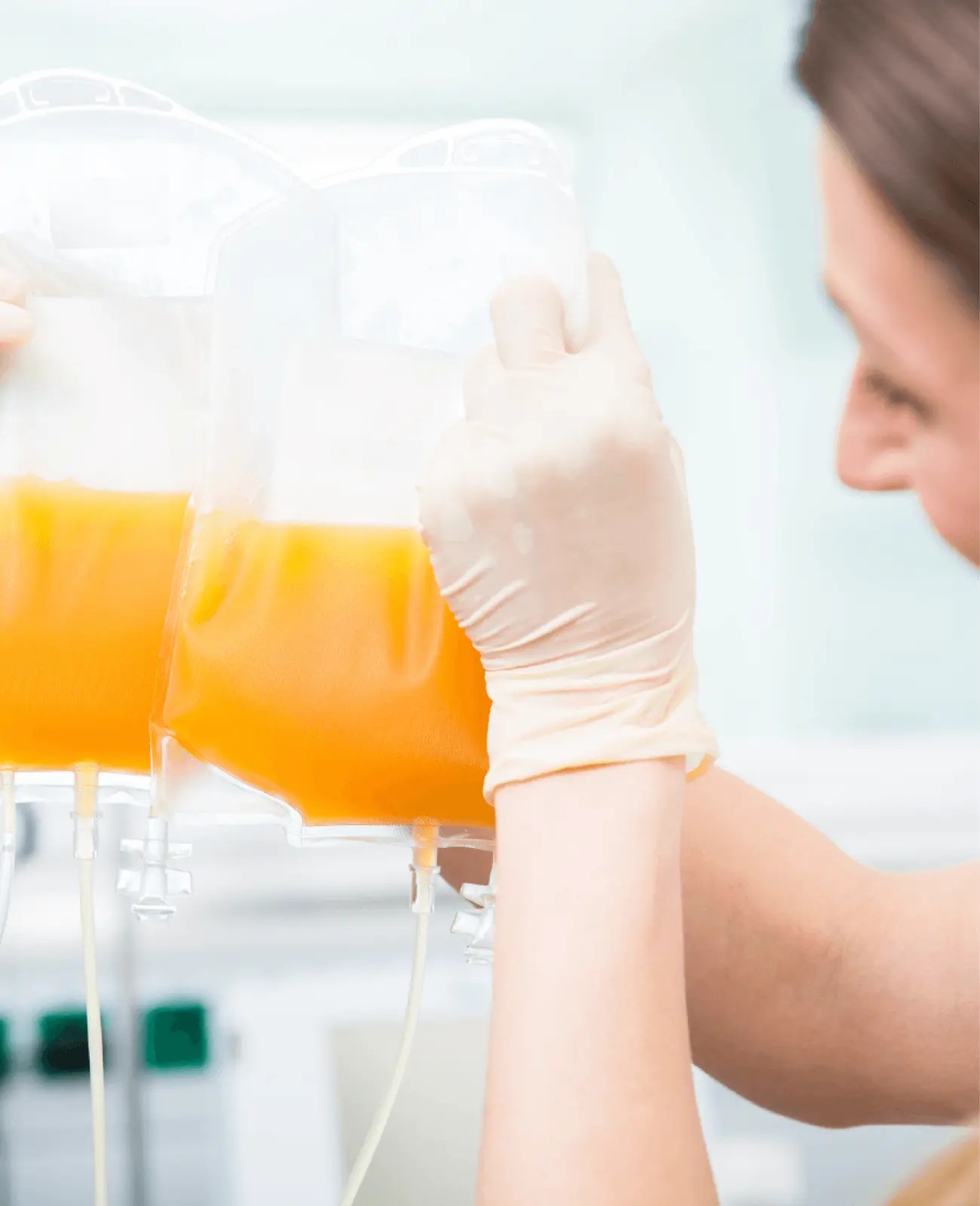
The bag beside the reclining patient is the visual that sells the procedure: cloudy, amber plasma leaving the body while red blood cells make the return trip. To a hospital apheresis team, this is familiar medicine. To the longevity crowd, it looks like a bag of time itself - debris removed, machinery refreshed, another lap around the track. Circulate Health did not invent therapeutic plasma exchange. Its wager was that the procedure could be standardized, staffed and distributed outside the hospital, then aimed at a much more speculative target: aging.
That wager produced a peculiar Seattle startup. Circulate supplies partner clinics with specialist apheresis nurses, FDA-cleared Spectra Optia equipment, clinical protocols, quality assurance, consumables, supply management, marketing tools and a platform called Circulate360. The clinic keeps the relationship with the patient. Circulate brings the difficult operating machinery. It is less a biotech company with a magic molecule than a traveling apheresis department in a box.
The procedure is old. The packaging is new.
Therapeutic plasma exchange, or TPE, has been used for decades against specific autoimmune, neurological and blood disorders. Blood is drawn through intravenous lines and separated. The liquid plasma - carrying antibodies, proteins and other molecules - is discarded. The patient's blood cells return with replacement fluid, commonly saline and albumin. In some Circulate protocols, intravenous immunoglobulin, or IVIG, restores antibodies removed during the exchange.
The Spectra Optia machine is FDA-cleared to perform therapeutic plasma exchange. That does not mean the FDA has approved plasma exchange as an anti-aging treatment. Circulate CEO and co-founder Brad Younggren called the longevity use off-label. The difference fits in one sentence but carries the weight of the story: the machinery is established; the promised outcome is not.
For a longevity clinic, buying a machine is the easy part. Recruiting clinicians who can run it safely, managing albumin and disposable circuits, screening patients, documenting care and maintaining quality systems are harder. Circulate made those frictions its product. Its direct customers are clinics; its end users are medically screened, generally affluent adults willing to pay privately for an intervention that insurance does not cover for longevity.
In 2025, sessions were reported at roughly $8,000 to $10,000. The company's research protocol used six treatments, so a simple same-price extrapolation would land between $48,000 and $60,000 before testing or extras. Actual clinic packages vary. This is not mass-market preventive medicine. It is a high-ticket service whose early buyers help finance the learning loop.
A biomarker moved. A life span did not.
Circulate's scientific foundation came through co-founder Eric Verdin, the chief executive of the Buck Institute for Research on Aging. Working with Buck researchers, the company sponsored a randomized, single-blind, placebo-controlled study of 42 generally healthy adults over 50. Participants received six sessions on different schedules: monthly TPE, twice-monthly TPE, or twice-monthly TPE plus IVIG. A control group received a sham procedure.
Published in Aging Cell in May 2025, the study found that the TPE-plus-IVIG group showed the largest response, with an average 2.6-year reduction across biological-age measures. Multiple epigenetic clocks shifted, and inflammatory proteins changed. Participants with poorer baseline metabolic and liver markers appeared to respond more strongly.
But biological clocks are proxies, not birthdays refunded by customer service. The paper reported no clinically meaningful functional, cognitive or symptomatic changes observed or assessed during the short study. Independent experts noted the small sample, brief follow-up and uncertainty around how long the biomarker effects last. One separate 2025 study of a different plasmapheresis protocol found no conclusive rejuvenation signal, a useful reminder that schedule, replacement fluid, population and measurement can change the answer.
The FDA-cleared machine is not the same thing as an FDA-approved anti-aging outcome.The distinction Circulate's customers must understand
That ambiguity did not repel Khosla Ventures. It shaped the investment thesis. The firm led a $12 million seed round in July 2025, joined by Seaside Ventures and CSC Ventures. Khosla partner Alex Morgan argued that Circulate could collect suggestive data from paying customers without consuming the capital a conventional drug program requires. In plain English: revenue could arrive before certainty, and the clinic network could double as research infrastructure.
What failed first was made of plastic
Circulate's next paper asked a more concrete question: can plasma exchange remove circulating microplastics? Researchers measured blood immediately before and after 174 procedures in 114 patients. Published in the Journal of Clinical Apheresis in May 2026, the study found significant reductions among people who started with moderate or high particle counts. It was the first purposeful demonstration that TPE could reduce microplastics circulating in human blood.
At the lowest starting levels, average counts rose after treatment. The suspected culprit was particle leaching from plastic tubing and fluid systems.
Removal and apparent addition competed with each other, making the net effect small or difficult to interpret.
Patients with higher starting burdens showed the clearest and statistically significant fall in circulating particles.
Then came the finding no marketing department would invent. At very low starting levels, particle counts sometimes increased. The researchers suspected that plastic tubing and infusion equipment leached microplastics into circulation, obscuring the removal effect. The treatment for particles had a particle problem.
That is what failed first: not the centrifuge, but the disposable pathway. It is also the paper's most useful result. It defines where the method may work, where it may not and what device makers could improve. The study did not show that lowering particles in one blood draw improves health, reduces total-body burden or changes disease risk. It could not measure nanoplastics below the assay threshold. For patients who already start low, the procedure may offer no net removal at all.
The acquisition closes a loop
By June 2026, Circulate had reached roughly 35 clinics. On August 12, Viome Life Sciences acquired the company for an undisclosed price. The pairing has an almost diagrammatic logic. Viome sells molecular diagnostics and personalized nutrition. Circulate supplies a physician-guided intervention and a network capable of delivering it. Test, treat, measure again.
Viome said the combined platform would reach a national network of more than 200 clinics. That figure describes the broader combined network, not Circulate sites alone. The purchase gives Viome a physical-care layer and gives Circulate a diagnostic front door. It also reveals what the buyer likely valued: protocols, trained clinical delivery, partner relationships and repeatable data collection, not merely access to a machine clinics can buy elsewhere.
| Option | What it sells | Tradeoff |
|---|---|---|
| Hospital apheresis | Established treatment for recognized medical indications | Not designed as a consumer longevity experience |
| Independent longevity clinic | Private-pay TPE and other preventive services | Must build its own staffing, protocols and quality stack |
| Circulate | A turnkey operating layer inside a partner clinic | Longevity claims remain ahead of long-term outcome evidence |
| Lifestyle and biomarker programs | Lower-risk, less invasive prevention | Do not offer rapid physical removal of plasma-borne factors |
The part worth stealing
Founders can copy Circulate's structure without copying its medical claims. Look for a proven capability trapped inside an institution, surrounded by scarce labor, procurement headaches and inconsistent execution. Then make the missing operating layer portable.
The clinic-in-a-box playbook
- Start with existing infrastructure. Circulate used cleared equipment and a familiar procedure instead of inventing hardware from scratch.
- Productize the bottleneck. Nurses, protocols, supplies, quality assurance and scheduling are the hard bundle.
- Sell through trusted distribution. Partner clinics already own the patient relationship and the room.
- Measure every repeat. A distributed service network can become an evidence engine if consent, methods and reporting are rigorous.
- Publish the awkward edge case. The tubing confound makes the microplastics research more useful, not less.
The model breaks under clear conditions. It needs dense demand from people able to pay, enough qualified apheresis staff, clinics with appropriate medical oversight and a procedure repeatable across sites. It becomes brittle if adverse events rise, regulators narrow off-label promotion, partner economics fail or long-term trials show that biomarker changes do not translate into patient benefit. It also does not fit patients whose physicians find contraindications or whose goals can be met with less invasive care.
Circulate sits in an unusual seam between medical devices, outsourced clinical operations, longevity biotech and luxury health care. Calling it a blood-cleaning company captures the spectacle. Calling it a clinical infrastructure company explains the acquisition. The plasma bag got the photograph. The system around it got bought.