Here is a fact that Generation Lab would like you to sit with: roughly 70% of the people who take its test turn out to be biologically older than their birth certificate says. This is either alarming or reassuring depending on your temperament, and Generation Lab is betting on both. Alarming enough that you buy the test. Reassuring enough that you come back to see if the number went down. That loop - measure, worry, intervene, measure again - is not a side effect of the business. It is the business.
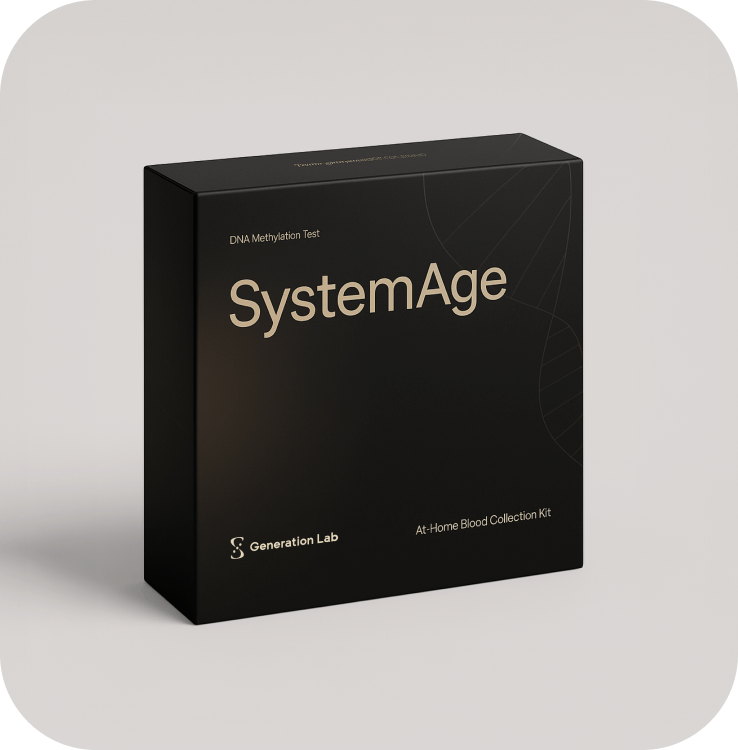
The company, founded in 2023 and based in San Francisco, sells a diagnostic called SystemAge. The pitch is deceptively simple and quietly contrarian. Most of the aging-clock industry predicts a number: feed a machine-learning model your DNA methylation data, and it estimates how old you probably are. Generation Lab says it does something different. Rather than predicting an age, SystemAge claims to measure the actual physiological signature of aging - the slow breakdown of your cells' epigenetic regulatory control, which the company calls "biological noise." It reads that noise across a panel of DNA methylation biomarkers and returns not one age but many: a separate biological age for roughly 19 organ and body systems.
The distinction between "predict" and "measure" sounds like marketing, and maybe some of it is. But it is also the intellectual spine of the company, and it is worth taking seriously. A prediction of your age is, tautologically, most accurate when it agrees with your actual age - which makes it a strange tool for someone trying to change their aging. A measurement of a physiological process, by contrast, can move independently of the calendar. If your liver's biological age drops while your birthdays keep arriving on schedule, that's a signal, not an error. Generation Lab has organized its entire product around the idea that the calendar is the boring part.
01 / THE SCIENCEAging, but with a receipt
SystemAge starts with a sample - the company has described both blood-based and swab-based collection - and analyzes hundreds of DNA methylation sites (the company cites 460-plus selected biomarkers). Methylation is chemistry stuck to your DNA that helps decide which genes are switched on. As you age, that switching gets noisier and less controlled, and it's that loss of control the test is designed to quantify. The output is a report card: your cardiovascular system might read 41, your immune system 47, your reproductive system something else entirely, each broken out so a clinician can point at the worst offender.
The scientific credibility here does not come from nowhere. Generation Lab's co-founder and Chief Scientific Officer is Dr. Irina Conboy, a UC Berkeley bioengineering professor whose lab has spent roughly two decades studying why old tissue stops regenerating - work influential enough that she gets called, with the usual press-release enthusiasm, the "mother of longevity." The company also points to an advisory bench that has included heavyweight names in the field. Twenty years of academic aging research is not a guarantee that a consumer test works, but it is a genuinely unusual thing for a two-year-old startup to be able to stand on.
02 / THE PEOPLEA cofounding team that spans three generations
The most charming structural fact about Generation Lab is that its three founders are described as spanning three generations, which is a nice thing to be able to say about a longevity company. Alina Rui Su, the CEO, is a Forbes 30 Under 30 honoree who studied at Harvard Medical School and Berkeley and previously founded another startup. Michael Suswal, the COO, was a co-founder of Standard AI, a computer-vision company that reached a reported $1.5 billion valuation - which is to say he has already done the operational grind of scaling a hard-tech startup. And Conboy supplies the science.
This is a fairly deliberate assembly. You have a young, fundable CEO who can raise money and tell the story; an operator who has built and shipped before; and a decorated academic who lends the whole thing the credibility that consumer-health products usually lack. It is the kind of team a venture firm looks at and thinks: someone here can sell it, someone can build it, and someone can defend the science when a journalist asks a hard question.
Alina Rui Su
Forbes 30 Under 30; studied at Harvard Medical School and UC Berkeley; repeat founder now leading Generation Lab's commercial push.
Dr. Irina Conboy
UC Berkeley bioengineering professor with ~20 years of aging and tissue-regeneration research behind the SystemAge science.
Michael Suswal
Previously co-founded Standard AI (reported $1.5B valuation); brings the operational muscle of scaling hard tech.
03 / THE MONEYAccel's first longevity bet
In October 2025, Generation Lab announced an $11 million seed round led by Accel - notable partly because it was reported as Accel's first investment in longevity. When a classic technology venture firm breaks its own pattern to write a check in aging biotech, that's worth a raised eyebrow. Either the firm sees a durable market forming, or it sees a team it doesn't want to miss, or both. The round brought Generation Lab's total funding to roughly $15 million and drew a genuinely eclectic cap table: Samsung Next, plus funds tied to Steve Aoki, Simu Liu, and Giannis Antetokounmpo.
That celebrity roster is easy to roll your eyes at, and it's also strategically legible. Longevity is a consumer category as much as a clinical one - people buy these tests the way they buy gym memberships and supplements, out of pocket and out of aspiration. A cap table with cultural reach is, in that framing, a distribution asset, not just a vanity list.
04 / THE MOATDistribution is the product
The number Generation Lab most wants you to notice is not the funding. It's the traction. In under a year, the company says it signed 275-plus clinic partners across roughly 18 countries, and accumulated 300 million-plus human-aging data points. If those figures hold up, they matter more than the technology, because they compound. Every clinic that adopts SystemAge feeds back more data; more data sharpens the reference models; sharper models make the test more useful; a more useful test recruits more clinics. That flywheel - not any single methylation marker - is the thing a competitor would struggle to copy.
It also frames the competition cleanly. Generation Lab is not really racing other labs on chemistry; the epigenetic-clock field already has established players like TruDiagnostic and Elysium. It's racing to be the layer clinics standardize on - the biological-age dashboard that a longevity doctor opens by default. In consumer health, the winner is frequently not the most accurate test but the most adopted one.
05 / THE CATCHWhat to keep an eye on
A skeptic would ask the obvious questions, and a fair profile should ask them too. "Biological noise" is a compelling frame, but the clinical evidence that lowering a SystemAge score reliably extends healthspan is exactly the kind of claim that takes years and independent replication to establish. The company cites striking figures - biological-age reversals in the range of several years in some interventions - and those deserve the ordinary caution owed to any young company reporting its own results. The retest-every-few-months model is great for engagement; it also means the product's value depends on those interim numbers being both accurate and meaningful.
None of that makes Generation Lab less interesting. It makes it a real bet. The company has assembled the three things a longevity startup usually can't get all at once - credible science, an operator who has scaled before, and fast commercial distribution - and pointed them at a simple, sellable proposition: your age is a number you can measure, and maybe move. Whether it moves the way the marketing implies is the open question. Whether people will pay to find out is, at 275 clinics and counting, apparently already answered.
06 / THE MISSION"Creating the Ageless Generation"
The company states its purpose in a phrase it clearly enjoys: "Creating the Ageless Generation." Underneath the slogan is a stated aim to make aging reversible and disease preventable, and - the part that's easy to skip past but harder to deliver - to democratize longevity technology across socioeconomic levels. That last ambition sits in tension with the reality of a premium, clinic-delivered, out-of-pocket test, and Generation Lab knows it. The bet is that the price of measurement falls the way the price of genome sequencing did, and that today's boutique becomes tomorrow's routine bloodwork line item.
Culturally, the company describes itself as science-first and evidence-based, human-centered, and focused on long-term health impact over short-term gains - the sort of values statement every health startup writes, made slightly more credible here by the fact that one of the founders has spent twenty years actually doing the science. What Generation Lab is really selling, in the end, is not a supplement or a promise. It is a feedback loop: a way to turn the abstract dread of aging into a concrete, repeatable number, hand it to a clinician, and check again in a few months to see whether anything you did mattered. That is a modest, almost clinical proposition. It may also be why the clinics keep signing up.