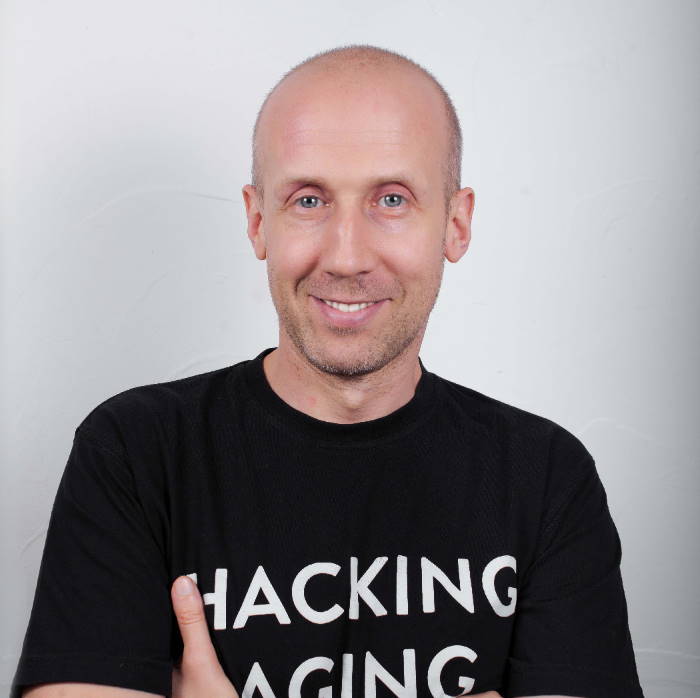
Max Kholin, Co-founder of Gero
Max Kholin - Co-founder & COO, Gero
Longevity Biotech / Singapore + Palo Alto

Max
Kholin

Co-founder & COO · Gero.ai

Before the word "longevity" became a Silicon Valley lifestyle brand, Kholin was already building the scaffolding: a biotech company applying the mathematics of non-equilibrium thermodynamics to figure out why bodies stop being resilient - and what to do about it.

100M+
Medical records analyzed
$250M
Chugai milestone potential
2015
Gero founded
Founder Biotech Gerophysics Longevity Drug Discovery

The lawyer who decided aging was a physics problem

Most people who want to stop aging start with biology. Maxim Kholin started with contracts. His MA in Financial Management and Law from Moscow Financial University in 2001 led to over a decade navigating international intellectual property law and corporate transactions - the kind of work that makes you intimately familiar with what big institutions want, how deals get done, and where the leverage lives.

That background, unglamorous from the outside, turned out to be exactly right for what came next. When Kholin co-founded Quantum Pharmaceuticals - a structure-based drug design company - he wasn't the scientist in the room. He was the person who knew how to translate science into deals with top-20 global pharma companies and academic licensing partners. The science was someone else's. Making it commercially real was his.

In 2015, he met Peter Fedichev, a theoretical physicist with a PhD from the University of Amsterdam who'd spent years studying ultracold quantum systems. Their collaboration became Gero - and their central idea was strange enough to make most biology labs uncomfortable: aging, they argued, is fundamentally a problem in non-equilibrium thermodynamics. Not a disease. Not a genetic program. A physics problem. Bodies lose resilience the way physical systems approach critical points - and that loss of resilience is measurable, predictable, and potentially interruptable.

"Aging takes our loved ones, brings suffering and death. If there were the only chance to stop it, we should use this chance."

- Max Kholin, Co-founder, Gero

That framing - later formalized as "Gerophysics" - wasn't just academic positioning. It changed what data they looked for, what models they built, and what kinds of interventions might work. By training their AI platform on over 100 million longitudinal medical records, Gero could watch how real human bodies age in real time, not in petri dishes. The result was one of the deepest computational views into human aging that exists anywhere.

Kholin's job in all of this was never to be the physicist. It was to turn the physics into a company. Corporate affairs, legal strategy, investor relations, strategic partnerships - the work that keeps a science-first startup alive long enough to be proven right. When Gero closed a $6 million Series A extension in October 2023, with participation from VitaDAO and EPAM founder Leonid Lozner, Kholin had built something fundable from an idea that sounded, to many, like science fiction.

The Pfizer partnership for fibrotic disease target identification arrived in early 2023. The Chugai deal - a joint research and license agreement for novel antibody therapeutics targeting age-related diseases, with up to $250 million in potential milestone payments - followed in July 2025. Two of the largest names in global pharma, betting on a physics-informed AI platform built on a theory most biologists found eccentric a decade ago.

Gero operates out of Singapore and Palo Alto simultaneously, with a team spread across five continents. In the lab, the results are accumulating: mouse studies showing reductions in frailty indices, improvements in senescence markers, increased synaptic plasticity, and improved survival - effects that persisted two months after treatment stopped. In 2024, Nature published a dedicated Gerophysics collection co-edited by Fedichev and longevity expert Brian K. Kennedy, cementing the field as a standalone scientific discipline. What started as a contrarian idea now has its own section in one of the world's most prestigious scientific journals.

Kholin's contribution to all of this is easy to underestimate. He doesn't run the physics. He doesn't publish the papers. What he does - building the commercial infrastructure around an idea that needs both scientific credibility and deal-making discipline to reach patients - is what separates a research project from a company. In an industry where visionary scientists routinely fail at the business side, Kholin represents the rare complementary half that makes the whole thing work.
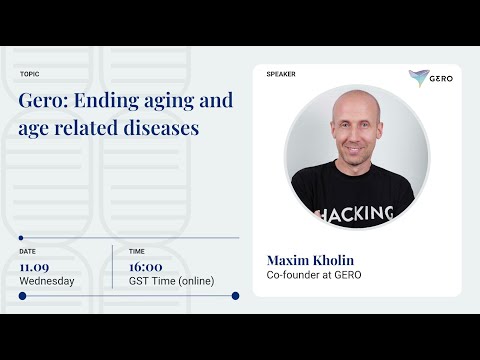
What Gero actually built

Physics-powered longevity biotech

Gero's core platform - what they call Gerophysics - applies tools from critical dynamics and statistical physics to the biology of aging. The central claim: aging is a loss of systemic resilience, best understood not through genetics alone, but through how far a biological system drifts from dynamic equilibrium and how slowly it self-corrects.

That framing, heterodox when Gero started, has proven productive. Their AI models are trained on over 100 million longitudinal medical records - one of the largest real-world aging datasets assembled anywhere. The platform separates reversible disease processes from irreversible biological decline, finds causal pathways rather than correlations, and identifies therapeutic targets with multi-drug potential.

Pre-clinical results in mice demonstrated reductions in frailty indices, improvements in senescence markers, increased synaptic plasticity, and improved survival curves - with effects persisting two months post-treatment. Nature's 2024-2025 Gerophysics collection, co-edited by Gero's co-founder and longevity expert Brian K. Kennedy, marked the field's formal scientific recognition.

Partnerships that pay the thesis

The clearest validation of Gero's platform isn't academic - it's commercial. Pfizer partnered with Gero in early 2023 to identify therapeutic targets for fibrotic diseases, applying the computational platform to large-scale health data.

Then in July 2025, Chugai Pharmaceutical - backed by Roche - signed a joint research and license agreement combining Gero's AI target identification with Chugai's antibody engineering. The potential milestone payments reach $250 million, with royalties that could run into billions if products reach market.

Two of pharma's largest players, in two separate years, writing checks against a physics-informed computational aging platform. That is not a coincidence. It is the scientific community voting with its R&D budget.

$250M
Chugai milestones
140
Employees
5
Continents
100M+
Medical records

Deals that moved the needle

Pfizer
Research Collaboration - January 2023

Gero applied its computational platform to large-scale health data to identify potential therapeutic targets for fibrotic diseases. One of the first major pharma validations of the Gerophysics approach.

Pharma Top 5
Chugai Pharmaceutical
Joint Research & License Agreement - July 2025

Combines Gero's AI platform for high-value target identification with Chugai's antibody engineering technologies. Targets novel antibody therapeutics for age-related diseases.

Up to $250M in milestones
VitaDAO + Leonid Lozner
Series A Investors - October 2023

The $6M Series A extension brought in VitaDAO (the decentralized longevity research collective) and EPAM Systems founder Leonid Lozner alongside lead investor Melnichek Investments.

$6M Series A Extension
Nature Gerophysics Collection
Scientific Recognition - 2024-2025

Nature published a dedicated Gerophysics collection co-edited by Gero's Peter Fedichev and longevity expert Brian K. Kennedy - cementing the field Gero helped create as a standalone scientific discipline.

Nature Journal Feature

From contract law to cracking aging

2001
Graduated Moscow Financial University with MA in Financial Management and Law
2001-2010
Legal advisor across international and domestic business, specializing in contract law, IP, and corporate transactions
~2010
Co-founded Quantum Pharmaceuticals - structure-based drug design; licensed technology to top-20 global pharma companies and academic institutions
2015
Co-founded Gero with physicist Peter Fedichev - the idea: aging is a physics problem of resilience decay
2018
Gero formally incorporated; "Hacking Aging" paper published in Frontiers in Genetics
2023-01
Research collaboration signed with Pfizer for fibrotic disease target identification
2023-10
Led $6M Series A extension with Melnichek Investments, VitaDAO, Leonid Lozner
2024
Nature published dedicated Gerophysics collection - the field Gero helped build gets its own section in the world's leading science journal
2025-01
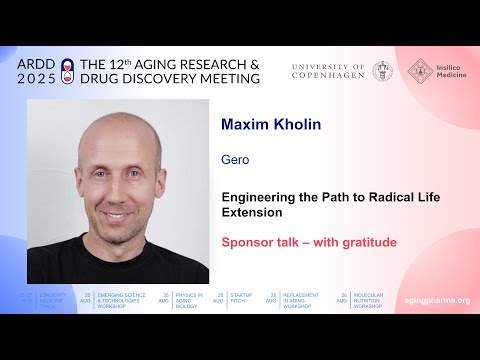
Presented "Engineering the Path to Radical Life Extension" at ARDD 2025 (12th Aging Research & Drug Discovery meeting)
2025-07
Gero signed joint research and license agreement with Chugai Pharmaceutical for novel antibody therapeutics; up to $250M in milestones

What Kholin has actually done

🆕

Co-founded the scientific discipline of Gerophysics - now recognized by Nature as a standalone field. Invented in 2015, now has its own journal collection.

📊

Built Gero's AI platform on 100M+ longitudinal medical records - one of the world's most comprehensive datasets on how human bodies age in real time.

🧬

Secured Pfizer research collaboration for fibrotic disease target identification in early 2023, marking major pharma's first engagement with Gerophysics.

🌟

Negotiated Chugai Pharmaceutical joint research and license agreement with up to $250M in potential milestones - one of longevity biotech's largest platform deals.

💰

Led $6M Series A extension in Oct 2023, bringing in VitaDAO and EPAM founder Leonid Lozner alongside lead investor Melnichek Investments.

📚

Co-authored "Hacking Aging" published in Frontiers in Genetics - the peer-reviewed scientific foundation for Gero's platform, cited widely in longevity research.

🌎

Built a 140-person team operating across 5 continents with dual headquarters in Singapore and Palo Alto - rare global footprint for an early-stage biotech.

At Quantum Pharmaceuticals, licensed structure-based drug design technology to top-20 global pharma companies before pivoting to found Gero.

Kholin in conversation

Five things worth knowing

01
When Kholin co-founded Gero in 2015, "Gerophysics" didn't exist as a scientific category. Nature now has an entire collection dedicated to it.
02
Gero's AI platform has processed more than 100 million longitudinal medical records - making it one of the most data-rich aging platforms anywhere in the world.
03
Before longevity biotech, Kholin spent over a decade as a contract and IP lawyer - the background that makes him unusually effective at pharma partnership negotiations.
04
The Twitter handle @hacking_aging doubles as the title of Gero's landmark 2018 Frontiers in Genetics paper - the brand and the science were always the same thing.
05
Gero operates simultaneously from Singapore and Palo Alto with a team on five continents - an unusual global structure for a biotech at this stage of development.