At Virtek Vision International, the trouble with expense reports was partly a matter of geography. The laser technology business needed to recover Canadian Harmonized Sales Tax. Its accounting setup made that recovery laborious. Spreadsheets multiplied. Old versions lingered. Paper receipts accumulated. One replacement tool introduced another indignity: employees were expected to understand general-ledger codes. A system meant to simplify administration had handed people a small accounting examination.
THE STORY IN THREE LINES
- SutiSoft sells connected cloud tools for the work between departments.
- Buyers can start with one application and add more over time.
- Its telling customer stories turn on specific, awkward workflow details.
The spreadsheet that would not retire
According to SutiSoft’s published case study, Virtek explored nearly two dozen expense-report products before choosing SutiExpense. The deciding feature was flexibility: SutiSoft configured the application to calculate Canadian HST and handle two distinct ledger codes. The complexity stayed in the system. Employees could get on with submitting their expenses.
Virtek reported preparation time falling from two or three hours to 10–15 minutes. That is a result from one vendor-published customer story, rather than a promise for every installation. Still, the mechanism is instructive. The earlier approach had failed at a specific junction: getting local tax requirements, accounting classifications and employee behavior to agree.
ONE CUSTOMER’S CLOCK / MINUTES PER REPORT
For a buyer, this is a useful way to think about business software. The memorable feature may be the obscure rule that finally stops requiring a workaround. Virtek’s experience suggests a practical opening question: which part of the process still depends on somebody remembering what the software cannot do?
A suite with a small front door
SutiSoft develops cloud applications for finance, human resources, agreements, procurement and customer management. Founder and CEO ND Reddy previously founded Alliance Semiconductor, which went public in 1993. His current company’s leadership includes CTO Ven Reddy, responsible for architecture and integrations, and operations executive Dave Roe, whose remit includes customization, training and support.
That combination helps explain the emphasis on fitting software around existing operations. On its about page, Reddy describes the starting point plainly: “We started off building stand-alone solutions”. The business now presents those applications as a connected enterprise suite. Its customers can still enter through a single task.
SutiExpense captures receipts and routes claims for approval. SutiAP handles invoices, coding and purchase-order matching. SutiHR connects employee records with recruiting, time, leave and performance processes. SutiSign handles electronic signing and document workflows. CRM, supplier management, contracts, inventory and analytics extend the range. The organizing idea is that records should travel between these jobs without being typed again.
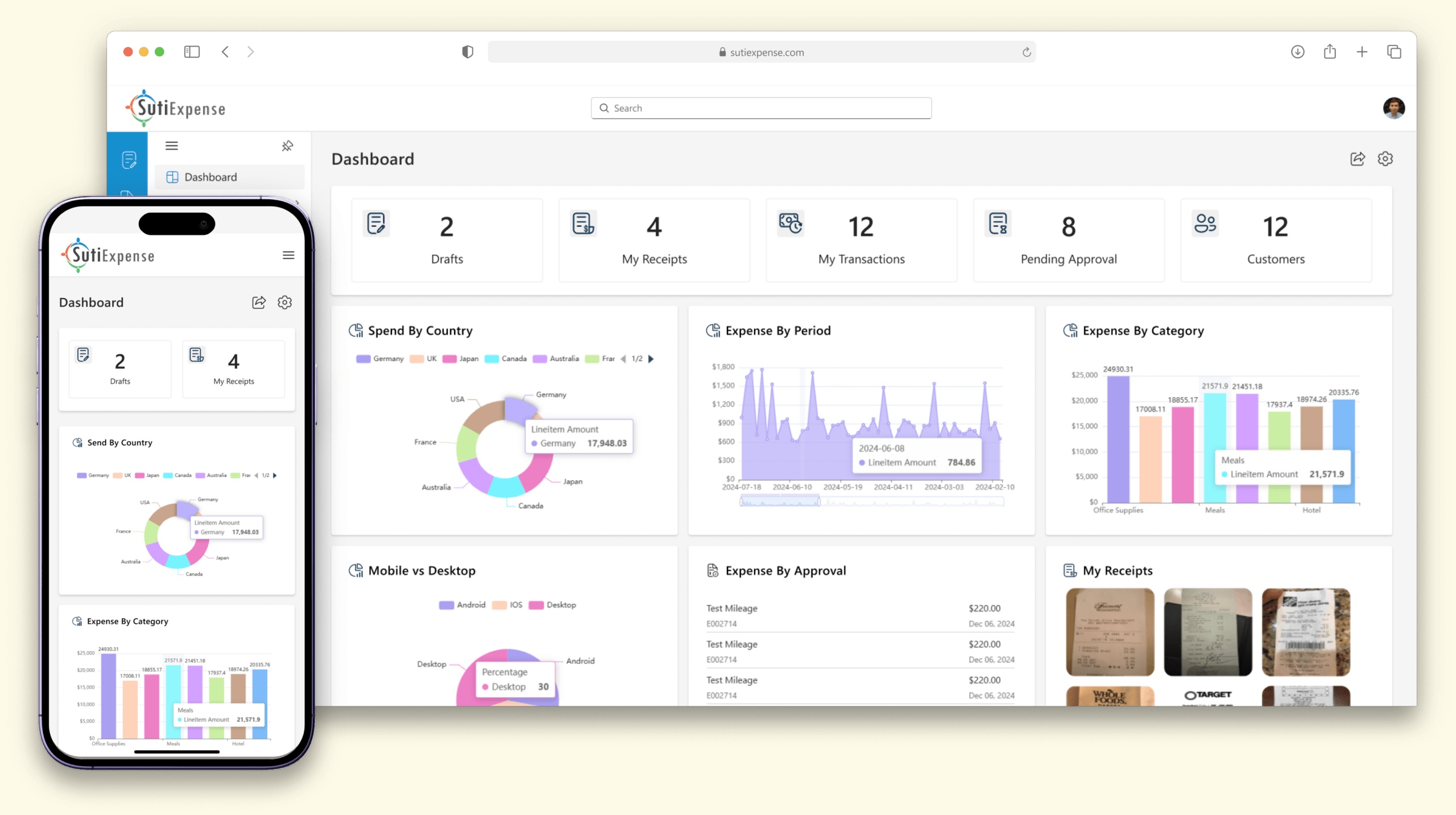
The company calls its connected system SutiERP and says it shares a login, data model and analytics. It also offers connections to existing accounting and ERP tools. This gives a buyer a gradual purchasing path: address expenses first, preserve the accounting system, then consider adjacent work once the first application proves useful.
The submitter is the unit
That incremental approach has a price attached. As checked on October 25, 2026, SutiExpense’s dedicated pricing page lists Professional at $6 per active submitter per month. An active submitter is someone who submits at least one expense report during that billing month. Approvers, finance users and administrators who only review are free.
Thirty active submitters for one month on the listed Professional rate. An illustration, not a customer invoice or a full-suite quote.
The page says setup, training and integrations are included. Premium and Enterprise require quotes. SutiHR separately advertises Core starting at $4 per employee per month. These are different units for different jobs, so a company comparing suites needs to count actual usage and required modules before comparing totals.
Buyers span sectors. SutiSoft’s customer directory includes Cipla, Yamaha Canada Music, Rinnai and ViewSonic. More useful than the logo list is World Wide Logistics’ HR story. As headcount grew, attendance, leave accruals and performance administration became harder to coordinate. Its SutiHR case describes consolidating records and giving employees self-service access.
Another HR testimonial, reproduced on SutiSoft’s site, explains the buying rhythm: “We have launched each module separately.” That observation captures the appeal for teams with limited implementation capacity. They can learn one workflow before introducing another. SutiSoft’s public values emphasize customer focus, security and reliability; these customer accounts show where those ambitions meet daily work.
“We have launched each module separately.”
Sharon G · HR director testimonial on SutiHR
Teach the system the exception
There is an organizational bargain here. Buying another module from the same supplier can reduce the number of interfaces a team must maintain, while placing more of its operations with that supplier. The sensible measure is the work removed: fewer duplicate records, fewer manual reconciliations and a clearer route for the next person handling the transaction.
The competitive field changes with each application. Expense buyers might also evaluate SAP Concur or Expensify; HR teams might consider BambooHR or Rippling; signature buyers might compare DocuSign or Adobe Acrobat Sign. SutiSoft’s pitch centers on combining configurable applications with connections to systems the customer already runs.
Its recent announcements develop that theme. A September 2025 expense release described Dynamics 365 Finance and Sage Intacct connectivity, alongside approval turnaround-time reporting. A July 2025 SutiSign announcement added identity-verification and audit controls. The present website also promotes SAM, the SutiSoft AI Manager, as coordinating agents across applications.
The practical test remains wonderfully unglamorous. Bring a real receipt, an unusual tax treatment and a rejected approval to the demo. Follow them into the accounting export. Ask who can see the record, who can change it and what happens when an approver is away. A connected suite earns its keep at those handoffs.
That approach demands preparation. Automating an unclear policy can move confusion faster. A narrow requirement may favor a specialist; an existing system with unusual interfaces may need integration work. The lesson worth copying from Virtek is to test the exception before buying the promise. Its tax problem was specific enough to expose a poor fit, and specific enough for SutiSoft to solve.