At 16, Susan Morris had a job that required calling adults about their bounced checks. Before she could oversee a supermarket company, she had to persuade someone to come back to the store and settle an account. It is a fairly bracing introduction to customer relations. Most teenagers are still negotiating the use of the family car.
The work was at an Albertsons customer-service desk in the Denver area. Years later, she remembered learning to be considerate, tactful and, when necessary, firm. That small assignment offers a useful way into her career: a grocery store puts people, money and awkward conversations within a few feet of one another. There is very little room for theory to hide.
On May 1, 2025, Morris became chief executive of Albertsons Companies and joined its board. Her predecessor, Vivek Sankaran, retired after a transition period. The promotion followed nearly four decades in the business, across operations, merchandising and regional leadership. It also arrived after the collapse of the proposed Kroger merger, when the company had to make its future work on its own.
The comfortable version of this story would stop at the promotion. Morris started in a store and reached the top. Applause, photograph, next item. Her actual career is more interesting because it includes a deliberate step backward, considerable practice in local decision-making and a present-day test that remains unresolved.
“I liked the pace of the business”
Susan Morris, 2020
The promotion that looked like a demotion
By 2010, Morris was a senior vice president of sales and merchandising at Supervalu. She wanted to join Albertsons LLC. The available opening was grocery sales manager in the Southwest division, several rungs below the job she already held. She took it.
In explaining that decision, Morris said the company’s culture and philosophy fitted her own beliefs and goals. She asked for the opportunity and then set about proving she could do more. The move makes a useful interruption in the usual corporate biography, where every sentence seems obliged to contain a larger title than the one before it.
Her subsequent assignments brought her back through merchandising into divisional leadership. In March 2013, she became Intermountain division president. Two years later, the newly combined Albertsons-Safeway organization put her in charge of its Denver division, a five-state territory with 141 stores and eight districts.
There was plenty of technical knowledge behind those appointments. Her earlier work included store director, corporate grocery sales director, vice president of bakery and operations, and vice president of customer satisfaction. A bakery, a pricing desk and a regional office ask different questions. Morris had worked in enough corners of the business to recognize how a decision in one could become a problem in another.
- 2010Joins Albertsons LLC in a smaller role
- 2013Intermountain division president
- 2015Denver division president
- 2018Chief operations officer
- 2025Chief executive officer
Who gets to decide in aisle seven?
In Denver, Morris helped move the division to a decentralized operating model. She assembled a team responsible for procurement, pricing, advertising and other functions. She also introduced a short employee update called 5 Minute Friday. The name had the merit of making a promise an employee could reasonably expect an executive to keep.
One choice was especially concrete: store directors could select the nonprofit partners receiving local grants. Nearly $500,000 was allocated. Rather than asking every neighborhood to fit a single charitable map, the approach let people running the stores identify organizations around them. It is a modest example of what local authority actually looks like when it leaves a presentation and acquires a budget.
Her territory continued to expand. In April 2016 she became executive vice president for the East region; in 2017 she took the West region. In January 2018, Albertsons named her executive vice president and chief operations officer, with responsibility for supply chain, manufacturing and operations.
The new scope extended beyond the sales floor. Goods have to move through distribution centers; products have to be made; store teams need the right items at the right time. A shopper encounters the result as a shelf. The operator has to understand everything that happened before the shopper arrived.
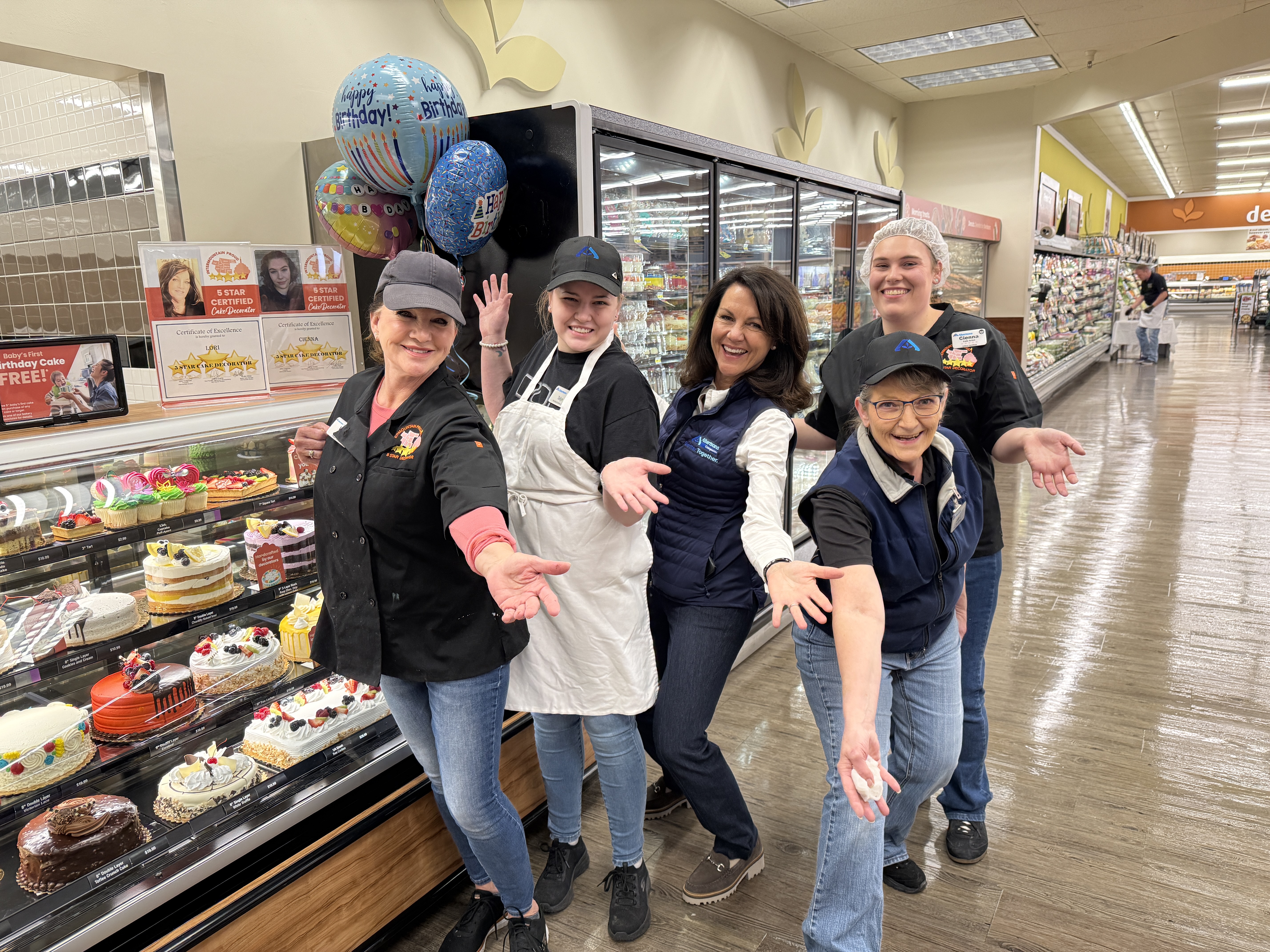
A chorus line, with cake
A photograph from an Albertsons bakery in Ammon, Idaho, catches Morris alongside the store team, arms extended in a cheerful chorus-line pose. The cake case is full. Balloons float above it. Her navy vest looks more at home here than a lectern would. Nobody appears to have mistaken the bakery for a solemn occasion.
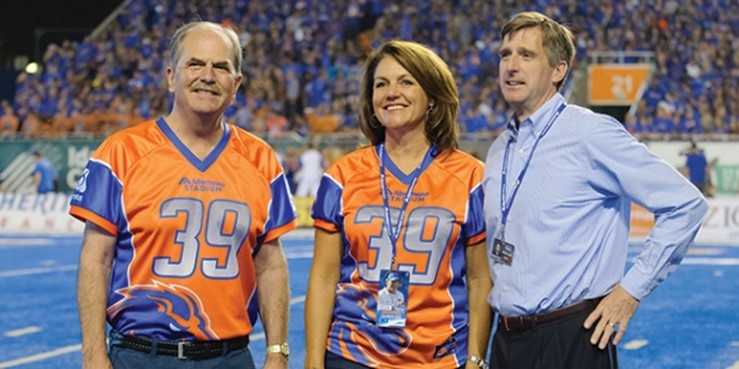
Another photograph reaches back to 2014, when Morris attended the opening football game of the Boise State season with her mentor Bob Butler and then-athletic director Mark Coyle. The occasion marked the stadium’s renaming as Albertsons Stadium. The commemorative number 39 referred to the company’s founding year, 1939. Even the shirts came with company history attached.
Those scenes sit beside a more formal record of recognition and service. Morris received Progressive Grocer’s 2020 Trailblazer recognition. In May 2023, she joined the boards of IDACORP and Idaho Power. Her education was in social science/political science at Colorado State University, and her board work has also included FMI.
The Idaho Power appointment placed her on a board serving another business with a daily obligation to customers. The announcement emphasized operations, leadership and ties to the Idaho community. It also recorded a career that had stretched beyond any single store or division. By then, her responsibility was national, but Boise remained an important base for her work and public service.
The personal details she volunteers are agreeably ordinary. She enjoys meals with friends and family and time outdoors. Asked about a favorite board game, she named Trivial Pursuit and described a family that was much better at laughing together than answering the questions. Competitive retail, apparently, does not guarantee command of the geography wedge.
The future that did not happen
For a time, Morris appeared headed for a different chief executive’s office. Under the Kroger-Albertsons divestiture plan, she was to lead the retail business at C&S Wholesale Grocers. Her familiarity with the stores and their people was part of the argument for putting her in charge.
During the Colorado merger trial in October 2024, her Denver background became relevant in a particularly direct way. She had begun working in the area, attended Colorado State and continued with the grocer through college. After graduation, she worked in the division office on pricing data. The market discussed in court was also a place she knew through years of work.
The proposed $24.6 billion merger was blocked, and that planned move never became her next chapter. Instead, Albertsons announced in March 2025 that she would succeed Sankaran. The board said it had considered internal and external candidates through a succession process. It chose someone whose experience included both the merchandise and the machinery behind it.
That background gives Morris a particular kind of credibility. It also puts a hard question in front of her: how much of the system she knows so well needs to change? Experience can make a person quicker to spot a problem. It can also leave a person responsible for revisiting decisions made by an organization in which she has spent much of her working life.
Stores overseen during Morris’s tenure as chief operations officer.
The receipt is still printing
The company she inherited operates under familiar names including Safeway, Vons, Jewel-Osco and Shaw’s. That collection of banners gives her assignment a particular texture. Customers may feel attached to the name above their own store without thinking much about the parent company in Boise. A chief executive has to organize the shared business while understanding why those separate names still matter to the people walking through the doors.
Morris’s stated ambition is to earn customers for life. In practice, the work involves prices, fresh assortment, company-owned brands, digital shopping and the ability to tailor merchandise to individual markets. The phrase is expansive; the customer’s decision is usually smaller. Was the trip worth the money and time, and would it be worth repeating next week?
In 2026, she described ACI Edge, a change from eleven divisions to four regions, alongside centralized center-store merchandising. That is an interesting turn for an executive whose Denver record included building decentralized functions. The balance between national buying power and neighborhood knowledge now has to be struck again at a different scale.
Meg Whitman joined Albertsons as executive chair in September 2026, with an explicit role advising Morris and the senior team on operations and strategy. Her experience at eBay and Hewlett-Packard adds another perspective as the retailer works on technology and a more consistent experience across stores and digital channels. The partnership is part of the work ahead, rather than evidence of its outcome.
The October 13, 2026 results made the pressure visible. Second-quarter identical sales fell 0.8%, while digital sales grew 11%. Those measures describe different things, so they should not be treated as opposite ends of one simple score. Together, they show why an improving online business cannot settle every question about the wider company’s performance.
Albertsons fiscal Q2 2026
Year-over-year change. Period ended September 12, 2026. These are separate measures, not additive components.
“Our results do not reflect the potential of the Company,” Morris said. Albertsons announced a comprehensive business review intended to simplify the organization, improve decisions and find savings to reinvest in customer value. The language is corporate; the consequences will be practical, reaching budgets, responsibilities and the work done between an order and a checkout.
There is a temptation to make Morris’s early job an explanation for everything that followed. A summer at the service desk cannot account for four decades of assignments, nor can familiarity alone guarantee a turnaround. What the early experience does establish is that she met this business where its promises are tested: in conversations with people who have something they need to get done.
Her career has required crossing between that world and the offices that organize it. She has taken a smaller title to enter a company she wanted to work for, handed local decisions to store directors, and eventually accepted responsibility for the whole operation. Now the judgment belongs to shoppers, employees and investors. The next chapter will have to show up in the stores.