The trouble with selling the same thing in five places is that it may appear to exist in five different quantities. A shopper buys from a Shopify store. A wholesale buyer has reserved units for next month. A marketplace has not yet received the stock update. Finance is still closing last week's numbers. None of these people has necessarily done anything wrong. Their software has simply given them different versions of the same business.
Tailor, founded in 2021 by Yo Shibata and Misato Takahashi, builds the software layer meant to reconcile those versions. It is an enterprise resource planning system, or ERP, for inventory, orders, purchasing, production and related financial operations. That sounds conventional until one reaches its defining choice: Tailor separates the operational backend from the screens people use. The company calls this a headless ERP. The phrase is odd; the ambition is plain. Keep the underlying facts together, then let each team see and change them through an interface suited to its work.
The short version
- Tailor serves growing ecommerce brands, omnichannel retailers and manufacturers.
- Its modular ERP connects existing commerce, warehouse and accounting tools.
- It charges for activated capabilities and usage, with no published per-seat fee.
- The company raised a $22 million Series A in 2025 after a $4.3 million seed round in 2022.
The sale that starts an argument
A retailer can survive a slow dashboard. It has a harder time surviving a false promise about stock. The original system may have been a spreadsheet, followed by a storefront, a warehouse app, an accounting package and an improvised bridge between them. A new channel adds another bridge. A bundle adds rules about components. Wholesale adds future orders, allocations and special prices. Soon the company is managing software relationships as carefully as supplier relationships.
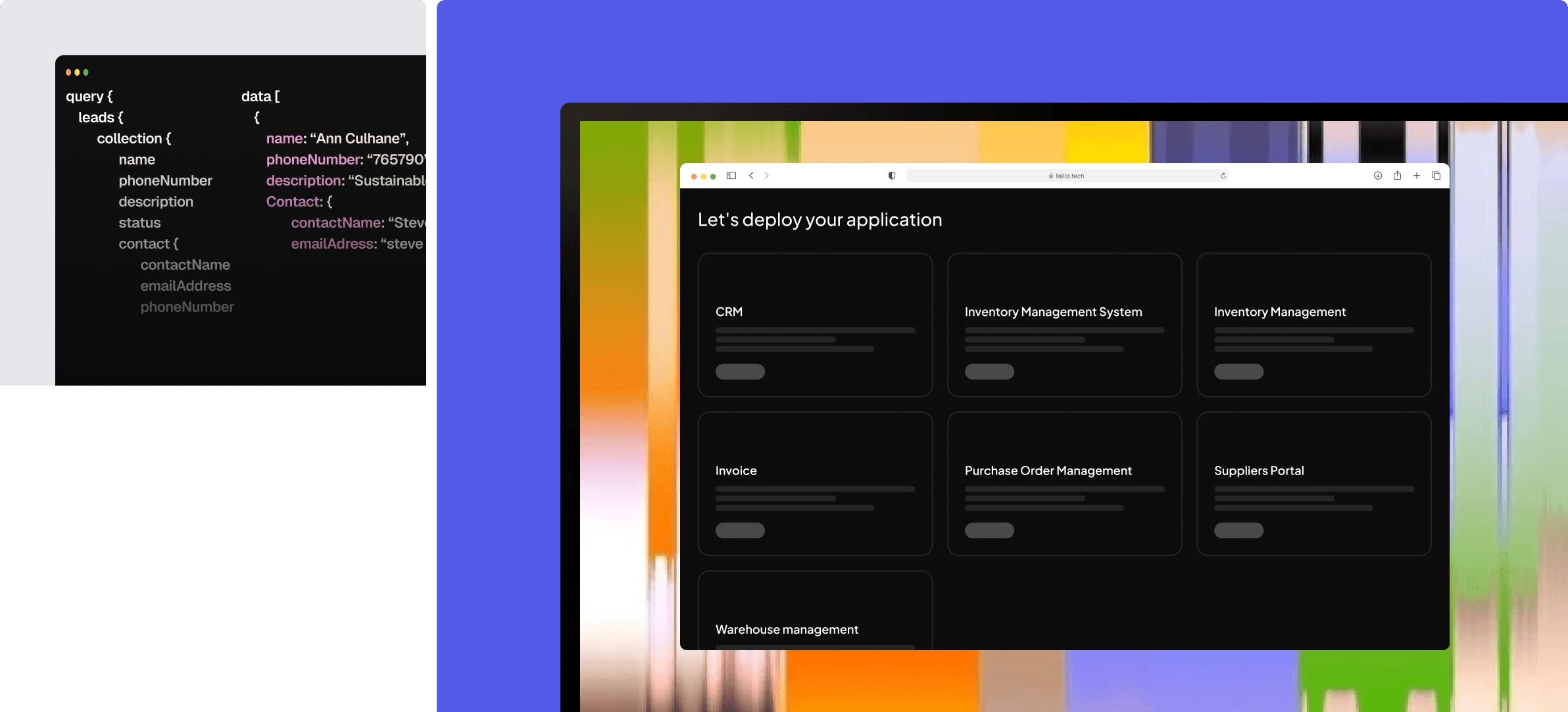
Tailor's answer is to put operational data and business logic in one place and make them available through GraphQL APIs, events and configurable workflows. Its ready-made applications cover inventory, omnichannel order management, production and purchasing. Operators can use those applications; developers can build other interfaces or connect existing tools. A warehouse worker may need a picking view, a finance team a costing view, and a wholesale partner a portal. The records behind those views can still describe the same order.
One order, three conversations
takes the order
updates stock & rules
see the change
There is a useful distinction in the company's language. “Headless” describes the split between backend and interface. “Composable” means a retailer can select or replace pieces of the backend, too. Tailor argues that a company with working accounting software need not tear it out to improve inventory and purchasing. Its Omakase offering, introduced for customers in Japan, makes precisely that case: adopt a focused operational system alongside the parts of an existing ERP that still earn their keep. The name means “chef's choice.” In enterprise software, that counts as a little whimsy.
A product for people with several kinds of customers
Tailor began with retail and ecommerce, particularly brands that sell through more than one channel. Its material describes Shopify, Amazon, point-of-sale systems, wholesale flows and third-party logistics providers feeding a common operational picture. Its integrations list extends to accounting packages including QuickBooks, and its company page names NetSuite and Odoo as systems it can connect to. The useful question for a prospective customer is therefore not “Can it replace everything?” It is “Which system should own each piece of data, and when does a change have to travel?”
This is where the product's promise becomes testable. A brand may need its available-to-sell quantity to account for warehouse stock, units already promised to a wholesale customer and components consumed by a bundle. Tailor says its inventory and order modules can model such rules and synchronize them across channels. A customer review on Shopify's app store offers a more grounded glimpse: one merchant described beginning with a custom connector between Shopify and Odoo, then moving toward Tailor's own ERP modules. Other named reviewers described smoother cross-location order handling and custom bundle logic. Reviews are accounts from individual users, not a universal performance measure, but they are more informative than a generic claim about “visibility.”
“Businesses want systems that can be composed, not hardcoded.”Yo Shibata, speaking to TechCrunch in 2025
Shibata and Takahashi did not arrive at this problem as first-time software makers. Their earlier startup was acquired by Rakuten. Shibata had worked at McKinsey; Takahashi held senior engineering roles including at Mercari. They founded Tailor in Japan, joined Y Combinator's Summer 2022 group and later made San Francisco its headquarters while maintaining a Tokyo presence. The company's public GitHub repositories include an SDK, an app shell and a Terraform provider. That developer surface matters because the pitch depends on other teams being able to extend the system, rather than asking Tailor to build every screen forever.

The price of changing shape
Tailor says customers pay for platform capabilities and usage instead of seats, with implementation and support included. It does not publish a standard contract price. That makes the cost question a matter of scope: how many modules, channels, integrations and custom workflows need to go live? Even with a modular system, the labor of deciding which application owns a product, order or cost does not vanish. Someone must define the rules, clean the data and test the exceptions. Tailor's own comparison material describes implementations of three to six months, phased with its team. That is more useful planning guidance than a promise that an ERP can be installed over lunch.
The financing explains the company's next chapter. In 2025 Tailor announced a $14 million first close of its Series A; later reporting put the round at $22 million, with investors including ANRI, JIC Venture Growth Investments, NEA, Spiral Capital and Y Combinator. Tailor said it would use the money for U.S. expansion, product development and its Japan operation. Its market sits between the large, deeply embedded suites of SAP and Oracle NetSuite and narrower tools that solve one retail task. A retailer that has outgrown a collection of point solutions but does not want to make every workflow look like a legacy ERP's default workflow is the customer Tailor most clearly wants.
What to steal from the idea
The practical lesson is smaller than an ERP purchase. Pick one consequential object - a SKU, a purchase order, a wholesale reservation - and name the system that owns its truth. List every other system that copies it. Then ask what happens if two changes arrive at once, a channel is offline or a bundle consumes the last component. Those questions expose the real cost of fragmented operations before a vendor demo can hide it behind a polished dashboard.
Tailor's architecture is well suited to businesses where channels and processes keep changing, and where teams need different views of shared data. It asks more of the buyer when the underlying records are chaotic or the organization cannot agree on its own rules. An API can move an error quickly; it cannot decide whether the error is an order, an allocation or an accounting policy. The headless idea works best after a company has faced that argument honestly.
The name Tailor suggests a custom fit. The company is betting that enterprise software should behave less like a uniform and more like a set of measurements that can be taken again when the business changes. For a retailer whose storefront, warehouse and finance team currently disagree about what just sold, that is a compelling proposition. It is also a demanding one. The software can make the same fact available everywhere. The people still have to agree what the fact means.