Before Ted Decker had a national supply chain to think about, he had a parents’ garage and a delivery problem. During college summers, he sealed driveways in Pennsylvania. Buying sealer bucket by bucket meant repeated hardware-store visits. He eventually went straight to the manufacturer and ordered a tractor-trailer load. The garage became, in effect, his distribution center. One hopes the family car had somewhere else to go. 01
It is an appealing place to begin the story of a Home Depot chief executive. The customer was also the purchasing department, the delivery planner and the person holding the broom. Any failure in the arrangement arrived directly in his own working day. Years later, the distance between a purchasing decision and a person waiting to finish a job would become a rather larger concern.
A phone call before the flight
The route to Atlanta took him through finance and two other continents. A native of the Erie area, Decker graduated from William & Mary in 1985 with an English degree, then pursued international banking. He worked in Sydney with PNC Bank and in London with Kimberly-Clark. Along the way, he earned his MBA at Carnegie Mellon in 1993. His professional life acquired a financial vocabulary without requiring him to surrender the literary one. 02
In London, on his way to the airport, he stopped at his office and answered a recruiter’s call. There was an opportunity in Atlanta. As it happened, he was already flying there for a meeting that day. He arranged a lunchtime interview with Home Depot’s CEO. A career change slipped into an existing itinerary, which is an unusually efficient use of a business trip. 03
“Lesson here: You can never plan life.”
Ted Decker, reflecting on the call that brought him to Home Depot
His account resists the temptation to make the whole thing sound inevitable. Answering the telephone was chance; being able to discuss the business was preparation. By the time Home Depot hired him as director of business valuation in 2000, he had worked in banking, strategic planning and corporate finance. The company was bringing in someone trained to ask what a business was worth and why. 04
The apprenticeship between the titles
Twenty-two years separate his arrival and his appointment as CEO. That span is easy to compress into a sentence and more useful to open out. He moved through business valuation, strategic business development and retail finance. These were different views of the same enterprise: what to buy, where to invest and how the existing operation performed. A retailer could look quite different from each desk.
Then came merchandising. For more than six years, Decker served as chief merchant and executive vice president of merchandising, with responsibility for products sold in stores and online, supplier relationships, marketing and the store environment. Finance had asked him to evaluate the business. Merchandising put him closer to the decisions customers encounter on a shelf. A valuation model does not have to locate the right fitting on a Saturday morning; a shopper does. 04
- 2000Business valuation
Joins Home Depot - 2020President & COO
The operating remit widens - 2022President & CEO
Then board chair - 2024SRS acquisition
A broader Pro business
In October 2020, he became president and chief operating officer. Global stores, supply chain, sourcing, real estate, sales and service joined merchandising, marketing and online strategy in his remit. The job required the separate pieces to work together. A customer’s order might begin on a screen, depend on inventory elsewhere and end with a conversation in a store. The organizational boundaries were the company’s problem to solve. 05
When Home Depot announced his elevation to CEO, effective March 1, 2022, Craig Menear emphasized both Decker’s operational experience and his conduct inside the company. Menear stayed on as chair during the transition; Decker took that role later in the year. The succession placed an internal operator in charge of an institution whose founders still supplied much of its language about leadership. 05
The boss at the bottom
Home Depot draws its hierarchy as an inverted pyramid, with customers and associates above management and the CEO at the bottom. It is a memorable corporate diagram because it gives the most senior person the least glamorous position. Decker has described the founders’ values as a central reason he joined and stayed. The attraction was a business model accompanied by a clear account of whom management was supposed to serve. 03
Such drawings earn their keep through ordinary decisions. Who gets heard when a process fails? How quickly can a store obtain help? What happens when the convenient answer at headquarters makes somebody else’s job harder? These are useful ways to interpret the model, rather than claims that a drawing can settle them. Decker inherited the philosophy; making it credible remains recurring work.
His public conversations repeatedly return to that inheritance. In a 2023 interview with retail analyst Simeon Gutman, he discussed preserving the company’s culture alongside the possibilities of AI and virtual reality. Putting those subjects in one conversation made the assignment plain enough: introduce new tools while keeping the shopping experience recognizable to the people who use it. Technical change and employee judgment have to share the same aisle. 06
The contractor’s clock
Decker’s early summer business gives the professional-customer strategy a particularly concrete backdrop. A contractor buying supplies is also buying the ability to keep work moving. A missing delivery can upset a sequence of tasks. For a retailer, serving that customer involves more than presenting a product assortment. The promise extends toward the worksite, where the consequences of an incomplete order become visible.
On June 18, 2024, Home Depot completed its acquisition of SRS Distribution at an enterprise value of approximately $18.25 billion. SRS served professional roofers, landscapers and pool contractors through specialty distribution. Decker described the acquisition as adding capabilities as well as complementing the existing business. At the announcement, Home Depot estimated that the combination increased its addressable market by about $50 billion to roughly $1 trillion. 07
Approximate enterprise value at completion
The distinction matters. Buying a distributor can add relationships, expertise and ways of fulfilling orders that a conventional store does not supply in the same form. The intended benefit is a broader answer to a professional’s project. Whether a customer experiences that benefit depends on what happens after the deal closes: how the parts coordinate and whether the promised convenience survives contact with a real order.
A bigger company, a more demanding sum
The numbers from fiscal 2024 give that ambition some necessary friction. Home Depot reported sales of $159.5 billion, up 4.5%, while comparable sales fell 1.8%. Net earnings were $14.8 billion, compared with $15.1 billion a year earlier. The year also contained an extra week, which added approximately $2.5 billion in sales. Decker pointed to continuing pressure on large remodeling projects while reaffirming investment in the company’s strategy. 08
Acquisitions and an extra fiscal week complicate the headline. Comparable sales exclude that extra week.
Those figures describe a business becoming larger while its comparable operation faced a tougher market. They also explain why the acquisition cannot be treated as a complete answer to demand. Decker’s task includes both managing what the company adds and improving what it already operates. The financial training and the years spent in merchandising now meet in a single, uncomfortable set of questions.
By July 2026, Home Depot was reorganizing leadership portfolios around that coordination problem. Private-brand merchandising moved into the core merchandising organization. Customer experience, online, financial services and loyalty were brought together under interconnected retail. An Office of Pro Acceleration was assigned to coordinate capabilities across Home Depot Pro, HD Supply, SRS and Construction Resources. Store, supply-chain and Pro product technology teams were also being aligned within the technology organization. 09
Read together, the changes suggest a company trying to make its expanding collection of businesses easier for customers to navigate. That is an interpretation of the plan, rather than a verdict on its results. A customer does not need to appreciate the architecture. The useful test is whether an order, an account or a delivery works with fewer interruptions.
The campus keeps turning up
Outside retail, Decker’s commitments lead back toward his education. In March 2025, he joined the Colonial Williamsburg Foundation’s board of trustees. He spoke about preserving the places where the nation’s ideas took shape and helping visitors encounter their history. The appointment connected an executive’s experience to an educational institution preparing for America’s 250th anniversary. It also suited an English graduate whose interest in history had helped draw him to William & Mary. 10
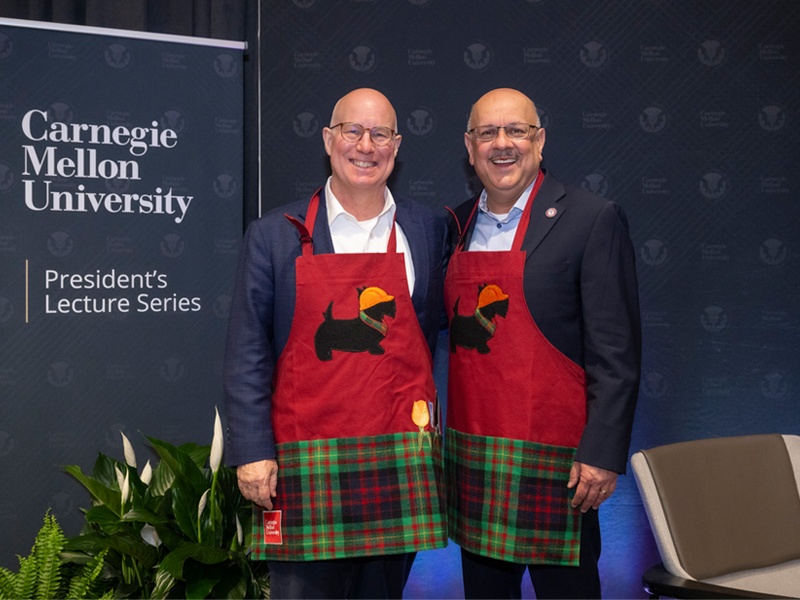
At Carnegie Mellon on March 26, 2026, he delivered a lecture and sat down with president Farnam Jahanian to discuss his career, AI and the future of education. His advice to students was to take advantage of the university’s interdisciplinary character. The finance graduate who had first studied English was recommending a wider education from experience. He had spent a career moving between kinds of problems, often before the job title caught up. 11
There is room in the picture for live music, gardening and the family he began building at William & Mary. But the most revealing thread is his continued appetite for different kinds of work. The young contractor had to understand the material, the price and the delivery. The chief executive faces the same relationship at a scale that makes it much easier to lose sight of the person holding the broom.
The garage story survives because its standard is so plain. The sealer has to arrive. The work has to get done. For all the acquisitions, organizational changes and technology in Decker’s later career, that remains a useful place to bring the conversation back.