Bernie Marcus stood before a Rotary Club audience in Atlanta in 1981 and asked a question that could have spoiled his afternoon. Who here was a real do-it-yourselfer? He meant someone who could change a light fixture or repair a toilet without calling a plumber. Of roughly 400 people in the room, perhaps 20 raised their hands. For someone building a business around home improvement, this was a rather small forest of arms.
The answer exposed the work ahead. Shelves full of tools would be useful only if people believed they could use them. A customer might arrive needing a part and leave needing courage. Marcus's warehouse idea depended on making the next step feel possible: explain the job, find the right supplies, let the person ask the question they hoped nobody would laugh at.
That room is a good place to begin his story. The orange sign would eventually become familiar across three countries. Before that, there was a merchant trying to understand the people standing on the other side of the counter.
A reminder that a market sometimes needs teaching.
A second start, with bills attached
Marcus was born on May 12, 1929, in Newark, New Jersey, to Russian Jewish immigrant parents. He grew up in a tenement. His father was a cabinetmaker; the family knew the difference between having a skill and having enough money. Marcus graduated from Rutgers in 1954 with a pharmacy degree, then found his working life increasingly pulled toward retail.
Even college had competed with commerce. He later recalled cutting classes to sell Amana freezers door-to-door. The detail suits the subsequent career: a student leaving the classroom to find out whether someone would buy something. There are less expensive ways to test your powers of persuasion than missing a lecture, but few that offer such prompt feedback.
He worked at O'Dell's and Vornado and rose through the business. By 1972 he was chairman and president of Handy Dan Improvement Centers, part of the Daylin conglomerate. There he developed the relationship with Arthur Blank that would shape the rest of his life. The partnership existed before the company that made both names recognizable.
Then, in April 1978, Marcus was fired. Blank and Ron Brill also lost their jobs. Marcus was 49. The episode offers an irresistible opening for a success story, provided you already know the ending. At the time, it meant unemployment, financial uncertainty, and the prospect of having to persuade other people to back an unbuilt store.
The founders began working through their idea in a Los Angeles coffee shop. They had little capital and had to win the confidence of vendors as well as investors. Ken Langone helped arrange financing. Pat Farrah brought merchandising knowledge. Blank, Brill, and Marcus supplied their own experience. The origin is easier to understand as a collection of complementary abilities than as a solitary flash of inspiration.
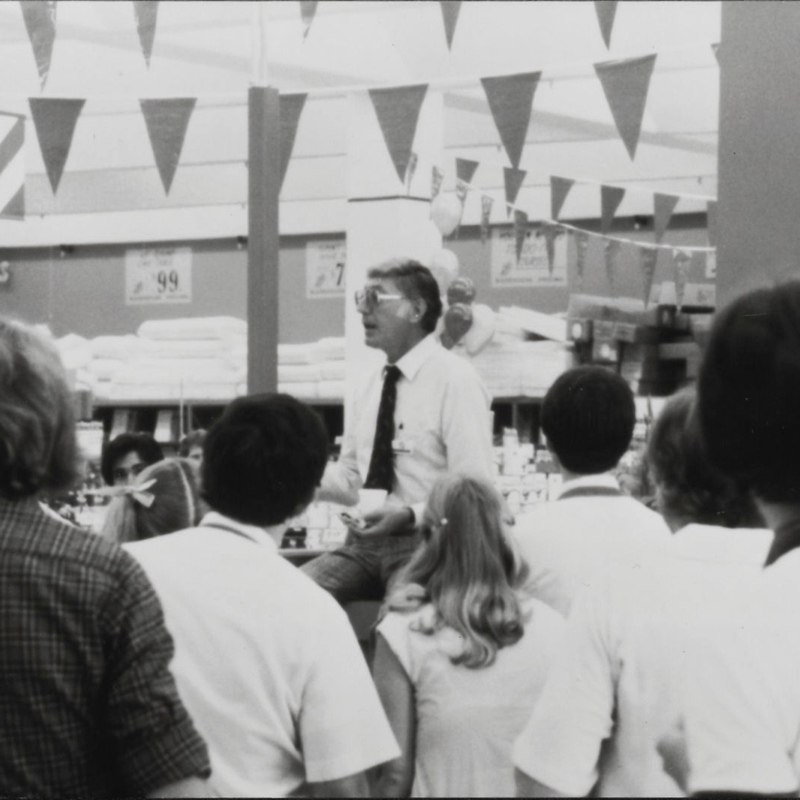
On June 22, 1979, the first two Home Depot stores opened in Atlanta. Each covered about 60,000 square feet and offered some 25,000 products. The proposition was broad selection in a warehouse setting, with prices and service that would persuade people to try a different way of shopping for their homes.
The opening was subdued. The founders gave their children dollar bills to hand to customers as a thank-you. Plenty of the money remained undistributed. Empty cardboard boxes and paint cans helped fill the upper shelves. A warehouse can make a young business look substantial; it can also give a small turnout an uncomfortable amount of room.
On the third day, an early customer returned with a bag of okra for Marcus. She was thanking him for a good shopping experience. The gesture was modest, personal, and useful encouragement. Somewhere beyond the balance sheet, a customer had decided the store deserved another visit. Word of mouth would bring more people through the doors.
The orange apron and the upside-down pyramid
Even the visual identity had to be worked out. Marcus and Blank consulted designer Don Watt. The resulting lettering took inspiration from freight crates, fitting the depot idea. Earlier possibilities included green or yellow aprons. Orange became so familiar that the alternatives now seem like costumes from a production that never opened.
The design gave the store a recognizable face. Service had to give that face a reason to be remembered. A large assortment can overwhelm as readily as it can impress. The useful employee is the one who can turn a wall of choices into the few things that belong in your cart.
In its statement of the founding philosophy, The Home Depot places customers and front-line associates above corporate management. Its organizational pyramid is inverted, with the CEO at the bottom. The corporate offices are called the Store Support Center. It is an unusually plain description of what headquarters ought to do.
Authority supports the encounter at the shelf.
Marcus's own advice was brisk: “If your mouth is open, your ears are closed.” He urged leaders to hire people whose abilities complemented theirs and to make room for employee suggestions. Listening, in this account, had a practical purpose. Someone close to a customer or a daily task might see the problem before the person with the title did.
That idea is less comfortable than it sounds. It asks a manager to accept that an answer may come from below them on the chart. It also asks the employee to believe speaking up will produce something better than an awkward silence. The diagram on the wall matters only if the conversation at work can survive it.

Marcus remained CEO until 1997, when Blank succeeded him. He stayed chairman until retiring in 2002. The friendship endured longer than the division of executive duties. In a 2020 interview, Blank discussed their political differences alongside their continuing bond. Shared work had given them a relationship that did not require identical voting preferences.
Both also had a role, with Langone, in establishing The Homer Fund in 1999. It assists Home Depot associates facing unexpected hardship. The fund gave the promise to take care of employees a practical mechanism. A company's values become easier to assess when they have a way to reach someone having a difficult month.
Atlanta gets an ocean
Bernie and his wife, Billi, established The Marcus Foundation in 1989. His departure from Home Depot gave philanthropy more of his time. The habits of the store builder traveled with him: get involved, ask what an institution needs, and look closely at what the money accomplishes.
Georgia Aquarium was the public expression of that second career. Marcus wanted to give something back to Atlanta, the city where the stores had found their footing. Bernie and Billi visited aquariums and consulted specialists. Their foundation records a $255 million gift to establish the institution. Gratitude acquired a construction budget.
The project depended on other people, too. Coca-Cola donated a nine-acre site near Centennial Olympic Park. Marcus, Mayor Shirley Franklin, and the aquarium team broke ground in May 2003. The building opened to the public on November 23, 2005, about 30 months later. Its millionth guest arrived just 98 days after opening.
The retailer's new destination offered another kind of instruction. A visitor could encounter animals they might otherwise never see; a school trip could turn the ocean from an abstraction into something occupying the other side of the glass. The aquarium's mission tied that encounter to education and conservation.
“My mother taught me to be generous.”
Bernie Marcus
By its 2024 remembrance of Marcus, the aquarium counted more than 40 million visitors and nearly 1.7 million students on field trips. In 2025 it marked its twentieth anniversary. Those figures describe repeated use of a gift: families making plans, teachers booking visits, and children getting an afternoon that a classroom alone could not provide.
- 1978Fired from Handy Dan; The Home Depot is founded.
- 1979The first two Atlanta stores open.
- 1989Bernie and Billi establish their foundation.
- 2002Marcus retires as Home Depot chairman.
- 2005Georgia Aquarium opens to the public.
- 2010The couple joins the Giving Pledge.
A fortune with work to do
In June 2010, Marcus wrote to Warren Buffett as he and Billi joined the Giving Pledge. He opposed leaving enormous wealth to children and favored distributing it during life. He described grants with expectations attached: his staff required outcomes and could withdraw support if those outcomes did not arrive. He wanted involvement to continue after the check cleared.
His public life also included partisan choices. Marcus was a Republican donor and an outspoken supporter of Donald Trump. He founded Job Creators Network, an advocacy organization focused on free enterprise and small business. Those commitments belong in the same portrait as the stores and the giving. His convictions helped determine where his attention and money went.
The books extended his desire to explain the work. Built from Scratch, written with Blank and Bob Andelman, appeared in 1999. Kick Up Some Dust, written with Catherine Lewis, followed in 2022, when Marcus was 93. Its subjects connected the two careers: thinking big, giving back, and doing things yourself.
Marcus died in Boca Raton, Florida, on November 4, 2024, aged 95. The foundation continues his philanthropic work. His story leaves a series of places where other people carry on: stores, an employee assistance fund, and an aquarium filled with visitors. The work began with customers who were unsure they could fix something. It lasted because enough people were willing to help them try.
Read, watch, explore
More of Marcus's life, in his own words and through the institutions he helped build.
- The Marcus Foundation His continuing philanthropic work
- Bernie and Billi's pledge letter The 2010 letter to Warren Buffett
- Watch: a conversation with John R. Miles Interview on entrepreneurship and his book
- Listen: Do what's great for customers Conversation with David Novak, January 2023
- Marcus on leadership and giving His 2022 interview
- Remembering Bernie Marcus Home Depot's remembrance and archival photographs
- Twenty years of Georgia Aquarium The next chapter of his Atlanta gift
- His life and legacy Associated Press obituary
- The Home Depot profile The company he co-founded