Peter Nicholas and John Abele had an unusual rule for resolving disagreements. They would weigh the votes. Nicholas liked to joke that he was bigger and heavier, which made the procedure pleasantly straightforward. Behind the joke was a serious arrangement: two founders with different skills needed a way to make decisions together. A business partnership is an awkward place to discover that everybody wants the casting vote.
Nicholas brought experience in sales, management and finance. Abele brought the technical knowledge and an existing business, Medi-Tech. In 1979, they created Boston Scientific. The archive photograph of the pair in Paris that year has the charm of a family album: two men at a table, raised glasses, and a handwritten sign recording their names, the city and the date. Nobody appears to have consulted a branding agency.
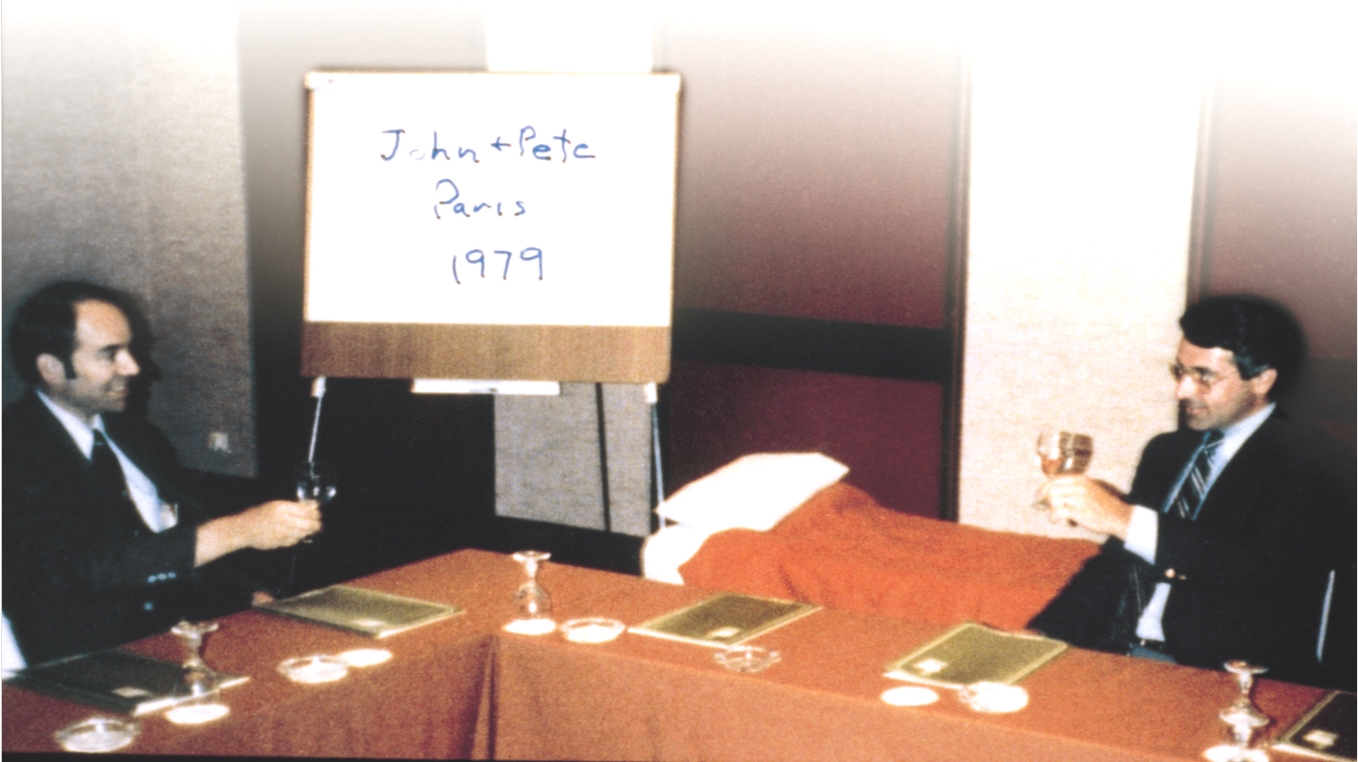
It is a useful place to begin a life that can otherwise disappear beneath company statistics. Nicholas spent twenty years as chief executive and remained chairman until 2016. By then Boston Scientific employed 27,000 people and reported annual revenue of $8.4 billion. The figures describe the size of the enterprise. The photograph gives us something else: the enterprise once fitted around a table.
The founding story is often told through a chance Christmas-party meeting in Concord, Massachusetts. Nicholas and Abele became partners in 1978; the company followed the next year. Their conversation joined two careers already in motion. Nicholas was thirty-eight when Boston Scientific was established. He arrived with a decade of corporate experience, an economics degree, an MBA and a period of naval service behind him.
Before the boardroom, a ship
Peter Michael Nicholas was born in Portsmouth, New Hampshire, on May 16, 1941. His parents, Nicholas and Vrysula, were Greek immigrants. His father became a career naval officer and commanded submarines during the Second World War. The family moved between places including New England, Denmark, Virginia and Puerto Rico. Portland, Maine, and its Greek community were part of that upbringing, but the childhood was hardly confined to one neighborhood.
At St. Paul’s School in Concord, New Hampshire, Nicholas played baseball, football and squash. Team sports gave him a practical education in discipline and shared effort. He later attended Duke, graduating in economics in 1964. There he met Virginia Lilly, known as Ginny. They married shortly after graduation and remained married for fifty-eight years. A campus acquaintance became the central partnership of his adult life.
Nicholas served two years in the Navy, including as communications officer aboard USS Lookout. In his later reflections, the experience mattered because other people depended on him. Trust had consequences. So did preparation. Naval service supplied an early encounter with responsibility that could not be delegated to a clever presentation. The ship still had to function after the meeting ended.
He left the Navy in 1966 and earned his Wharton MBA in 1968. A period at Eli Lilly followed, taking him through sales, marketing and general management, including work in Europe. His next role was at Millipore. These were substantial organizations, with customers to understand and operations to run. The future founder learned the business of business before having one of his own.
That sequence complicates the familiar picture of entrepreneurship as youthful impatience with employment. Nicholas had been employed for years. Starting a company meant carrying accumulated experience into a smaller setting. It also meant finding someone whose experience added something different. Abele’s technical background and Nicholas’s commercial background made their partnership specific; neither needed the other to be a duplicate.
The awkward business of getting bigger
Boston Scientific began with fewer than fifty employees, a $500,000 loan and $300,000 in partners’ capital. It acquired other businesses early in its life. Growth brought a recurring organizational problem: how to preserve useful habits when the number of people, products and decisions kept increasing. A founder can remember everyone in one room. A global company eventually requires more rooms than any founder can visit.
Nicholas had a question for that problem: “How do we stay small as we grow big?” The question did not contain its own answer. It demanded one from the people around him. There is a reason it remains interesting decades later. A company can increase revenue and still make everyday work slower, less personal and harder to understand. Size is easy to count. Those losses are harder.
How do we stay small as we grow big?
Peter Nicholas
In May 1992, Boston Scientific went public on the New York Stock Exchange. Nicholas and Abele had wanted to preserve the control available to a private company. Permanent capital eventually made a public listing attractive. The decision put their preference for continuity beside their need for financing. By the end of that year, a gift of company stock had made all employees shareholders.
The stock gift gave the expanding business a concrete connection to its workforce. Ownership is a more substantial gesture than asking people to feel like owners. It does not settle every question about culture, but it gives the language a financial meaning. People helping to build the company now held a piece of it. The relationship had been written into something they could keep.
Nicholas’s own executive responsibilities changed over time. He was co-chairman from 1979 to 1995 and chairman thereafter. He handed over the chief executive role in 1999 while continuing on the board. The distinctions matter. Twenty years running a company and another seventeen years as chairman are different kinds of service, requiring different ways of staying involved. His retirement from the board came in 2016.
Founding headcount and headcount at Nicholas’s board retirement. Linear scale; the founding bar has a minimum visible width.
Ginny, Duke, and a longer horizon
Duke remained part of both Nicholas lives long after their 1964 graduation. Pete and Ginny returned to cheer for the Blue Devils at Cameron Indoor Stadium. Their three children also earned Duke degrees. The university became a place where personal history, family connections and public work repeatedly met. For alumni with that many ties, a visit to campus could have a crowded itinerary.
In 1995, a $20 million gift from the couple supported the development of what became the Nicholas School of the Environment. The school itself had been formed in 1991 from existing Duke programs. Their gift helped an institution already under way develop further. That distinction gives their contribution a clearer shape: resources went into people and work with an established foundation.
In 2002, they gave $25 million for the Nicholas Faculty Leadership Initiative. The program used their gift to encourage other donors to support faculty. Here generosity had an organizational design. One contribution could prompt another, extending the reach of the original commitment. It was a familiar kind of problem for an enterprise builder: how could the resources at hand bring more resources into useful work?
The couple also co-chaired the Campaign for Duke. In December 2003, they committed $72 million as the campaign closed; the gift was announced the following January. Of that amount, $70 million was designated for environmental programs and $2 million for Perkins Library renovation. The campaign ultimately raised $2.36 billion. Its scale depended on many donors, with the Nicholases serving as both contributors and organizers.
A library renovation and environmental research belong to different parts of university life. They share a long timetable. Students use collections assembled before they arrive; researchers build on work begun years earlier. Funding these places means accepting that some benefits will appear after the donor’s own moment has passed. The attraction lies in what an institution can continue to make possible.
The Nicholas Institute was established in 2005 with Pete and Ginny’s support. Its work connected environmental expertise with decisions beyond the university. Pete served on Duke’s board of trustees from 1993 to 2005, including two years as chair. Giving money was one form of participation. Taking responsibility for governance was another, with the less photogenic obligations that accompany committee work and institutional decisions.
Pete and Ginny Nicholas’s gift, announced January 2004
The boat had a call sign
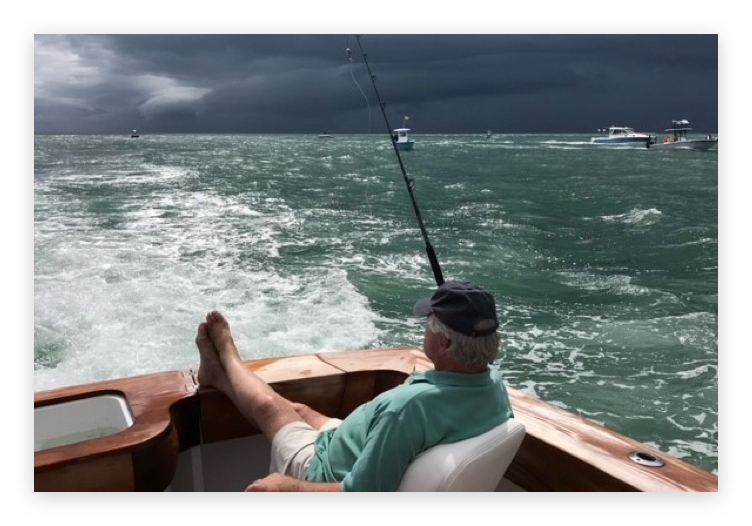
Outside the company and university, Nicholas had a workshop, a taste for marine art and an affection for boats. He collected carved Bellamy eagles and nineteenth- and twentieth-century marine paintings. His maritime call sign was Big Eagle. For an otherwise understated figure, it was a satisfyingly theatrical name. Even a quiet person can allow himself a little flourish over the radio.
He coached his children’s teams and enjoyed Red Sox games. Boating brought Ginny, relatives and friends together. Pete and Ginny lived in Concord, Massachusetts, for more than thirty-five years before moving to Boca Grande, Florida. The move put him in another coastal setting, with the water still close by. His interests had a consistency that a list of corporate titles would miss.
Nicholas was elected to the American Academy of Arts and Sciences in 1999 and served its Trust. He chaired the Massachusetts High Technology Council from 2013 to 2015. In 2019, he received the Joseph Wharton Lifetime Achievement Award. Duke presented him with its University Medal in 2021, recognizing years of service. The honors accumulated around commitments that had already occupied much of his working life.
Retirement from Boston Scientific also left room for another business venture. With his children, he established Ithaka Partners, a family investment firm. The arrangement put his continuing interest in building companies into a family enterprise. The formal corporate chapter had closed; work remained part of his life. For someone who liked questions and practical problems, retirement offered a different set of people around the table.
What could keep going
Nicholas died at his home in Boca Grande on May 14, 2022, aged eighty. That year, Duke announced a $25 million Nicholas family gift supporting its Climate Commitment. The contribution included Ginny and the late Pete, their children and family members. It extended a pattern of environmental giving that had begun decades earlier. The institution and the family were continuing work already in motion.
His story is easiest to understand through those repeated partnerships. John Abele brought another kind of expertise. Ginny shared a marriage, a university and years of philanthropy. Colleagues helped a small business become an international company. His children joined him in another investment venture. Nicholas’s achievements took place in organizations, and organizations are made of relationships that need tending as well as resources that need managing.
The Paris photograph remains a useful counterweight to all the later numbers. A company has begun, two partners have raised their glasses, and somebody has remembered to write down the date. Nicholas would spend years confronting what happened when that small gathering became much larger. His question about staying small survives because growth keeps creating the same practical difficulty: remembering the people when the table can no longer hold them all.