Field Guide · The Survey Stack
How Surveys Escaped the Phone Bank and Got Into Your App
Survox, LimeSurvey, Typeform and PostHog trace a 50-year shift in how the world asks questions - from punch cards and phone banks to forms that feel like chat and surveys that pop up mid-click.
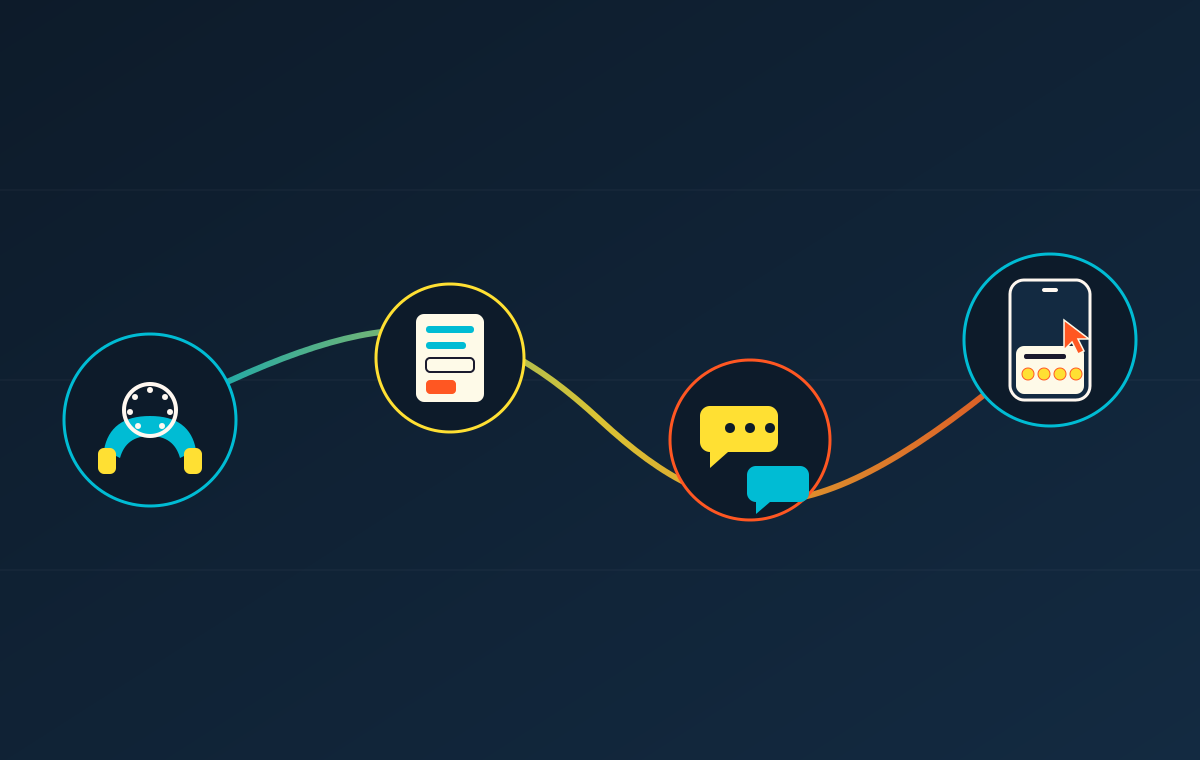
Pick up your phone during dinner and there is a decent chance it is a survey. You will not answer it. Almost nobody does anymore. The response rate for cold telephone polls has been sliding for two decades, and yet the business of asking people questions has never been bigger. It just moved. The question walked out of the call center, learned to design itself, and eventually climbed inside the software you already had open.
Four companies mark that journey cleanly. Survox, which started life in 1967 as Computers for Marketing Corporation. LimeSurvey, an open-source project that quietly runs studies in more than 80 countries. Typeform, the Barcelona startup that decided a form should feel like a conversation. And PostHog, the engineer-built platform that fires a survey the moment you use a feature. Line them up and you get a working map of how feedback has changed - not the questions, but where and when we get to ask them.
01The phone-bank era
Survox · born 1967
Before there was a browser to put a form in, there was a room full of phones. Computers for Marketing Corporation opened in 1967, founded by Joe Weisman, Leif Gjestland and Charlie Yarbrough, with a plainly stated goal: make statistical analysis usable by the pollsters and researchers who needed it. The early work ran on punch cards and tabulation software. Later it became CATI - computer-assisted telephone interviewing - the backbone of political polling and market research for a generation.
The company rebranded to Survox in 2015 to lean into voice-based, multi-mode collection, then was acquired by Canada's Enghouse Systems in 2017 and folded into Enghouse Insights. What is striking is that it still exists. Phone and IVR surveys remain the way you reach a representative sample of a whole population, not just the slice of it that happens to use your app. Survox is the reminder that old tools do not die when new ones arrive. They keep the jobs the new tools cannot do.
A phone survey reaches everyone and knows nothing about them. An in-app survey knows everything and reaches only your users. The whole history is a fight over that trade-off.The venue problem
02The web opens up
LimeSurvey · open source since 2003
In 2003, Carsten Schmitz released a project called PHPSurveyor. It grew into LimeSurvey, and it did something the phone banks never could: it handed the whole apparatus to anyone with a web server and gave it away. LimeSurvey is licensed under the GPL. You can download it, self-host it, run unlimited surveys, and never pay a cent. It supports more than 80 languages and 28-plus question types, with the conditional logic and branching that serious research demands.
That model has quietly made LimeSurvey a fixture in universities, governments and financial institutions - the places that care about owning their data and inspecting the code that touches it. It pitches itself, without much modesty, as a free alternative to SurveyMonkey, Typeform, Qualtrics and Google Forms. The lesson worth stealing here is old but durable: when your buyer is technical, "here is the source, host it yourself" beats "trust us" almost every time.
Figure 1 · Where the question lives, 1967 → 2020
- 1967 · Survox (CfMC)The phone bank. Punch cards, then CATI. Reaches a whole population, one dial at a time.
- 2003 · LimeSurveyThe web form, open-sourced. Self-host it anywhere; own every answer.
- 2012 · TypeformThe conversation. One question at a time, designed to feel human.
- 2020 · PostHogThe product itself. A survey triggered by what you just did.
03The form learns to charm
Typeform · Barcelona, 2012
David Okuniev and Robert Muñoz were running web design shops in Barcelona when a client project - the story goes that it was a form for a toilet company - pushed them past their limit. The form tools of the day were ugly and joyless, and completion rates showed it. So in 2012 they built their own. Typeform's idea was simple and slightly radical: show one question at a time, make it look good, and let it feel like a conversation instead of a tax return.
It worked, and then it got copied everywhere. Typeform launched in beta in April 2013 on 550,000 euros of seed money and went on to raise roughly 188 million dollars, reaching a reported valuation near 938 million. The deeper point is about attention. Typeform treated the survey as an experience you could design your way to a higher response rate. That reframe - form as conversation - is now the default expectation, which is the surest sign a company changed the category it entered.
Their origin problem was a form for a toilet company. The boring problems are where the big markets hide.On Typeform
04The survey moves in
PostHog · Y Combinator, 2020
James Hawkins and Tim Glaser met at Arachnys, a London regulatory-tech startup, and landed in Y Combinator's Winter 2020 batch. Their frustration was specific: to understand which features people used, they had to ship their users' data off to third parties. So they built PostHog and put it on GitHub and Hacker News in February 2020 as open source. Engineers took to it immediately. By October the project had crossed a million dollars in annual recurring revenue with no sales team, pulled entirely by inbound demand, and it went on to raise 12 million dollars led by GV and Y Combinator.
PostHog is not really a survey company. It is product analytics, session replay, feature flags and A/B testing in one open-source stack - and surveys are one more tool inside it. That context is the whole innovation. A PostHog survey can fire based on what a user just did, asking a contextual question at the exact moment in the journey when the answer is honest and fresh. Reportedly used by a majority of Y Combinator companies, it represents the endpoint of the arc: the question stopped being a thing you send and became a thing that lives where the behavior happens.
Figure 2 · How close does the question get to the moment?
05Four bets on human attention
Read together, these are not four versions of the same tool. They are four different bets on how to get an honest answer out of a distracted person. Dial them. Email them a link. Charm them with design. Or catch them in the act. Each bet still wins somewhere, which is why the market never fully consolidated - and why the right question for anyone building today is not "which survey tool," but "where should the question live."
Survox
Multi-mode voice collection for polling and market research. Reaches a representative sample beyond your own users.
reachLimeSurvey
Self-hosted, GPL-licensed, 80+ languages. Own your data outright; pay nothing if you host it.
ownershipTypeform
One question at a time, beautifully designed. Lifts completion by making surveys feel human.
designPostHog
Behavior-triggered questions inside the product, next to analytics, replays and feature flags.
contextThere is a builder's takeaway hiding in all of this, and it is worth saying plainly. Do not just ask users what they think. Ask yourself where they are when you ask it. A phone call reaches the person who never installs your app. An open-source form keeps the answers on your own server. A conversational layout gets more people to finish. And an in-product prompt catches the reaction while it is still warm. The venue is not a detail. It is half the answer.
The questions people ask
What do Survox, LimeSurvey, Typeform and PostHog have in common?
They all collect feedback, but from different eras and in different places: Survox by phone (CATI and IVR), LimeSurvey via open-source web surveys, Typeform through conversational forms, and PostHog with surveys embedded inside the product itself.
Which of these is free?
LimeSurvey is open source under the GPL and can be self-hosted for free, with paid hosting available. PostHog is open source with a generous free tier. Typeform and Survox are commercial products.
What makes PostHog's surveys different?
They live inside your app and can be triggered by user behavior and properties, so you can ask a contextual question at the exact moment in the journey - right alongside analytics, session replay and feature flags.
Is phone survey software like Survox still relevant?
Yes, in market research and opinion polling where representative sampling matters. Phone and multi-mode collection still reaches people that in-app tools never see.
Why did Typeform get so popular?
It reframed the form as a conversation - one well-designed question at a time - which lifted completion rates and made surveys feel less like paperwork. The style was widely copied.