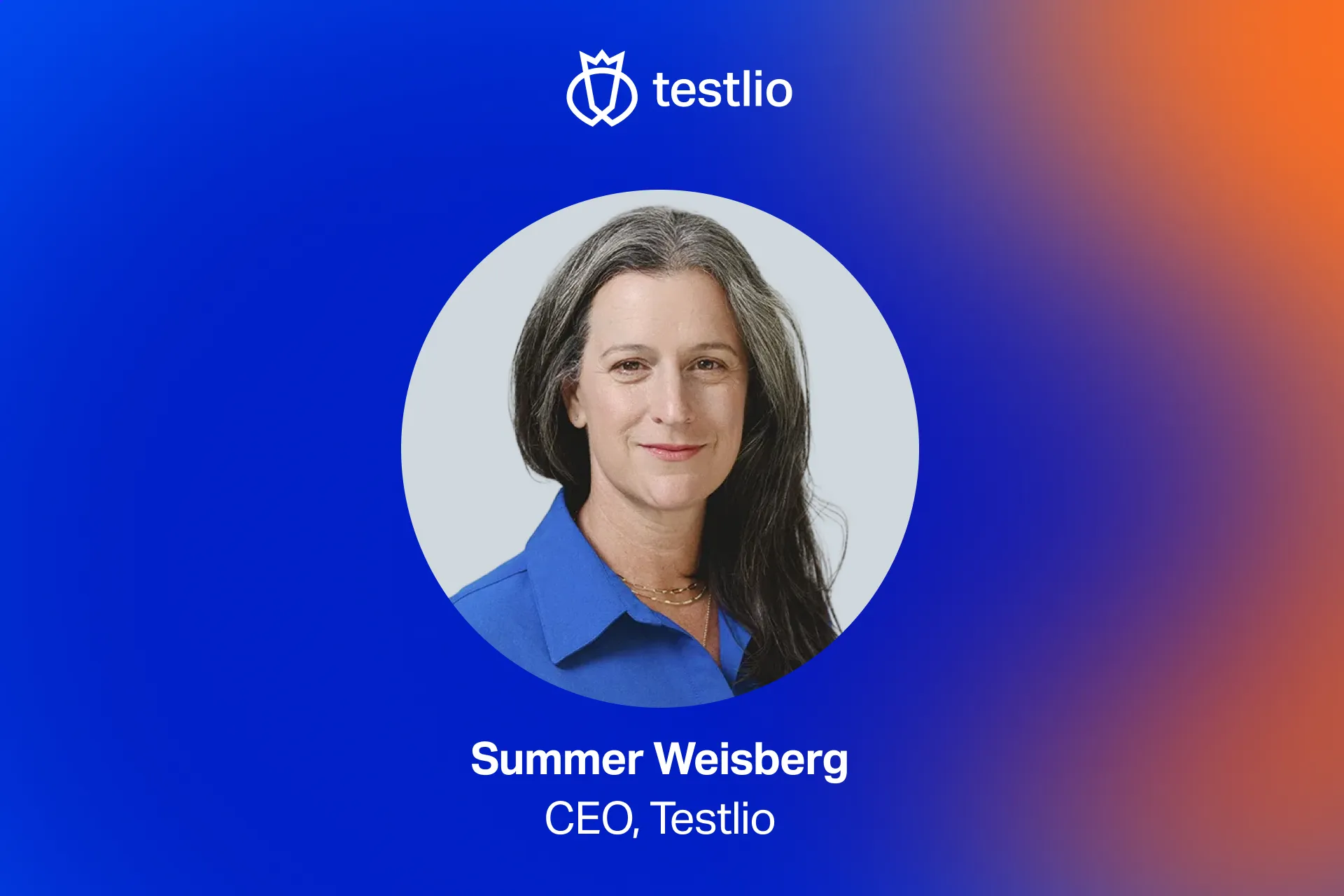
She ran the company before anyone called her CEO
The title arrived in February 2026. The job had been hers for longer. When Testlio's board launched a six-month external search for a new chief executive, Summer Weisberg was already in the chair as Interim CEO - sharpening strategy, aligning teams, building momentum. The board watched and concluded the obvious. After an exhaustive search process, they picked the person who had already been doing it.
That is not a small thing. CEO searches often produce candidates who arrive with their own playbooks, their own read of the business, their own version of what matters. The board at Testlio chose someone who had earned the role through operational clarity and a refusal to drift. "Strategic clarity, operational discipline, and accountability" - their words, not spin. The kind of description that only reads as credible when the recipient has already demonstrated each quality in plain sight.
Weisberg did not start in SaaS. She started writing software. A computer engineer by training - both her bachelor's and master's degrees from the University of Central Florida - her first role out of school was at Silicon Graphics, one of the defining workstations companies of the 1990s. Then FedEx, for a decade, where she wrote business applications and led test operations. The enterprise isn't glamorous territory. It is the kind of work where you learn what actually breaks, and why, and at what cost. It is the best possible education for someone who would later run a company whose entire product is making sure things don't break.
The pivot from large legacy enterprise to the startup world came through CA Technologies, where she spent over six years leading the Continuous Delivery Practice across North America - managing implementation of DevTest, Release Automation, and Test Data Manager tools. That role required her to straddle the technical and the commercial simultaneously: understanding enough about software pipelines to be credible with engineers, and enough about business value to be trusted by the executives signing the checks. Then CloudBees, the Jenkins enterprise, where she built the worldwide customer success operation and spoke at Grace Hopper Celebration in 2019 on how high-performing companies navigate digital transformation.
She joined Testlio in 2020, as Head of Services. That framing is worth sitting with - she did not arrive as a C-suite hire. She joined to build something functional. Over the next five years she advanced through Chief Client Officer to COO, and then, by circumstance and demonstrated competence, to Interim CEO. The board just made the interim permanent.
"Quality is your only real defense."- Summer Weisberg, CEO, Testlio
What Weisberg runs is genuinely unusual. Testlio describes itself as an AI-powered managed crowdsourced testing platform - a phrase that requires unpacking. The core idea is this: global product teams at companies like PayPal, Paramount, Strava, and Clari need software testing that goes beyond what automated checks can cover. They need real humans, on real devices, in real contexts. Testlio connects them with a global network of quality engineers - spread across 150+ countries, working across 600,000+ real devices, covering 100+ languages and 800+ payment methods. The platform layers AI tooling on top of that human network, using 13 years of proprietary data and 2.6 million test cases to make the whole thing faster and more consistent.
It is, structurally, a marketplace and a managed service at the same time. The diversity of the tester network is not incidental. Testing software for global audiences requires people who actually live in those contexts - who know what payment flows work in Brazil, what UI expectations differ in Japan, what accessibility edge cases arise on older Android devices in sub-Saharan Africa. You cannot automate your way to that knowledge. You need the humans.
Weisberg's position on AI is the most interesting thing about her public voice. She talks about it the way a doctor talks about medication: powerful, specific, dangerous if misapplied. The quote that keeps circulating - "AI is a tool, not a strategy" - is the kind of line that sounds obvious until you look at how many enterprise software companies are doing the opposite, leading with AI as a brand rather than a capability. Her version is pointed: if you haven't built a quality engineering foundation first, AI accelerates your mistakes. It does not correct them.
That position shapes her vision for Testlio. The company's LeoAI engine is not positioned as a replacement for human testers. It is positioned as the layer that makes human judgment faster, more consistent, and better targeted. "AI excels at pattern recognition," she has said, "but human judgment remains essential for interpreting context and understanding user intent." That framing - human judgment at the center, AI as support infrastructure - is both a product thesis and a market bet. The bet is that AI-enabled products are harder to test than prior-generation software, precisely because AI outputs are probabilistic and context-dependent in ways that deterministic code is not. Testing them requires exactly the kind of human-in-the-loop rigor that Testlio is built around.
"You can't improve what you don't measure. Establish clear quality metrics, unify your testing data, and build visibility."- Summer Weisberg
Testlio is also a useful case study in what a diverse tech company looks like operationally rather than rhetorically. The company was founded by Kristel and Marko Kruustük, an Estonian couple. Today, approximately 46% of full-time employees are women. Over half of the leadership team are women. Weisberg herself is now the CEO. None of this happened by accident, and she is direct about why it matters: "Diversity makes a difference. Companies are recognizing that diverse companies work better and have longer term success." Not a moral argument dressed up in business language. A business argument, stated plainly.
Testlio has raised just over $20 million in total funding, with a $12 million Series B in late 2021. For a company serving enterprise clients at the PayPal and Paramount tier, that capital efficiency is notable. This is not a company that grew by outspending its category. It grew by being genuinely useful to the customers it serves.
Weisberg is also a certified DevOps Foundation practitioner and SAFe Agilist - credentials that most executives at her level would not bother to acquire, let alone advertise. They are the professional equivalent of a chef who still sharpens their own knives. A signal that the distance between what she knows and what the people doing the work know is smaller than typical. That matters in a company where the product is technical credibility.
She has been consistent about one thing across every role: the emphasis on measurement. "You can't improve what you don't measure." It is a founding principle of quality engineering, but it is also a description of how she thinks about leadership. Establish the metrics. Unify the data. Build visibility. Then make decisions. The sequence is not negotiable, and it is not decoration. It is infrastructure. And she has spent fifteen years building it, one company at a time, before arriving at the one where she would run the whole thing.