A school hall pass seems an unlikely place to meet a software entrepreneur. It is a small permission, usually granted without ceremony, to go somewhere else. Put it inside an application, however, and the humble hall pass acquires colleagues: sign-on systems, classroom tools, calendars, notifications. Suddenly the little slip of paper has an IT problem.
Sudheer Gaddam’s company, Neumeric, has worked in precisely this territory. Its MyTomorrow project for Cincinnati Public Schools brought school functions into a mobile application connected with the district’s existing systems. There is something appealingly unromantic about the assignment. The point is to help a school function. A successful result might attract less attention than an unsuccessful login.
Gaddam is Neumeric’s founder, CEO and CIO. Those last two titles put the commercial and technical sides of a software business next to each other. His career offers a way to understand the arrangement: engineering education, automotive systems, the construction of an IT department, and eventually a company whose services include the ongoing care of what it builds.
Launch day makes an excellent photograph. Tuesday morning makes a rather better test.
The factory before the founder
Gaddam studied engineering at Osmania University in India, then earned a master’s degree in Engineering at Oklahoma State University. His professional background crosses information technology, engineering and computer aided design. It is a useful combination for someone whose later business would have to understand an organization before writing software for it.
His early work included consulting experience involving Caterpillar Corporation and CadVision Engineers. At Quantum Consultants, an engineering services company, he built an information technology department. He also helped architect ADVMS, a lean engineering software system used within General Motors.
Consider the scale change within those assignments. An engineering tool has a technical purpose. A department requires people, responsibilities and coordination. A system used across an automotive manufacturer must occupy a place among other systems and established ways of working. The work gives his founder story a setting beyond the familiar image of someone staring at a laptop and deciding to start a business.
It also supplies a practical connection to what followed. Software in an engineering organization has to serve the work around it. So does software in a school or a municipal office. The organizations differ, sometimes considerably. The need to make the new tool fit into an existing operation survives the journey.
A thematic career map; stages without verified dates remain undated.
Neumeric traces its beginnings to a Detroit suburb in 1999. Today its business is based in central Ohio, while Gaddam’s professional profile places him in the Columbus metropolitan area. His leadership work also extends to Sudhi Infomatics, where he is identified as executive president.
Two titles, one set of consequences
The founder’s dual CEO and CIO responsibilities are a useful detail. In any software business, the promise to a customer eventually becomes a set of technical choices. Someone must decide how to build the application, connect it to existing tools, manage the work and support the result. The invoice and the architecture have a habit of meeting.
Neumeric offers website development, custom applications, mobile software, staffing, cloud services, maintenance and support. Its range includes both building something new and tending to something already in use. That breadth places Gaddam in a business where the relationship can continue well beyond the initial delivery.
The company describes itself as platform agnostic. Its technology menu includes established content systems such as Drupal and WordPress, alongside a range of development tools. The implication for a customer is straightforward: the starting point can be the organization’s requirements and existing environment. A favorite technology need not receive an invitation to every meeting.
Neumeric reports more than 380 full-time professionals and more than 1,300 successful projects. It also says public-sector customers account for over 60 percent of its business. Those are the company’s own figures. Taken together, they describe a service organization with a substantial public-sector focus, rather than tell us how any particular project performed.
Neumeric’s reported scale and customer mix. Figures are company-reported.
The pricing menu is similarly varied. Neumeric lists fixed-price projects, time and materials, retainers, subscriptions and other arrangements. Different work carries different kinds of uncertainty. A tightly specified assignment and a continuing support relationship do not necessarily belong under the same commercial terms. Here, too, the CEO’s business has to accommodate the CIO’s reality.
The support offering makes that continuing relationship explicit. Neumeric lists packages ranging from email and ticket access to live support, including an option for round-the-clock assistance. Its monitoring services cover application updates, content management systems, patches and performance. Backup and disaster recovery sit within its maintenance packages. These are services a client might need repeatedly, long after the original development budget has been discussed.
There is an organizational responsibility here as well as a technical one. Neumeric offers vendor management, serving as a point of contact across technology suppliers. For a customer with several pieces of software, the task can include working out which supplier should respond. The company’s menu acknowledges the coordination work that accumulates around an application. Gaddam’s business includes selling access to people who will remain involved.
The hall pass gets a software department
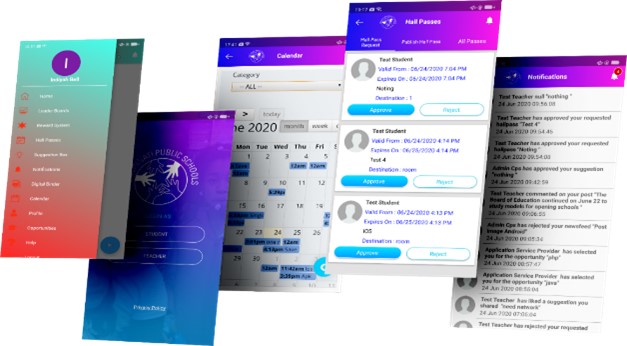
The school application brings these abstractions down to a sensible height. In Neumeric’s account, Cincinnati Public Schools had a MyTomorrow project that needed to move forward. The work involved making the application cooperate with systems the district already used, including single sign-on and classroom integrations. Calendars, notifications and student information shared the same practical setting.
The MyTomorrow work also included bug fixes, design changes and features ranging from digital media storage to internship matching and a student reward system. Schoology and PowerSchool were among the named integrations. The list gives the project a distinct character: a collection of school activities brought together across a web platform and native mobile applications, each with its own practical reason to be there.
A school is full of people doing different jobs on overlapping schedules. Software introduced into that environment has to find its place. The hall pass is a particularly good example because its purpose is easy to understand, while its digital surroundings can be complicated. Permission remains a small human transaction even when the machinery around it grows.
Other projects put the same business in very different surroundings. Neumeric describes a Miami Beach application that lets city assessors record, photograph and track cleanliness across public spaces, then send information to the departments responsible. Behind the resort city’s public face sits the distinctly practical matter of deciding what needs attention and who should provide it.
In Detroit, its work for the People Mover included modernizing a website and replacing an older mobile application with a progressive web application. A transit service needs people to reach useful information. The choice of delivery method belongs to that task, along with the continuing effort required to maintain it.
These are team projects in the company Gaddam leads. Their value in his story is the picture they give of the business: varied clients, established institutions, and technical work shaped around a specific operational need. A school, a transit operator and a city department make different requests. All have reasons to care about what happens after delivery.
Launch day makes an excellent photograph. Tuesday morning makes a rather better test.
On the operating life of software
A classroom in the middle of a career
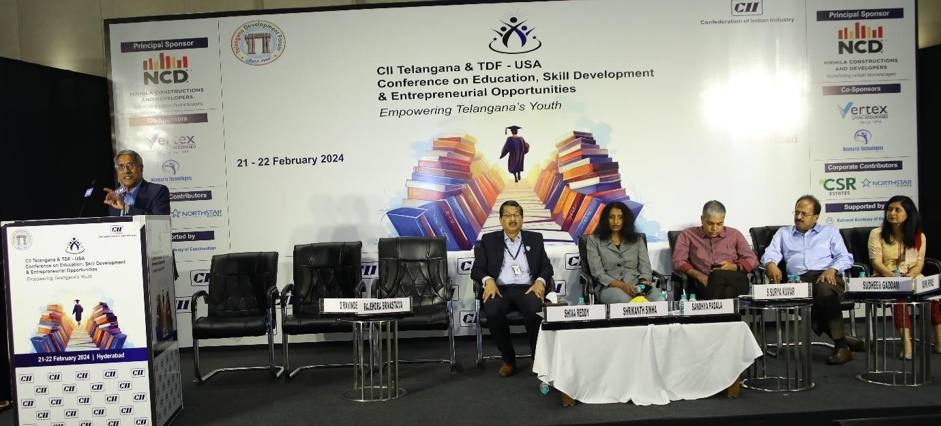
In February 2024, Gaddam appeared at a conference in Hyderabad organized by CII Telangana and the Telangana Development Forum in the United States. The event, held on February 21 and 22 at The Westin, concerned education, skill development and entrepreneurial opportunities.
He joined a session about collaboration between industry and academia. Fellow panelists included Rajendra Srivastava of the ISB Centre for Business Innovation and Shrikanth Sinha of the Telangana Academy of Skill and Knowledge. The discussion covered employer needs, training priorities and the relationship between academic curricula and practical work.
The setting fits another part of Neumeric’s business. Staffing and software delivery both depend on people who can apply their skills, and the company describes investment in continuous training. The conference placed the broader question in public: how should employers and educators work together so that learning connects with the tasks waiting outside the classroom?
Gaddam’s own published interests range across that working territory. His LinkedIn article list includes pieces about choosing a managed services provider and a hospitality management portal in 2017, followed by a piece on tuning machine learning for very large datasets using Spark in January 2018. The subjects move between technical performance and the organization of a service.
His official biography also connects continued learning with an aspiration to contribute positively to the community and society. That ambition sits comfortably beside the skills discussion. An engineering education may begin a career; the need to learn new tools and work with other people tends to keep its own calendar.
The maintenance of a dream
There is a lighter introduction to Gaddam on Neumeric’s team page. After his titles comes the description, “All around pretty cool guy with lots of cool toys.” His colleagues receive similarly playful introductions. It is a welcome flash of personality in a corner of business writing often occupied by solemn declarations of competence.
The wording makes a pleasing companion to the company’s maintenance menu. Updates, monitoring, backups and support are sober responsibilities. They ask a business to remain attentive after the novelty has worn off. The people doing that work are allowed to enjoy themselves. Even an institution’s software does not require its builders to speak like an institution.
That is where the engineering background, the executive titles and the everyday projects meet. Gaddam’s career has moved through tools, departments and businesses. At Neumeric, the work continues into the operational life of an application, with all the small requests that life produces. Somewhere, a student wants a hall pass. The software has a job to do.