A hundred years is an awkward target for a technology founder. The laptop will be obsolete. The programming languages may have retired. Even the office furniture will have had several opportunities to disappoint. Chirag Agrawal wants to build on that timescale anyway. Asked about his ambitions, the WebKorps founder describes an organization capable of going on for a century. It is a rather longer horizon than the next product release.
The wish gives his story its shape. Agrawal runs a software services business from Indore, a city in Madhya Pradesh. His work concerns other people’s businesses: the applications they need, the systems they maintain, the engineering capacity they lack. His own problem is more personal. How does someone who starts a company make it durable enough to function beyond the reach of his own hands?
For a founder, that question contains a small insult. Starting a business rewards the person who takes responsibility for everything. Building an institution eventually requires other people to take some of that responsibility away. Agrawal has acknowledged that delegation was difficult for him to learn. That admission is more revealing than a polished declaration about leadership. It describes a skill he had to acquire, rather than a virtue he simply claims to possess.
His century-long aspiration remains an aspiration. There is no useful way to certify a hundred-year future in advance. What can be examined is the shorter journey already made: an engineering career, a company started with a colleague, work delivered for clients, and the gradual accumulation of people who must be trusted to make decisions.
Before the chief executive, the developer
Agrawal’s route into management began in software. His professional history records an associate software engineering role at Consultadd from June 2012 to May 2013. He then worked at Open Destinations, from June 2013 to January 2016, as a full stack Ruby on Rails developer. Those dates put several years of employed engineering work before the decision to establish WebKorps.
The distinction matters. A developer experiences a business promise as something that must eventually be made to run. Requirements turn into code. Code encounters users. Users discover all the cases the requirements neglected to mention. That sequence provides a useful education for anyone who later has to sell the work, although it offers few shortcuts through the commercial side of running a firm.
His education includes Rajiv Gandhi Prodyogiki Vishwavidyalaya, and his professional profile lists certifications in Java and Microsoft SQL Server 2008 R2. The latter is a pleasingly specific timestamp in a sector inclined to speak entirely in futures. Before conversations about intelligent systems, there were databases to understand and applications to build.
Former colleagues describe a person with technical ability and an easy manner. Abdul Gafar Khan’s recommendation emphasizes attention to detail, unconventional approaches to problems and a calm disposition. Shampi Jain, who says she worked with him for more than three years, recalls logical thinking and a readiness to develop new ideas. These are colleagues’ judgments, but they offer a more human picture than a job title can.
Two founders, then a roomful of decisions
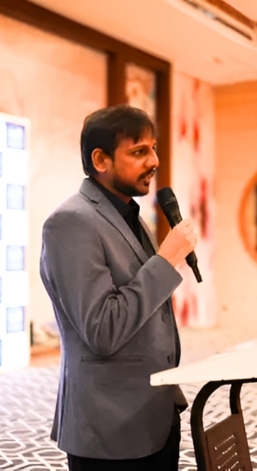
In 2016, Agrawal and Amul Choudhary started WebKorps. The company’s account of its beginnings places two departing employees in a 500-square-foot office. Agrawal became CEO; Choudhary is now COO and co-founder. The physical scale of that beginning is easy to grasp. Five hundred square feet leaves limited room for either a large workforce or an elaborate mythology.
By 2026, WebKorps reports more than 250 technologists, more than 500 delivered digital solutions and work spanning more than 30 countries. Those are company-reported measures of activity and reach. They do, however, describe a business whose coordination problems are very different from the ones two founders can settle across a desk.
The present leadership roster includes a chief technology officer, Parakh Garg, alongside executives responsible for business, growth, engineering, people and delivery. Indore remains the headquarters, with a company presence in Pune, Bengaluru and the United States. The organizational chart supplies a practical context for Agrawal’s interest in delegation. There are now many kinds of decisions, and many people employed to make them.
The early commercial dilemma he describes is familiar to services founders: a client arrives before the necessary people, or the people arrive before the money to employ them. Neither order is particularly considerate. Hiring and selling have to proceed in relation to each other, while each side would prefer the other to be safely settled first.
Growth therefore changes the founder’s work. The first question is whether the business can win and complete a project. The later question is whether different teams can do that repeatedly. Agrawal’s comments about ownership, execution and delegation address that change in the founder’s work.
A referral is a very small sales department
One client account brings Agrawal’s work into sharper focus. Brandon Stevens, founder and CEO of Scoutr, described hiring his team for a frontend overhaul intended to improve the product’s experience and reporting. A local engineering lead made the referral. Four people worked across frontend, backend, testing and design, with discovery, architecture and sprint management included in the assignment.
Stevens singled out Agrawal’s leadership and commitment to clients. He also wanted more complete reporting and documentation. That combination is useful: a positive relationship with a concrete request for improvement. Software projects have a way of producing both. A client can appreciate the people and still want a clearer account of what is happening.
The detail keeps the story at working height. A referral earns an introduction; the subsequent weeks must justify it. Design, testing and communication do the less glamorous work of maintaining confidence. There is little theatrical about documenting progress, which may explain why documentation appears so rarely in founder mythology and so frequently in client requests.
Agrawal’s language about clients centers on partnership. The practical test of that word is what happens once interests become inconvenient: a requirement changes, a deadline tightens, a report needs improving. Calling someone a partner creates an expectation of involvement. The Scoutr account offers a bounded example of a working relationship, including the part that could be better. It is more informative than an unqualified compliment.
The temptation to confuse activity with value
A software services company has to keep changing what it can deliver. WebKorps now offers work across cloud systems, mobile and web applications, enterprise software, AI, data and additional engineering capacity. The breadth creates a leadership problem of its own. When the service list expands, somebody still has to decide what a particular client actually needs.
Agrawal’s public message in September 2026 addressed that tension. He described the changing emphasis from cloud adoption to modernization and then to AI, while returning to a simpler test: whether the work produces value. His stated priorities include moving AI beyond experiments, designing systems that can grow with a business and continuing to question the company’s own habits.
That last point deserves attention. Experience is an asset until it becomes an automatic answer. A successful approach can acquire the authority of a company tradition, even after the circumstances that made it useful have changed. For a founder who wants longevity, the willingness to revise a familiar method is part of the job.
His outward-facing work also includes industry events. WebKorps promoted meetings with him at INDIASOFT 2025 and at CES in Las Vegas. The exhibition setting offers an almost comic concentration of the technology business: new possibilities everywhere, and the old requirement to make a useful connection. A conversation still has to become a practical assignment.
The pace of technological change makes his hundred-year horizon more interesting, rather than more plausible by default. No current service menu can serve as a century’s plan. The durable ambition must sit alongside decisions that are much more immediate: what to build, whom to hire, when to revise a process and how to tell whether the result helped.
“I wanna build something which is bigger than myself.”Chirag Agrawal, in conversation with The Mainstream
Learning to leave room for other people
Agrawal has discussed using AI to extend people’s abilities and automate repetitive work. Alongside that technology discussion sits a distinctly human concern: a culture in which people take ownership. A business can buy software more quickly than it can develop that kind of working relationship. Responsibility requires people to understand both the task and the room they have to act.
There is a connection between those interests. Delegating to a colleague and introducing a new tool each require a leader to reconsider where work should sit. The decisions are different, but neither is resolved by wishing for greater efficiency. Someone has to understand the job well enough to assign it sensibly and recognize when the outcome needs attention.
His advice to younger entrepreneurs emphasizes execution and knowing their reasons for starting. His own account allows progress to precede perfection early in the work, while preserving a place for quality. That is a more demanding balance than the familiar injunction to move quickly. Progress needs a direction; polish needs a deadline.
What makes Agrawal’s ambition worth following is the tension it creates in the present. A company intended to last beyond its founder has to make room for other people’s competence now. The original developer must sometimes resist being the person with the answer. The chief executive must help establish conditions in which answers arrive without him.
The two founders who began in a small office have already built a larger organization. Whether it becomes the enduring institution Agrawal imagines will be decided through work that rarely looks historic while it is happening. Another person gets trusted with a decision. A client returns. A method is improved. The hundred years can wait; the next handover cannot.