Consider the utility pole. To someone waiting for faster internet, it is scenery. To a network designer, it is a crowded piece of real estate, carrying cables and equipment, exposed to weather, and subject to physical limits. Before another line goes up, somebody has to establish whether it belongs there. What can this particular pole carry?
Polosoft Technologies has made that territory part of its business. Founded in 2016 by Lalit Tyagi, the company supplies telecom engineering, geospatial processing, CAD drafting, and software services. Its most revealing work happens between a proposed network and the documents needed to build it. Delivering broadband involves rather more than buying fibre.
- Surveys, GIS, LiDAR, and CAD turn infrastructure data into usable plans.
- Telecom operators, utilities, and engineering firms are core buyer groups.
- Ask how the team verifies its work.
A map is a hypothesis
Start with a route on a screen. Polosoft's fibre engineering service includes field walk-outs, site surveys, high-level and low-level designs, permitting support, and as-built drawings. The sequence matters. A route first needs information about terrain and existing infrastructure. It then needs a design detailed enough for other people to use. After installation, the record needs to reflect what actually went into the ground or onto the poles.
In an August 2025 article about reviewing Smallworld FTTH designs, Polosoft begins with the repository itself: coordinate systems, missing attributes, geometry errors, and stale data. Only then does it discuss architecture and optical paths. Its practical observation is blunt: “A paper-perfect route can still fail in the field.” Trench availability, crossings, and aerial constraints can turn an elegant drawing into an expensive revision.
This is the first useful lesson to borrow from its approach. Review the inputs before admiring the output. For a buyer, that means asking what field evidence supports the design, how exceptions are recorded, and who checks the finished package. The benefit depends on the answers. A tidy map cannot compensate for an inaccurate account of the street.
The tree is data, too
Polosoft's LiDAR work tackles a related problem: measurements need interpretation. A point cloud represents a scene through three-dimensional coordinates. Classification separates features such as ground, buildings, vegetation, and power lines. Identifying bare earth helps create terrain models; separating trees from wires makes a different analysis possible. The deliverable is useful because the points have acquired meaning.
The company's classification page describes automated processing alongside manual verification. It calls this “Trust-but-verify Learning.” That small phrase is more informative than a sweeping promise about artificial intelligence. For readers evaluating a geospatial supplier, the question is how a classification gets checked and corrected. Automation can handle a first pass; acceptance still needs a definition of correct.
The catalogue extends into tree classification, powerline vectorization, orthophotos, contours, and digital elevation, terrain, and surface models. CAD services add land-survey drafting, drawing conversion, civil engineering drawings, and building information modelling. These are connected capabilities: a measured landscape can become a classified dataset, then a map or drawing that another specialist can work with.
THE QUALITY QUESTIONHow does a classification get checked and corrected?
What the buyer is buying
The likely buyer is an organisation with infrastructure to plan or engineering work to deliver. Polosoft identifies telecom operators, utilities, engineering firms, government agencies, and enterprises among the groups it serves. Its published telecom portfolio includes examples labelled AT&T, Brightspeed, Comcast, and Charter. Those labels establish the kinds of documentation it showcases; they should not be read as proof of direct contracts with each operator.
Its market position is easiest to understand through the alternatives. A buyer could keep work inside an engineering department, split it among surveyors and drafting specialists, or commission a broader engineering services provider. Polosoft offers several adjacent stages through one supplier. The potential advantage is continuity between data collection, analysis, design, and documentation. Buyers still need to establish that continuity on their own project.
Software names make that proposition concrete. Its fibre engineering page lists tools including 3-GIS, IQGeo, OSPInsight, CAD, and G-Technology. Its pole-analysis material discusses structural loading, clearance, attachments, and make-ready design. Familiarity with a client's working environment matters: a deliverable has to fit the system where the network will be maintained, long after the initial drawing is approved.
A services company with a product shelf
The commercial offer includes commissioned technical work, dedicated teams, staff augmentation, and offshore development centres. Alongside that sits custom application development, cloud services, testing, and digital marketing. For someone choosing a partner, the breadth creates a sensible follow-up question: which team will do this particular job, and what comparable work has that team delivered? A long menu begins that conversation.
There are named products as well. Polosoft links to Bright Directories, a directory-building platform, and Poloda AI, which offers website accessibility auditing, remediation, and monitoring. They sit some distance from pole engineering. They show why the company is best understood as an engineering and technology services business with software products alongside it. Each offer deserves its own evaluation and buying criteria.
Cost enters through scope. A field survey, a drawing conversion, and a dedicated software team involve different kinds of labour. A useful purchasing brief specifies geography, input quality, output formats, review rounds, and acceptance requirements. That is a practical inference from the service mix: compare proposals against the same deliverable, then examine how changes and corrections will be handled.
The people behind the drawing
Polosoft reports more than 300 professionals and a 10,000-square-foot facility. Treat those as company-reported measures of capacity. The more tangible expansion is geographic: it announced a new Bhubaneswar workspace in March 2025, then a Hyderabad office in March 2026. Its contact page lists both Indian locations alongside Sheridan, Wyoming. The operating picture spans American commercial presence and Indian delivery locations.
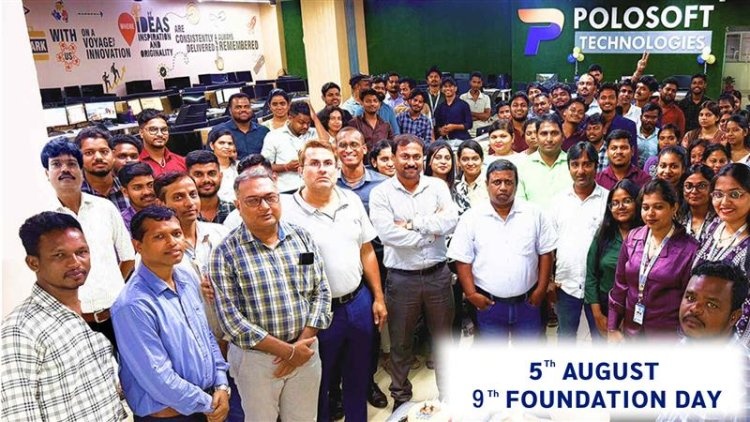
The company describes patience, perseverance, precision, and accountability among its values. Its ninth anniversary celebration, held on August 5, 2025, brought employees and leadership together for games and cake-cutting. At the Hyderabad inauguration, employees decorated the space with rangoli. These are modest but specific glimpses of a workplace whose output can otherwise look anonymous: files, layers, drawings, and review comments.
For a prospective customer, the useful takeaway is to follow one deliverable through. Ask how a field observation becomes a database attribute, how that attribute affects a design, and how a reviewer catches a mistake. Polosoft's catalogue gives buyers several places to ask those questions. Somewhere between the survey and the construction package, the ordinary utility pole stops being scenery. It becomes a decision.