A scholarship is a peculiar kind of business capital. It arrives before the business, usually before there is any reason to imagine one. For JM Akbar, it meant leaving Bangladesh for Japan, studying a new language alongside computer engineering, and beginning the long education that comes with doing business in somebody else’s country. Years later, the company he founded would put both countries in its name.
BJIT stands for Bangladesh Japan Information Technology. There is very little mystery in those four letters. They tell you where the idea began: engineering talent in Bangladesh, customers in Japan, and a founder who had learned to operate between them. The name has survived an expansion into other markets. A business can acquire a larger map and still keep its original address book.
In June 2026, Akbar stood before a different kind of assignment. BJIT was celebrating its silver jubilee at its headquarters in Satarkul, Dhaka. He introduced Vision 2036, a plan for the next decade. The company announced a move toward AI-powered solution delivery. Twenty-five years of experience had brought him to another occasion for learning.
A scholarship, then a sales career
The early sequence matters. Akbar moved to Japan on a scholarship and studied Japanese and computer engineering. He became fluent in Japanese. A presentation at Japan’s National Graduate Institute for Policy Studies places his departure in 1984. Long before the international offices and corporate alliances, there was a student working toward an understanding of a country.
Learning a language is a fairly direct encounter with the limits of confidence. A person may have a perfectly good idea and still lack the words to order lunch, explain a mistake, or make a sale. Fluency changes the range of conversations available. For someone who would eventually sell technical work across borders, that was useful preparation.
Akbar’s professional background included international sales in Japan’s information technology industry. Sales is a revealing apprenticeship for a future founder. An engineer can explain what a product does; a customer wants to know what it will do for them. Somewhere between those two accounts sits the work of making an agreement possible.
By 2001, Akbar had founded BJIT. The decision gave his experience a new use: helping build an employer in Bangladesh that could serve customers abroad. His own journey had involved leaving home to study. His company would create another route into international work, with Bangladesh as a delivery base.
A company with two countries in its name
BJIT’s beginnings belong to the practical world of software development and IT services. There are customers with work to commission and engineers with the skills to carry it out. Getting the two together sounds straightforward until the conversation includes different languages, working habits, locations, and expectations about a finished result.
Akbar’s position between Bangladesh and Japan helps explain the company’s starting point. He had studied in Japan and worked in its technology industry. BJIT could build from that experience while developing an engineering operation in Bangladesh. The connection was specific enough to become a business name, then an organizational structure.
The Japanese entity followed in 2004. Finland came in 2011, an early step into Europe. A United States operation followed in 2015. These are useful dates because expansion can sound almost frictionless in retrospect. An overseas office, however, commits a company to being available in a particular place. Geography comes with administrative chores.
By its twentieth anniversary, BJIT was describing a workforce of more than 600 engineers and more than 1,000 completed projects. Its work covered fields including mobile applications, enterprise solutions, mechanical design, and product lifecycle management. The range is a reminder that a software-services company grows through many separate assignments, each requiring someone to understand a customer’s particular problem.
Akbar’s public recognition included Bangladesh’s Commercially Important Person status, awarded by the Ministry of Commerce. It is a wonderfully literal title for a career spent making commercial connections. Behind the official wording lies a more everyday measure of a founder’s work: an organization that can keep employing people and delivering what its customers ordered.
The classroom belongs in the business plan
In 2014, BJIT established an academy to train engineers and developers. The date belongs alongside the office openings. A company that sells expertise needs a way to develop it. Recruiting a capable graduate begins a relationship; preparing that person for international project work adds another set of obligations.
Akbar’s own history gives the classroom a particular place in this story. Study in Japan came before his career there. BJIT’s academy made training part of the company’s infrastructure. It is tempting to describe business expansion entirely through customers and markets. That account leaves out the people who must become ready to handle the next contract.
On January 14, 2019, Japan’s minister for economic and fiscal policy, Toshimitsu Motegi, visited BJIT’s development center in Dhaka. Japanese diplomatic, trade, and development officials accompanied him. Engineers showed their work and discussed it. The visit also included exchanges in Japanese with IT engineers learning the language as they prepared for employment with Japanese companies.
The scene joins several parts of Akbar’s career without needing a grand metaphor. Language study, technical skill, and international employment were in the same conversation. The student’s experience had become an institutional activity, substantial enough to bring a visiting minister into a development center.
In November 2021, Akbar led a BJIT delegation to meet Bangladesh’s ambassador in Tokyo. The work of connecting countries continued beyond the sales call. A founder operating internationally also has to maintain relationships with the institutions around the business. Software may travel electronically; introductions still have a habit of requiring people.
The partners arrive with their own maps
Marubeni announced a business and capital alliance with BJIT in April 2023. The Japanese trading company brought a commercial network and a stated intention to support international expansion. BJIT brought an engineering operation and more than two decades of software-services experience. The arrangement connected two organizations with different routes to customers.
That distinction makes the alliance interesting in Akbar’s story. A founder who began with knowledge of a particular market was now working with a partner able to open further commercial conversations. Marubeni’s announcement covered investment in BJIT Ltd and a Singapore company managing overseas sales. Expansion was being given a corporate mechanism.
Etteplan followed in June 2024, announcing a 19.99% minority stake in BJIT. The Finnish technology-services company identified Akbar as BJIT’s founder, chairman, and largest shareholder. The intended collaboration included stronger delivery capabilities and the possibility of extending cooperation into product engineering and technical information services.
“The relationship with Etteplan significantly strengthens BJIT’s position in key European markets.”
JM Akbar · June 2024
The sentence is commercial and specific. It points to markets, rather than treating investment as a trophy. Akbar’s next comment in the announcement turned toward the teams getting acquainted and projects beginning. That is where agreements have to become useful: colleagues learning what the other organization does well, then putting that knowledge to work.
Business + capital alliance
Announced June 2024
A detour into the property listings
Software outsourcing is not Akbar’s only business interest. He also founded Navigation BD Limited and launched RentalHomeBD, a property marketplace. The subject changes from development projects to homes and commercial space, while the role of an intermediary remains recognizable: help people find something they need and make the transaction easier to approach.
Property listings introduce a different customer conversation. Someone looking for a place to rent needs usable information and a way to reach the other party. NavigationBD describes its aim in terms of convenience and trust. Alongside BJIT, the venture puts a domestic information service into Akbar’s otherwise strongly international business biography.
It is an instructive change of scale. A founder can spend years organizing technical work across countries and still see a useful problem in an everyday local search. The person looking for an apartment has little reason to admire the machinery behind a website. They would quite reasonably prefer it to help them find an apartment.
Twenty-five candles, a ten-year plan
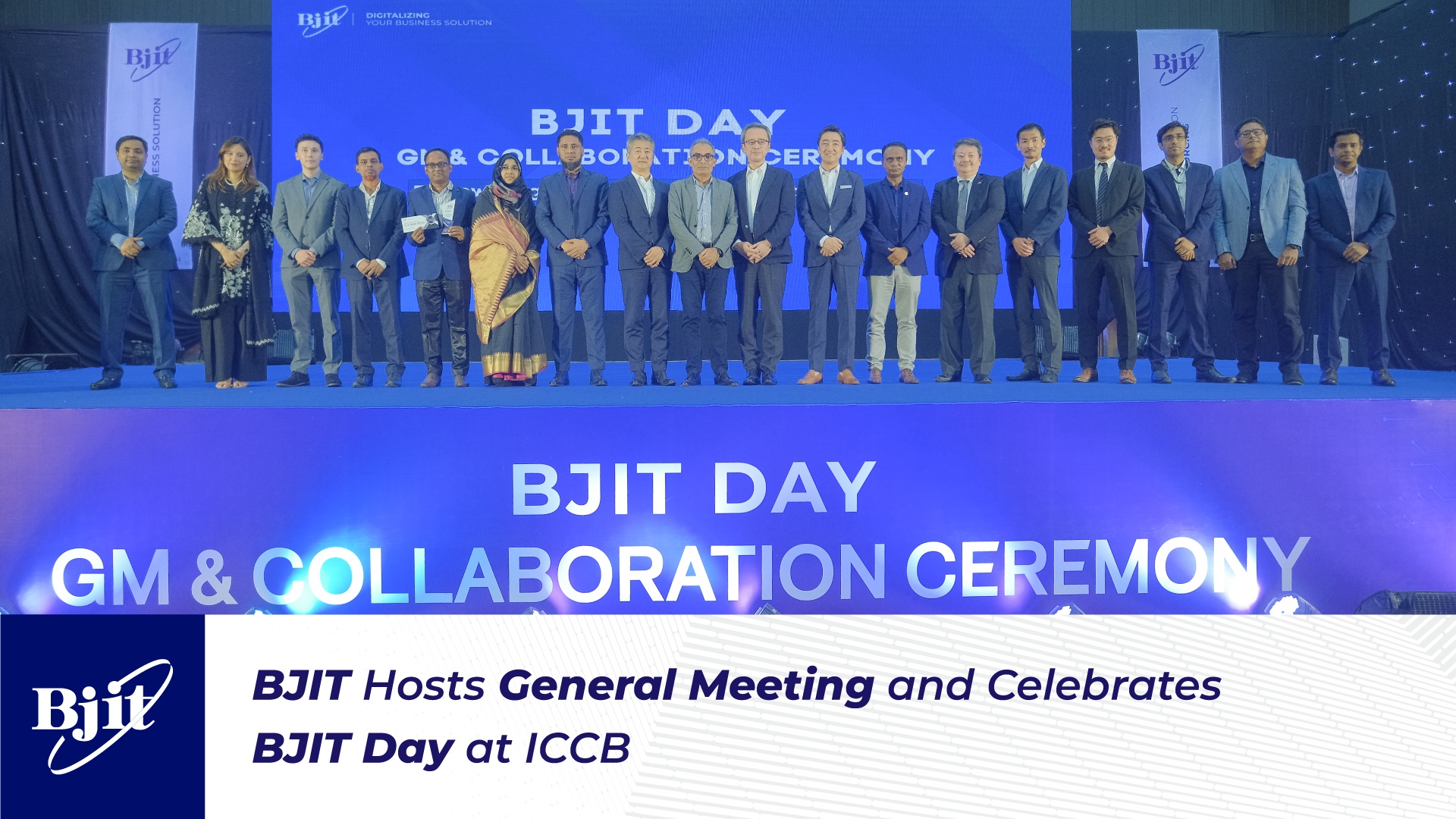
At BJIT Day in 2024, Akbar opened the company’s general meeting at the International Convention City Bashundhara. The event introduced miniERP, FaceAI, and Xamify, alongside discussion of the Etteplan collaboration. There were also new employee benefits. Products, partners, and the people doing the work shared the agenda.
Two years later, the silver-jubilee celebration connected the Dhaka headquarters with employees joining online from overseas offices. Marubeni delegates attended; Etteplan’s Juha Näkki addressed the gathering virtually. Akbar introduced Vision 2036, with innovation, international expansion, and talent development among its themes. The network built over earlier years was present for the next set of plans.
The announced shift toward AI-powered solution delivery gives that plan a concrete direction, while leaving plenty of execution ahead. A roadmap is a statement of intent. Engineers and customers will supply the daily particulars. The next chapter asks an established services organization to change how it approaches its work.
Akbar’s career has already crossed several such boundaries: from student to salesperson, from salesperson to founder, from a Bangladesh-Japan business to international partnerships. Each transition required a new conversation. At twenty-five, his company was putting another one on the calendar. The scholarship began the journey. There is still homework.