Stuart Kearney once tried to bring the logic of defence procurement to the purchase of a household appliance. While studying, he and some friends built a website using technology employed by Australia’s Department of Defence to help choose tanks and submarines. Their version would help people choose consumer goods. A fridge, perhaps. A television. The gap between a tank and a blender turned out to contain quite a lot of product design.
The project did not settle the question. It gave him a reason to keep asking it. Kearney eventually left NASA, a workplace he had dreamed of joining as a child, and began building a company around buying decisions. There are easier ways to avoid choosing the family’s next DVD player.
A radio before the recommendation
Before the shopping tools, there was a very different piece of hardware. In 2012, Kearney was first author on a paper examining whether a commercial radio could serve small satellites. His affiliation was the Universities Space Research Association at Moffett Field, California. The work brought together collaborators from NASA Ames and RT Logic.
The economics were practical. Radios designed for space missions could cost more than $4,000 a unit. The Microhard MHX2420 cost less than $1,000. For a small spacecraft with a small budget, that difference deserved investigation. A cheaper component becomes useful only if it can do the job under the conditions it will actually encounter.
The team used a channel simulator to test radio performance and identify useful settings, including conditions in which the connection failed. Kearney’s paper appeared on the programme of the 2012 Small Satellite Conference in Logan, Utah.
Read alongside his later career, the work offers an interesting comparison: choosing hardware requires more than a promising specification. You need to understand its limits. A price tag starts the inquiry; the operating conditions finish it.
The family’s unofficial buying department
Kearney’s LinkedIn lists the University of Queensland from 2007 to 2011. His engineering background also includes Aerospace Concepts and Australia’s Defence Science and Technology Organisation. His public career crosses the Australian and American engineering worlds before arriving at a problem familiar to anyone with an internet connection and something to buy.
The move invites an obvious question. Why leave spacecraft for shopping? His own account begins with being the family technology enthusiast. Looking into purchases became an interest in how people make decisions. By December 2014, he was explaining the thinking behind Slant, a question-and-answer approach to recommendations.
There is a useful distinction here between knowing a product’s specifications and knowing whether it suits someone. A shopping question comes with a person attached. The person has a budget, preferences and a reason for asking. Any useful answer has to survive contact with those particulars.
That distinction changes the standard by which a recommendation should be judged. Two people can read the same specifications and reasonably choose different products. One wants portability; another cares about a particular task. A ranked list can look conclusive while leaving the important question unanswered. A helpful explanation gives the buyer a way to check whether the advice applies. Seen through that lens, product research is partly a problem of translation: turning information about an object into a decision that makes sense for the person considering it.
Three names, one persistent question
Slant asked a community to assemble product knowledge. In Kearney’s account, it reached millions of people each month, but manually maintaining that knowledge proved difficult to scale. Lustre took the next step, using the accumulated material to train systems that could automate more of the work.
Automation brought its own difficulties. Older language technology struggled to make sense of the variety of products and questions. Kearney later credited large language models with making unstructured material, including forum discussions and video transcripts, more usable.
“Once LLMs came along, everything changed.”
Stuart Kearney · May 2025
He still favoured beginning with research, the part of shopping where a person works out what to choose. His ambition was to make that experience useful enough to earn trust, with discovery and checkout as possible extensions. His caution about automated purchasing included a mundane danger: an order can appear successful to the software and still fail with the merchant.
Consider the difference between suggesting a purchase and completing it. The suggestion can be discussed, compared and changed. A completed transaction creates expectations about payment and delivery. An assistant that crosses that boundary takes on another kind of responsibility. Kearney’s example makes the appeal of handling the whole journey easier to understand, along with the practical reasons for approaching it carefully. The moment a recommendation becomes an order, the merchant’s systems join the conversation.
People organize recommendations.
Build search and product knowledge systems.
Make scattered review material usable.
The sequence is revealing because the difficulty changes shape. First, people have to collect the knowledge. Then software has to interpret it. Eventually, a buyer has to trust the result enough to make a decision.
A company built around the homework
Kearney was building alongside Tim Etler and Tom Raleigh. Golden Ventures investor Ameet Shah met the three co-founders in 2018. When he described the investment in 2022, he emphasized their sustained interest in the problem and the difficulty of the underlying technology.
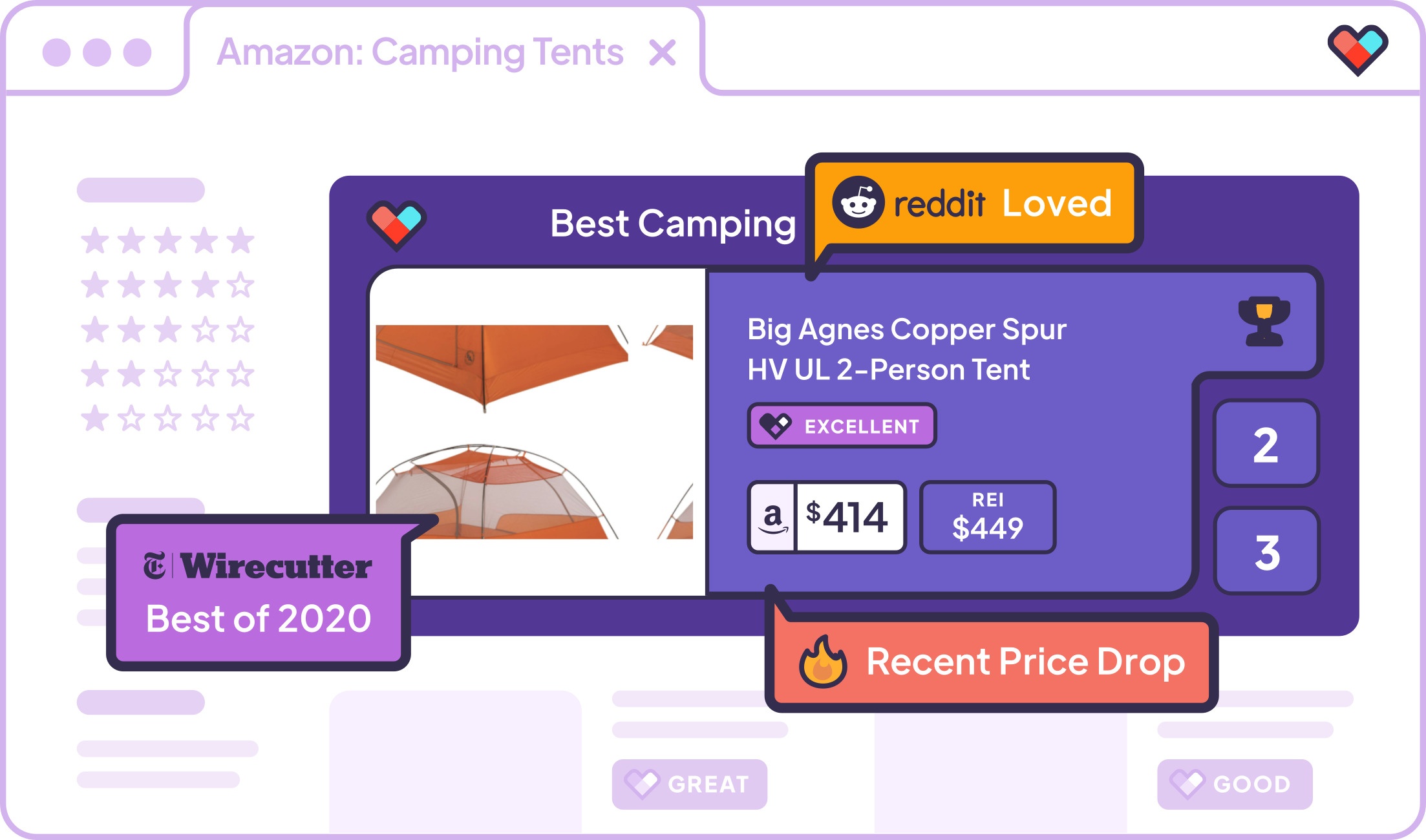
The early Vetted product met shoppers where they already were: on retailer websites. Browser extensions brought recommendations, alternative products and price comparisons into that experience. The choice of location matters. Asking someone to form an entirely new shopping habit is a substantial request. An extension can enter during the habit they already have.
Shah’s description of the desired experience was recognizably social: a knowledgeable friend who has already done the research, then reduces the options according to what matters to you. The comparison has an appealing economy. You can borrow the homework without inheriting the evening spent doing it.
Putting money behind the question
On August 2, 2022, Vetted announced a $14 million Series A led by Insight Partners. Index Ventures, Bling Capital and Golden Ventures participated, alongside angel investors including former Meta commerce executive Shiva Rajaraman. The announcement introduced Vetted under its new name, following Lustre.
The product combined review material with price history, use cases and reviewer consensus. It also explained why a product had been selected. That last detail makes a recommendation something a buyer can inspect, rather than a verdict delivered from behind a curtain.
Led by Insight Partners, with participation from existing investors and angels.
At the time, Vetted said more than 330,000 shoppers used it. Marketing vice-president Hanna Jung reported that users bought its recommendation in a category 70 percent of the time. These were company-reported figures at the launch, describing that moment rather than a current audience count.
Jung also described requests for help beyond consumer electronics. The next task was broader product and retailer coverage. A service that answers one purchase well is useful; covering the next unfamiliar category presents another round of work.
The colleagues behind the comparisons
The organization behind the product was distributed. Product manager Nick Wasylyshyn, who joined in November 2021 as a data scientist, described colleagues spread across five continents. His account of Kearney’s leadership emphasized support, involvement without micromanaging and an interest in people succeeding.
That is a colleague’s view, and it gives the founder story a useful human scale. Wasylyshyn described varied, challenging work and feeling that his contribution mattered. A shopping assistant may look like a single answer on a screen. Producing that answer involves people with different skills, responsibilities and judgments.
Etler’s background was in frontend development. Raleigh worked on the backend. Kearney brought systems engineering experience. Read together, those roles make the product easier to picture: an interface someone can use, systems that can sustain it, and the continuing work of deciding what information belongs in the answer.
A short recommendation can conceal a large amount of coordination. Ideally, the shopper never has to think about any of it. They have a tent to buy.
The Yahoo chapter
In November 2025, Kearney announced that Vetted had been acquired by Yahoo. He thanked the team and investors and named Matt Sanchez, Sarah Priestley, Ryan Massie and Eric Feng among the people he looked forward to working with. His public LinkedIn profile now lists Yahoo and describes him as an AI product leader.
Sanchez’s announcement described an agreement to acquire Vetted and connected its product discovery work to Yahoo’s plans for more personal shopping experiences. Comparisons, recommendations and insights were central to the stated rationale. The team and technology were both part of the attraction.
The move gives the story a different setting. A founder who worked on a shopping problem through successive products is now associated with a company whose services already form part of many people’s online routines. The practical question becomes where that recommendation work can help within those routines.
Acquisitions make convenient endings for company histories. Kearney’s career is more interesting when the buying decision stays in view. Someone still needs to choose. Someone still wants an explanation that respects their circumstances. The software can change, and the organization around it can grow. There remains a small, stubborn question waiting at the other end: which one should I get?