Roberto Ortiz took a picture of a necktie to his Lockheed Martin interview. More precisely, a picture showing how to tie one, tucked into his pocket in case the knot came loose. He was sixteen. He had exchanged his Jordans for dress shoes and his hoodie for a button-down. Corporate life apparently required a little technical documentation before one even reached the desk.
In the lobby, he rehearsed a brief set of instructions to himself: “Chill. You got this. Firm handshake. Eye contact. Smile.” He got the job. The detail that survives is the diagram: a young designer preparing for an unfamiliar world by finding something practical he could do about it.
His career would take him through Google, Yahoo, a fantasy sports business, and Welcome, the online events company he co-founded. Along that route, he would discover that getting through a door and deciding to remain inside were quite different skills.
The neighborhood was his first client list
Ortiz grew up in North Philadelphia. His mother raised five children after his father died when Roberto was nine. Work entered the picture early. By twelve, he was trying to persuade a neighborhood bodega to employ him. His mother’s Saturday routine involved Marc Anthony on the stereo and children assigned to cleaning. Before there was a design team, there was a broom.
He liked drawing and once imagined becoming an architect. Technology offered another way to make things. As a teenager, he taught himself web design and front-end work, then approached local businesses with an offer: he would build them a website for free. The restaurant owner and the person selling tacos became possible clients, and the neighborhood became a place to practise.
Eventually, people paid. That changed the meaning of the exercise. A skill he was teaching himself could have value to somebody else. He has described that discovery as empowering. A website was both a finished object and evidence that he could figure out the next problem.
His mother also made sure he joined educational programs that supported his interest in technology. The route into a professional career involved personal initiative and people making room for it. Both would remain part of his thinking about opportunity.
- 16Starts at Lockheed Martin
- 2013Fantasy sports business acquired by Yahoo
- 2020Welcome pivots into online events
- NowBuilding and advising through Ventura Partners
The trouble with a dream job
Google looked, by his own account, like the dream. The pay was good. So were the perks and the chances to develop his craft. For someone whose starting point was inner-city Philadelphia, simply arriving there represented a considerable journey.
Yet a few months into the job, he could imagine staying for the rest of his working life. The prospect unsettled him. Comfort had become persuasive enough to make leaving difficult, and that was reason to consider leaving. He wanted to attempt ventures whose outcome was less certain.
“I wanted to take some bigger swings.”
Roberto Ortiz, on leaving Google
He later recalled the concern of friends and family when he quit. His own retrospective contains ventures started, failures endured, capital raised, and businesses sold. It is a less tidy account than an employer list, and considerably more informative. The list tells you where a person worked. The decisions explain what they were willing to risk.
A fantasy sports venture with Jerry Shen was acquired by Yahoo in 2013. Ortiz went on to lead mobile design there. The small company and the large platform offered different scales for his work; the design responsibilities connected them.
A conference before a company
Alongside the software, there was a room full of entrepreneurs. Jerry Shen, Roberto, and Charlena had helped start a community at South Bay Church. Meetings brought together people interested in business, books, and the experience of running a startup. Some gatherings attracted more than a hundred attendees.
In June 2013, Shen announced the group’s first ELEO conference. Its subject was leadership for entrepreneurs. The questions included how to persuade people to follow a vision and how to become someone worth following. Speakers included founders from YouVersion, Watsi, and FiveStars. Admission was free.
For Ortiz, this work also offered a practical education in events. A conference requires attention to speakers, staging, presentation, and the audience’s experience. Software has users; an event gives you the unusual privilege of seeing a number of them sitting in front of you.
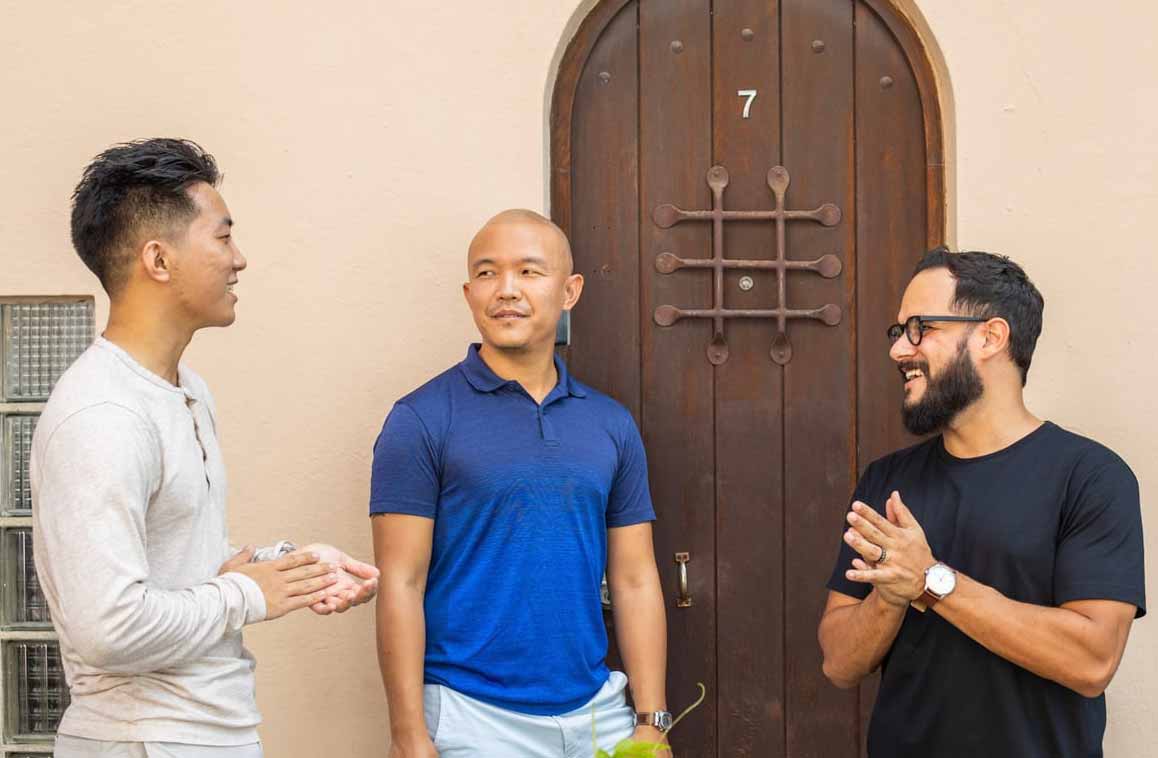
The eventual connection to Welcome becomes easier to understand with ELEO in view. When the team started making software for gatherings, they already knew how much work went into making a gathering feel worth attending. A side project had supplied an apprenticeship.
When the plan stopped working
By the beginning of 2020, Ortiz and his partners were pursuing a different business: connecting restaurants with food wholesalers. They had entered Y Combinator’s winter batch. The plan had a market, a purpose, and customers to approach. Then restaurant closures removed the foundation beneath it.
Ortiz, Jerry Shen, and Tiger Shen had to decide where their skills could be useful next. They were attending online events themselves and finding the experience unsatisfying. Their background in producing conferences gave them a particular objection: the presentation fell short of what they would want associated with their own brand.
Welcome emerged from that objection. The team began building a platform that would let organizers put more care into an online gathering’s production and visual identity. The original business had been about ordering goods. Its successor concerned how people gathered around an idea.
Welcome’s announced Series A
Led by Kleiner Perkins · Kapor Capital · Y Combinator · WINKleiner Perkins partner Ilya Fushman connected the investment to both the product and the founders’ purpose. The team had experience producing events and wanted more people to benefit from the connections those events could create. The capital arrived after the difficult decision to change direction.
A better seat in the room
Welcome’s later webinar pitch put a familiar frustration into commercial terms. Organizers could collect registrations and measure attendance while still giving the audience a dull hour. The product included a content creation studio, with music, video, and on-screen overlays. Presenters could add calls to action during a session.
These details made the designer’s priorities visible. The audience was meant to have something to follow beyond a talking face and a slide. Branding belonged in the experience. Production tools belonged within reach of the person running the session. Attention was something the event had to earn.
In a 2023 conversation with marketing host Scott Logan, Ortiz discussed making webinars more interactive and considering the opportunities before and after the live event. The gathering occupied a larger sequence: inviting people, holding their interest, and continuing the conversation afterward.
There was also a personal reason for caring about who could attend. An early Welcome event brought together seven thousand engineers. Ortiz thought about his younger self, unable to afford the travel and accommodation required to join a conference in San Francisco. Online participation could remove those costs.
A beautifully arranged event may seem an expensive way to express a democratic instinct. In his case, the two belonged together. He wanted a distant participant to have access to an experience worth accessing.
The family in the business story
Charlena appears in the story well before Welcome. She helped begin the entrepreneur community that became ELEO. In 2015, she and Roberto launched Grit & Virtue, a faith-based personal development company that has reached more than a hundred thousand women.
That work gives his public commitment to faith and family a concrete setting. He also serves on the board of FamilyLife, an organization focused on marriage and family. His career includes institutions whose purpose extends beyond software customers and venture returns.
In a public anniversary tribute to Charlena, he described the domestic planning, curriculum design, and business work she undertook, and argued that founders’ partners receive too little credit. The household was part of the enterprise’s working conditions. His account made that contribution visible.
The family connection also runs through Puerto Rico. Ortiz identifies with his Puerto Rican heritage and now lists San Juan as his base. The island belongs to the present tense of his life, alongside the places that helped shape his professional past.
An island, a studio, another blank page
His current personal site labels Welcome as exited and describes Ventura Partners as a small studio for coaching founders, advising companies, and building. The choice of scale is interesting after a career spent inside large organizations and venture-backed businesses. A studio leaves room for several kinds of work.
He describes interests in education, including more personal learning tools, and in what very small teams can build with AI. He also writes about making things with his hands and developing land for his family. The screen shares his attention with something you can stand on.
There is a practical continuity here. The teenager offering websites needed a way to learn by doing. The event organizer wanted people to meet and learn from one another. The designer of Welcome wanted a better experience for the person joining from elsewhere. Each project concerned the conditions that let someone take part.
Ortiz once called entrepreneurship “a blank canvas.” It is an inviting description, provided one remembers that a canvas does not paint itself. There are customers to speak with, partners to credit, and plans to revise. He has spent much of his career doing those things. The next page, like the first interview, still calls for preparation.