At one in the morning, Jerry Shen was visiting wholesale food markets in San Francisco. He and his partners wanted to connect restaurants with suppliers. The opportunity looked large. Their understanding of the people doing the buying was less convincing. Then restaurants closed during the pandemic. The team needed another business.
- Welcome turned event production into browser software.
- Its buyers wanted branded webinars, audience interaction and reusable video.
- A $12 million Series A financed the pivot; YC now lists Welcome as inactive.
The useful detail is what the founders already knew. They had organized conferences. They understood the difference between having a speaker and putting on a show. When business events moved online, that distinction suddenly looked like a software opportunity. Welcome would build the room around the video call.
A browser with a backstage
Consider the transition between two speakers. In a meeting, a pause is ordinary. At a customer event, the same pause becomes dead air. Someone has to prepare the next guest, remove the previous slide and give the audience a reason to keep watching. Those jobs exist whether the stage is in a hotel or a browser.
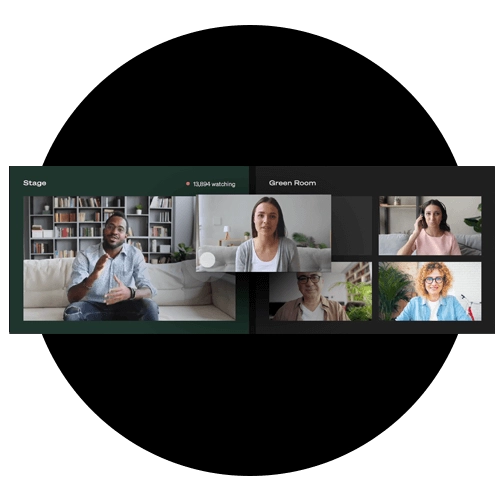
Welcome divided that work into recognizable spaces. Speakers could prepare in a Green Room. Producers could manage the program in a Control Room. The audience saw a branded stage. Live video could sit beside prerecorded material, graphics and clickable calls to action. Chat, questions, lounges and breakout rooms gave attendees ways to participate.

The engineering underneath was partly supplied by Agora, whose video infrastructure supported the experience. Welcome concentrated on the production interface and customization. That division offers a practical product lesson: a company can specialize in how a job gets done while buying the infrastructure that makes the job possible.
The wrong market was a clue
Shen’s account of the restaurant venture is unusually plain. The founders were struggling with an industry they did not understand well enough. The pandemic made the decision urgent. A fire at the Airbnb they were using supplied a grim additional complication. But the new direction came from experience they had accumulated before the crisis.
Roberto Ortiz brought a designer’s background. His career included Google and Yahoo, and his earlier work with Shen included a fantasy sports business acquired by Yahoo. Their events had begun as entrepreneur gatherings. The skills involved in arranging speakers, branding and production were already familiar. Now there was a customer with an immediate reason to pay for them.
“Quality is our differentiator.”
Roberto Ortiz, in Hispanic Executive
That sentence made the company’s ambition concrete. Welcome competed on the feel and control of an event. Its expertise lay in translating production decisions into actions that a small team could manage. The product asked marketers to care about details audiences might never name, but would experience all the same.
The customer bought a room, too
The early examples were more varied than a software conference circuit. Brooks Winery used Welcome for wine experiences. Freely in Hope held virtual galas. All Raise used it to reach people beyond a physical venue. Different programs shared a requirement: the organizer wanted an occasion with an identity of its own.
Hashtag Sports made that requirement visible in June 2021. Its online festival used Welcome and advertised a roster of more than 100 creators, executives and athletes. A program like that involves changing faces, topics and audience expectations. Production controls have an obvious job when a schedule contains that many moving parts.
Welcome’s marketing also displayed technology company logos including Brex, Dribbble and Airship. Its materials offered onboarding by event professionals and advertised SOC 2 Type II. The proposition included help getting ready, alongside the software itself. For a team preparing a public event, rehearsal and reassurance belong in the purchasing decision.
- 01PrepareGreen Room
- 02ProduceBranded stage
- 03ParticipateChat + questions
- 04RepurposeVideo content
A conceptual map of the product workflow, not measured performance.
The recording gets another job
Later positioning brought the marketing department closer to the center. Welcome described itself as a webinar and content platform. Agora’s account describes AI tools that turned moments from online experiences into short videos and shareable content. A live conversation could become material for distribution after the audience had left.
For a content team, the appeal is straightforward. Recruiting a guest, preparing questions and assembling an audience already require effort. Reusing a good answer gives that effort another destination. The sensible discipline is editorial: choose a moment that survives outside the original conversation, preserve its meaning and give it enough context.
This also changes how to plan the live session. A question that invites a specific example is more likely to produce a useful standalone answer than a request for a broad prediction. A clear recording and a well-framed exchange make later editing easier. Teams can copy that habit with whichever event tools they already use.
An annual contract needs a calendar
Kleiner Perkins led Welcome’s $12 million Series A in November 2020, with Y Combinator, Kapor Capital and WIN participating. Launch pricing put annual enterprise contracts in five figures. The commercial logic favored organizations running enough meaningful events to make a dedicated platform part of their regular work.
For buyers, that creates a useful test. List the events that actually need production controls. Estimate preparation and editing time, then compare the total with the contract. A recurring customer program offers more opportunities to use specialist tools than an occasional presentation. A beautiful stage still needs a program worth producing.
There are limits to what the format can repair. A team that needs an informal conversation may gain little from another production layer. An audience with no reason to care will not acquire one from a background graphic. The transferable lesson is to design the sequence first: arrival, preparation, presentation, participation and follow-up.
Today, Y Combinator lists Welcome as inactive. Its history remains instructive because the original observation was precise: putting everyone online did not eliminate the work of hosting them. Someone still had to welcome the speakers, direct attention and make the room feel ready. Welcome built software around that overlooked work.