The most expensive part of a webinar may be the moment everyone clicks the link. Marketing has bought the ads, bribed the speakers with calendar reminders, cleaned the registration list and persuaded a few hundred people to care at the same hour. Then, at the decisive instant, the audience is escorted off the company website and into a beige digital meeting room owned by somebody else. When the show ends, the marketer gets an attendance export. The buyer’s surrounding journey - the pricing page opened before the event, the product page visited after it, the colleague who watched the replay - is mostly a mystery.
Sequel.io was built around the suspicion that this handoff is absurd. Its software puts registration, live video, chat, polls, calls to action and replays directly on the customer’s domain. A viewer at a Carta or Salesloft webinar can remain inside Carta or Salesloft’s world. The host keeps the brand, the path to conversion and the first-party behavioral trail. Sequel then pushes useful pieces of that trail into systems such as Salesforce, HubSpot, Marketo and Eloqua.
That sounds like a design tweak. It is actually the company’s business thesis. The video is only the loudest object on the page. The valuable product is continuity: what a person did before the broadcast, how actively they participated, what they watched later and whether several people from the same account are warming up together.
A problem discovered inside HP
Oana Manolache came to the problem as a marketer, not as a nostalgic television producer. During her time at HP, she ran into the friction of placing live engagement on a large corporate website. The available tools wanted to own the destination. Custom work wanted developers, time and patience. She and technical co-founder Andrei Ermilov started Introvoke in 2019, shortly before a pandemic turned virtual events from a niche into office furniture. The company later adopted the much cleaner Sequel.io name; IntroVoke Inc. remains on the legal paperwork.
The early pitch was broad: no-code live video for online communities, complete with networking hubs and an API for custom experiences. By the time Sequel announced its $8 million Series A in August 2022, led by Javelin Venture Partners, it said it had powered more than 20,000 embedded live events. Customers named at the time included Comcast NBCUniversal and HP.
The sharper version of Sequel arrived through focus. Today the home page speaks less about community as a category and more about marketers, pipeline and the “intelligent website.” The buyer is a demand-generation, content, field-marketing or revenue-operations team. The job is not merely to convene people. It is to turn attention into recognized intent, content and sales action.
What they built, exactly
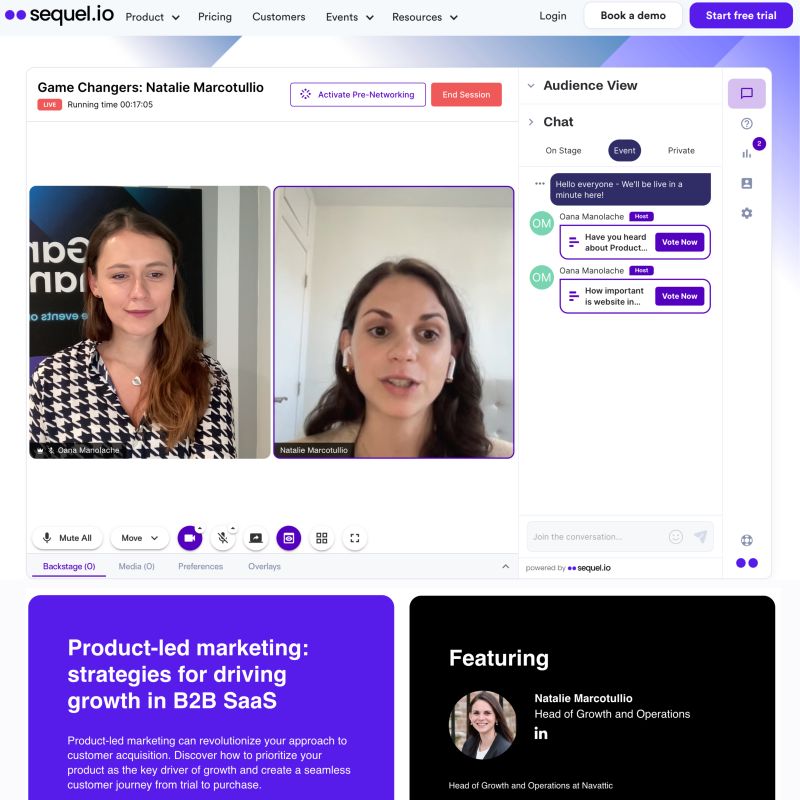
At the front of the machine is an embeddable event component. A marketing team can create a branded webinar or simulive session, place it on a website without asking visitors to install an app, and add registration, email reminders, speakers, chat, Q&A, polls, breakouts and calls to action. Recurring programs can share a registration flow through Event Series. Virtual summits handle multiple sessions. In-person tools cover approvals, check-in and attendance so the physical and digital records do not live in separate filing cabinets.
Behind the event sits Audience Insights. It connects registrations and in-session actions with visits around the website. Newer account-level views roll up several people from the same company, which matters because enterprise software is rarely purchased by a heroic lone webinar attendee. Sequel can sync the result to a CRM, where sales sees more than “Jane attended.” It can see that Jane asked a pricing question, a colleague watched an earlier session and both returned to the product pages.
Afterward, Media Hub hosts the replay and Sequel AI Studio works on the leftovers: locally recorded video, clips, chapters, summaries, blog posts, emails and social assets. Dubbing, translated captions and interface languages extend a program across markets. In 2026, Sequel added an MCP server and a ChatGPT app so approved transcript material can be used inside the AI tools a team already visits. Sequel says 85 percent of its customers actively use AI Studio. Treat that as a vendor-reported adoption figure, but it explains where the roadmap is pointing.
The proof is in programs, not features
Sequel’s best sales material is unusually specific. Apollo.io embedded educational webinars into its product and onboarding journey, ran as many as eight sessions a week and used polls to steer the conversation. Sequel reports a 500 percent increase in product adoption and six times more meetings booked by participating users. The portable lesson is not “buy Sequel.” It is to put education beside the behavior it should unlock, run it often enough to learn and use audience questions as product feedback.
The 6sense LevelUp masterclass became a series rather than a stack of disconnected campaigns. Sequel says it generated 8,600 registrations and influenced millions in pipeline. Carta’s program produced more than 51,000 webinar and livestream registrations and, according to Sequel, cut friction in the audience journey by 75 percent. ThreatConnect built a full-funnel program that the vendor says drove more than $2 million in pipeline, then repurposed sessions into landing-page copy, YouTube descriptions, short video and social posts.
These are customer stories published by Sequel, not controlled experiments. Still, the pattern is more useful than any individual percentage: make the webinar a recurring operating system. The audience gets trained to return. Registration data compounds. Old recordings attract new visitors. The marketing team improves through repetition instead of relearning the choreography every quarter.
The price of owning the room
The public Growth plan costs $833 a month when paid annually, or $950 month to month, for sessions of up to 500 attendees. That annual commitment begins at $9,996. Business and Enterprise tiers are quoted according to attendance and requirements; they add broader CRM integrations, concurrent sessions, security controls, custom analytics, localization and service. Every plan begins with a demo, not a credit-card checkout.
This is where Sequel’s difference from Zoom Webinars, ON24, Goldcast, Livestorm, Demio and other alternatives becomes concrete. It is not universally cheaper and does not need to be. It argues that a company running webinars as a revenue channel should pay for an owned experience and the data beneath it. Reviews tend to praise embedding, branding and support; cost and the jump between tiers appear as recurring cautions.
What failed first - and what changed
The first failure was the handoff, not the livestream. Traditional webinar software could reliably put faces in rectangles. What it did poorly was preserve commercial context. Marketing drove a prospect away from its site, received thin event metrics later and tried to stitch the result back into the buyer journey. Manolache’s experience at HP made that gap visible. Sequel changed the destination first.
The company’s own message then changed. “Stripe for live video” was an infrastructure metaphor broad enough for communities, developers and event producers. “Webinar solution for data-driven marketers” named a budget owner and an outcome. The newer “intelligent website” language expands the ambition again, but around the same wedge: an embedded experience generates a richer first-party record than a link out.
When the playbook does not work
If a company runs two webinars a year, has little website traffic, treats its CRM as an attic or lacks anyone to follow up on signals, Sequel can become expensive plumbing. The same is true when the audience prefers a familiar meeting app, procurement cannot approve embedded scripts, or strict site governance makes every page change a campaign of its own. Data without cadence and action is only a better-organized shrug.
The part to steal
A team can copy the operating logic without copying the entire stack. Pick one repeatable audience problem. Build a named series around it. Put registration and replay beside the product or content that viewers should explore next. Ask one poll that segments genuine needs. Send high-intent behavior to a human while it is still warm. Cut the useful moments into articles and clips, then let those assets recruit the next cohort.
Sequel fits in the market between webinar software, video infrastructure, content repurposing and marketing intelligence. Its risk is sprawl: each new AI agent, in-person workflow and analytics layer makes the suite more valuable but also harder to explain. Its advantage is that the layers share the same event record. The broadcast, transcript, web visit and account are not strangers introduced by a spreadsheet.
The company’s enduring insight is less fashionable than its AI releases and more defensible. Attention is expensive. Sending it away casually is strange. A webinar on your own website can behave like a page, a product lesson, a research session and a sales signal all at once. Sequel.io built a company around making that obvious.