Before WebFX sold the science of growth, its founder was learning the arithmetic of panic. William Craig has written that in 2007 he had $3 in his checking account, a $5,000 credit-card balance, two months of late rent, a month of unpaid payroll and $135,000 owed to the IRS. His young web shop could design and code. What it could not reliably do was sell, collect, hire, manage and repeat.
That unhappy spreadsheet is the most useful way into WebFX. The Harrisburg company now presents itself as a full-service digital marketing partner with 750-plus specialists, a broad menu from search optimization to connected-TV ads, and proprietary software that follows a prospect from first click to closed sale. Its website says its work has generated more than $10 billion in client revenue over the latest five-year window. The number is company-reported, but the choice of scoreboard matters. WebFX does not want to be graded on pages delivered or keywords moved. It wants to be graded on money.

The craft was good. The company was not.
Craig and co-founder Karie Shearer started the business while at Shippensburg University in the mid-1990s. The WebpageFX name was registered in 1995; Craig says his first paid website arrived in 1999, a $900 flat-file database for an import-export company, followed by a $500 site for a Michigan cookie maker. Craig Webpage Design became WebpageFX in 2002. By 2005, the founders skipped conventional job applications and tried to make the agency their job.
What failed first was not delivery. It was the machine around delivery. Craig loved technical books, design tools and building projects end to end. He later concluded that this focus was killing the business. The redline changed his mind. Sales, marketing, operations, people and money moved ahead of raw technical ability on his priority list. He credits the shift with producing profits and consecutive double-digit revenue growth.
“Our business was always redlining. Never enough clients. Never a big enough paycheck.”William Craig, CEO and co-founder
There is a stealable lesson here, especially for founder-led service firms: your best craft can become your favorite hiding place. A beautiful deliverable does not fix weak pricing, a dry pipeline, missing approvals or uncollected invoices. WebFX eventually made the boring machinery visible, teachable and measurable. The company's modern product is, in part, that old lesson repackaged for clients.
An agency with a data layer
Today, WebFX sells the usual agency departments under one roof: SEO, local and ecommerce search, paid search, paid social, programmatic advertising, content, social media management, email, influencer work, web design and development, conversion optimization and marketplace marketing. It increasingly adds AI-search visibility and generative-engine optimization, reflecting a discovery market that now includes ChatGPT-style answers alongside Google results.
The differentiator is less any single service than the connective tissue. RevenueCloudFX, its proprietary platform, unifies advertising, website, lead, customer and sales data. Its modules cover call and form tracking, lead scoring, account identification, content analytics, personalization, integrations and reporting. WebFX says the platform offers more than 1,200 built-in integrations and supports 1,500 businesses. Setup is handled by its team, which is important: software only becomes useful after someone wrestles the tags, fields and definitions into agreement.
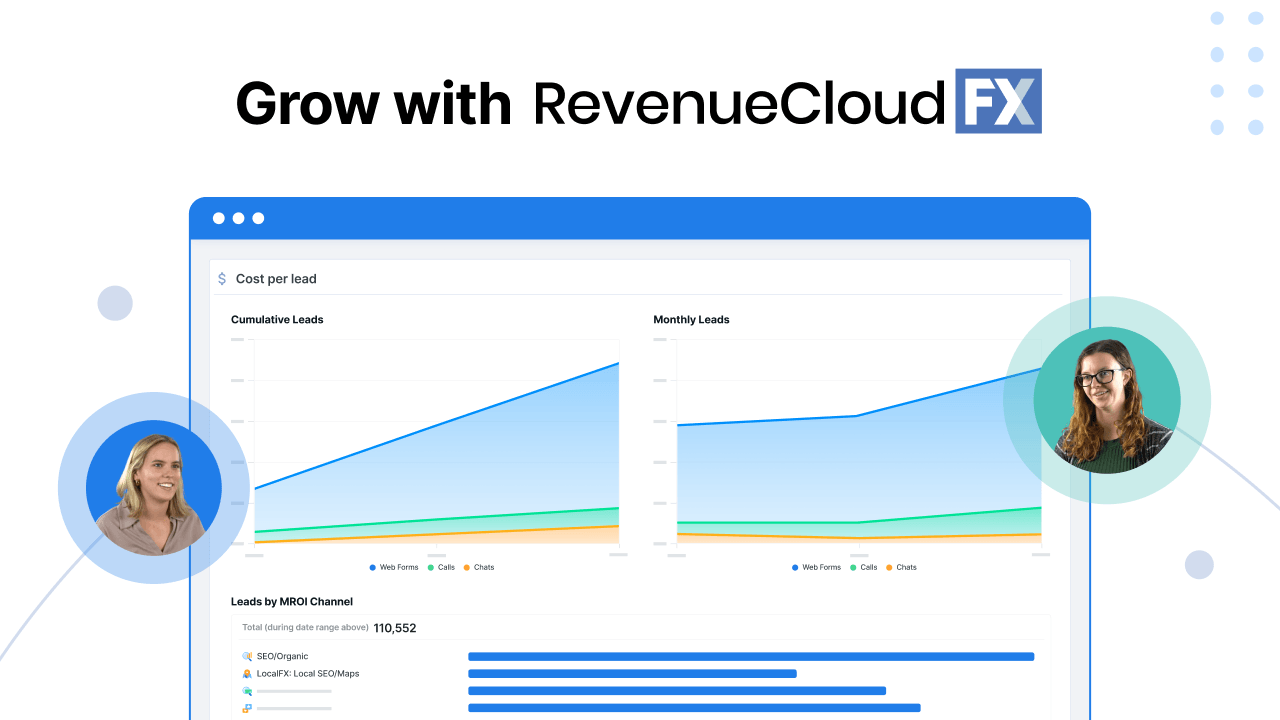
The company closed a crucial gap in 2022 by acquiring Nutshell, the Ann Arbor CRM and email-marketing platform. The move was unusually legible. WebFX had been a Nutshell customer for more than nine years, so it was buying a known piece of workflow rather than auditioning a fashionable acronym. Nutshell carries contacts through a B2B sales pipeline; RevenueCloudFX connects that result back to the marketing source. In theory, the agency, attribution layer and CRM form one closed loop.
Who hires the whole machine?
The practical customer is a growth-minded small or midsize business whose marketing has outgrown a freelancer but whose internal team cannot staff every specialty. WebFX also serves enterprise accounts. Its published platform page displays customers including O'Reilly Auto Parts, Hilton, YMCA, Fujifilm, Verizon, Subway, Wrangler and Northrop Grumman. Its case studies and verified review profiles range across manufacturing, healthcare, retail, professional services, construction and ecommerce.
The problem is vendor sprawl. A company may have one firm for paid media, another for SEO, a developer on call, a CRM nobody loves and a monthly report that counts form fills without knowing which became good business. WebFX's bundle offers one account team and one measurement system. That can shorten the distance between a campaign decision and a sales result. It also concentrates dependency. When the agency, dashboard and operating process live together, changing providers is not as simple as pausing an ad.
Its business model is therefore stickier than a conventional project shop. Clients buy managed services on recurring retainers, plus custom website, creative, data and integration work. Software makes the engagement more measurable and harder to disassemble. Private-equity firm Trilantic North America invested in 2021 to support hiring, new services, offices, technology, analytics and AI. The amount was not disclosed. A year later came Nutshell, the clearest evidence that WebFX intended to own more of the revenue workflow.
A mansion, a code and a lot of ritual
WebFX has also treated culture as an operating system. Its headquarters grew from a small Carlisle office into a Harrisburg campus anchored by an 1895 mansion, inevitably called MansionFX, with neighboring buildings known as FX2 and FX3. The company history features murals, a coffee bar, a gym, pet-friendly desks, a putting patch and, with admirable specificity, a 2022 record for the largest game of flip cup. Offices now extend to other Pennsylvania cities, Florida, Ann Arbor, Guatemala and Cape Town.
The formal doctrine is the POSITIVE Code, an acronym covering personal best, opportunity, success, integrity, tenacity, impact, value and embracing change. There are monthly goals, continual-learning programs and a recurring instruction to improve by one percent. FXBuilds, begun in 2014, funds schools, clean-water projects and charities; WebFX says the program has affected more than 8,500 lives. None of this proves that every employee experiences the same company. It does show that WebFX understands process applies to belonging as much as lead attribution. Ritual is how a growing services firm tries to keep its personality from dissolving into departments.
What does it cost - and what can go wrong?
WebFX publishes unusually concrete SEO pricing. Its current overview says SEO services start around $3,000 a month. The package table lists a two-month initial investment of $5,900 for the entry plan, followed by $2,900 monthly optimization during a six-month commitment; larger standard tiers rise above $12,000 initially and $9,000 monthly. Paid media, web builds and integrated programs depend on ad spend, creative demands and scope. On Clutch, the most common reviewed project band is $10,000 to $49,999, though many engagements run higher.
Published SEO package ladder
The spend can work when a customer's lifetime value is high, the website converts, sales records outcomes and leadership can wait through a learning cycle. It fails when attribution rests on dirty CRM data, nobody follows up with leads, stakeholders cannot approve content or the company expects SEO to repair weak product-market fit. A dashboard cannot rescue a broken sales process. It can merely describe it in nicer colors.
Scale introduces another condition: governance. WebFX has hundreds of strong verified reviews praising communication, organization and results. The same review pool also contains a sharp recent complaint alleging missed approvals, late deliverables and loss of account continuity. One account does not define a company, but it points to sensible buyer diligence. Ask who may publish, how approval is logged, what happens when an account lead changes, who owns the data and how it exports at termination.
High customer value, clean analytics, responsive sales follow-up, clear approvals, a six-month horizon and enough budget to learn.
Unproven demand, poor CRM hygiene, tiny margins, instant-result expectations, unclear ownership or a need for one narrow specialist.
The moat is accountability
WebFX competes in several markets at once. Large agencies such as Wpromote, Merkle, Tinuiti and NP Digital can offer broad expertise. Specialists can go deeper in one channel. HubSpot, Salesforce and Semrush let an internal team assemble its own stack. Hiring in-house provides control and company context. WebFX's answer is integration: the strategists who recommend the work, the practitioners who execute it and the platform that attributes it sit inside one commercial relationship.
That is useful, but not mystical. The company reports a 20 percent average ROI increase from RevenueCloudFX; buyers should treat that as a portfolio claim, then demand a baseline, attribution rules and a measurement plan for their own account. The honest advantage is simpler: when the same vendor owns execution and evidence, it has fewer places to hide. The honest risk is the mirror image: the same vendor also helps define the evidence.
The most copyable WebFX idea does not require 750 employees, a CRM acquisition or a mansion overlooking the Susquehanna. Pick the business outcome your customer truly worries about. Instrument the path to it. Review the failures. Turn the repeatable fixes into process, then software only when repetition earns it. Craig learned that the craft was not the company. WebFX's three-decade project has been building everything around the craft - and attaching a dollar sign to the result.