The most revealing Noble House Media Group client sells portable toilets. This is not a joke at the client's expense. It is the point. Advertising agencies tend to parade sneakers, cocktails and handsome pieces of consumer technology. A Royal Flush rents the objects that event planners urgently need and almost never put on a mood board. In 2018, it had three locations, a modest digital footprint and the ambition to grow. The work was operational, local and measurable. Nobody could hide behind taste.
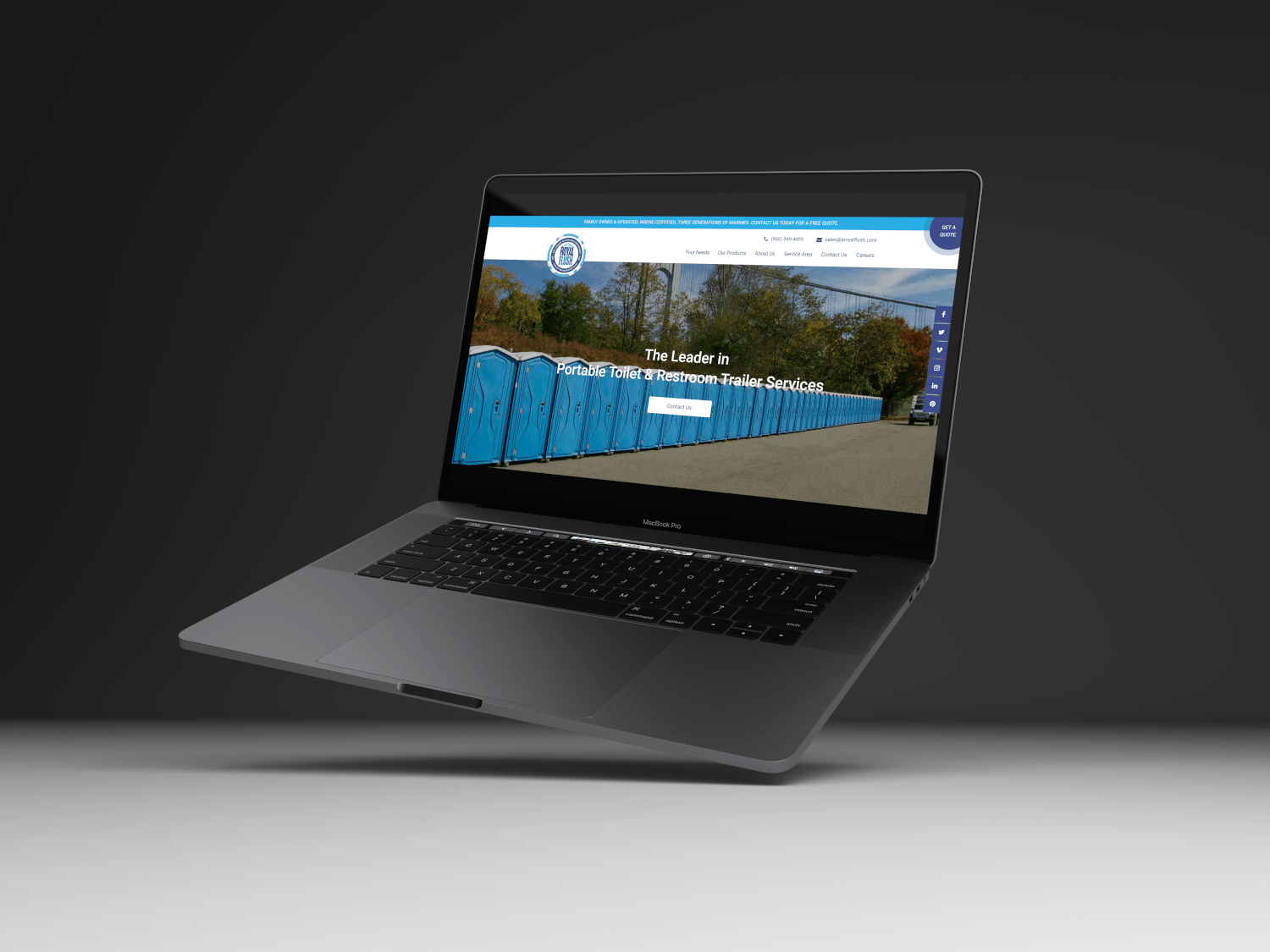
Noble House rebuilt the company's website in WordPress, connected it to HubSpot, ran search and display ads, automated email, handled organic social and local listings, managed reviews, made photographs and video, and added public relations and event marketing. The agency says attributed customers from Google Ads rose 116 percent, new-visitor sessions rose 228 percent and organic sessions increased 57.95 percent within 12 months. Closed-deal revenue grew 88 percent year over year. Those are the agency's own case-study figures, but the mechanism behind them is more interesting than the victory numerals.
Selected results reported by Noble House Media Group for A Royal Flush. The company does not publish underlying client spend.
The expensive space between two specialists
Imagine the ordinary agency arrangement. One shop buys the click. Another built the page where the click lands. A freelancer writes the email that follows. Somebody in-house exports a report from the CRM. If the lead disappears, four competent people can produce four plausible explanations. Each explanation begins at the border of someone else's responsibility.
Noble House's answer is to erase the border. Its public menu now runs to twelve disciplines: websites; search and AI optimization; paid search and marketplace ads; paid and organic social; email; reputation; branding; AI and digital transformation; workshops; process automation; and public relations. Older pages add application development and custom logistics tools. This looks, at first, like an agency unable to say no. Look again and it resembles a map of the customer journey.
The sequence Noble House publishes for several verticals is disarmingly plain: audit, strategy, build, measure. Before a production-company campaign, for example, it compares the website, reel, rankings and reviews with three competitors. Then it chooses channels, builds the required assets and connects inquiry tracking to a live dashboard. The important phrase is not “full service.” It is “before anything goes live.” Breadth without order is an expensive buffet.
The product is not twelve services. The product is the absence of an alibi.What the Noble House model is really selling
The lawyer-programmer in the agency chair

Peter Belbita founded Noble House in 2010. His biography is unusually helpful in explaining the firm's shape: degrees in computer science and law, nearly two decades in digital and marketing, and earlier work involving B2B marketing, product placement and product development for clients that included Target, Walmart and Lego. A founder trained to see systems and contracts might naturally distrust a strategy made of disconnected promises.
The company is privately held and based at 5 Brook Street in Darien, Connecticut, with a second location listed in New Haven. LinkedIn places it in the 11-to-50 employee range. It serves a comically broad collection of industries: home services, healthcare, retail, food, finance, legal, education, nonprofits, manufacturing, tourism, transportation, entertainment, government and construction-site services. The common customer is not an industry. It is an organization whose growth problem crosses departmental lines.
The specialist stack
- Separate scopes and reporting
- Expertise concentrated by channel
- Client manages the handoffs
- Failure can fall between contracts
The Noble House bet
- Custom cross-channel scope
- One account team's shared context
- Measurement follows the lead
- One firm owns more of the outcome
What failed first
The firm's DR Bank case study begins with a two-branch Connecticut bank whose deposits had stagnated. The visible failures arrived in a heap: negative reviews, unsuccessful rebranding attempts, a dormant social presence and heavy spending on traditional campaigns. Noble House's intervention mixed new photography and video with design, landing pages and other digital work. The bank's executive vice president later credited the agency with helping grow its brand. Again, the lesson is less “use social media” than “stop treating reputation, creative and acquisition as unrelated line items.”
A Royal Flush reached the same conclusion from a happier starting point. It had drive, referrals and three locations, but little online machinery. What changed the equation was a referral to an agency willing to connect advertising to a conversion-focused site, a CRM and the dull work of listings and reviews. Social ads used lookalike and remarketing audiences to reach event planners and brides; search campaigns matched copy and landing pages to location and intent. Biweekly reporting calls forced the pieces to meet in the same room.
What did it cost? Noble House does not post a rate card, and its client case studies do not disclose spend. That omission is consistent with the model. The company says there is no standard package; engagements are built around needs, goals and budget. A buyer is purchasing a scope, not a box. The sensible question is therefore not “What is the monthly SEO fee?” but “Which constraint deserves money first, and what must connect to it for the result to be visible?”
A copyable operating system
You do not need to hire Noble House to borrow its clearest ideas. They are procedures, not magic.
- Audit the entire path from discovery to sale. A fast ad attached to a slow page is still a slow system.
- Name the first constraint before choosing a channel. The company explicitly says channel choice should follow the fastest likely source of qualified inquiries.
- Install measurement when the campaign launches. Noble House emphasizes live dashboards and inquiry tracking rather than decorative monthly PDFs.
- Turn completed work into proof. Review requests, case studies and follow-up sequences make one job feed the next.
- Give one person the whole map. Even when specialists do the work, somebody must be answerable for the seams.
There are limits. An integrated agency is most useful when several channels truly depend on one another and the client will share sales data, approve work and sustain the program long enough to measure it. A company needing only a logo, a one-week media buy or deep expertise in one narrow, regulated problem may prefer a specialist. The model also weakens if “full service” becomes an excuse to start everything at once. Noble House's own published method guards against this by putting the audit and priority channel first.
From search results to operating systems
The agency's newest language is about AI-search visibility, workflow automation and digital transformation. It offers audits of existing systems and promises to connect tools such as AI assistants to repetitive business processes. This is a natural extension, but also a test. Automating a broken follow-up process merely makes the disappointment arrive faster. The useful part of Noble House's pitch is its insistence on inspecting the system before installing the machinery.
There is a cultural clue here. In 2021, Belbita announced that employees would finish at 1 p.m. on summer Fridays. The policy was an experiment: perhaps time away from the screen would make the team more attentive when it returned. It is a small story, but it matches the firm's larger habit. Find the part of the system that is quietly wasting energy, change the arrangement, then see what happens.
Sixteen years after it opened, Noble House is still making the unfashionable case for generalists. The case works when generalism means connected judgment, not a long menu. Its most persuasive proof remains a growing sanitation company, because that business strips marketing of glamour. A customer searches, clicks, calls, books and needs a clean follow-up. Somewhere between those verbs, most agencies hand over the baton. Noble House decided to keep running.