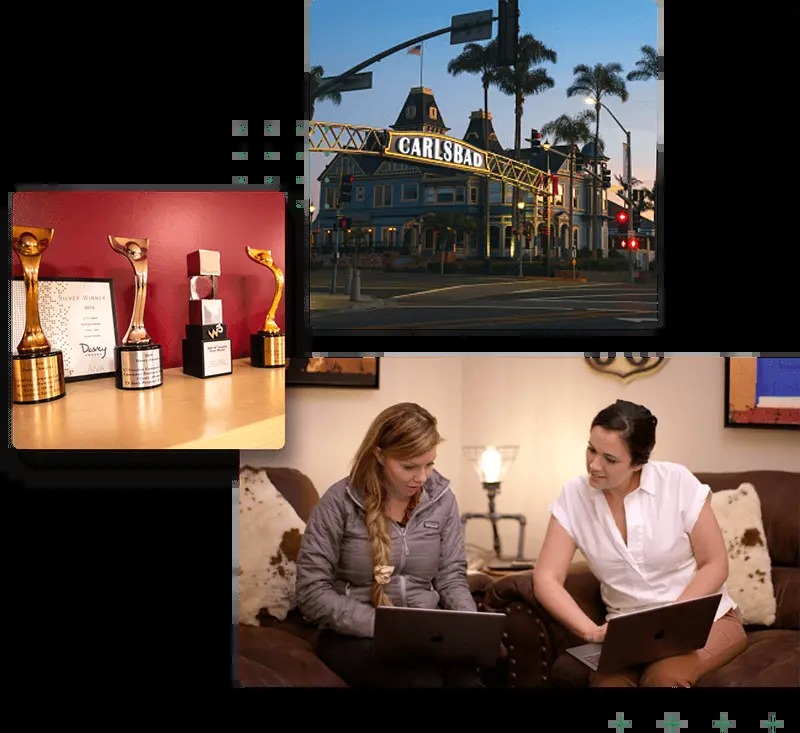
There is a particular sort of death that occurs inside L7 Creative’s Carlsbad office. No one is fired. No account is lost. The casualty is an idea - often an attractive one - that cannot answer a plain question: will this help the client’s business? The agency’s own account of its process says concepts are debated, dismantled and rebuilt. A headline can pass through 30 versions; a logo, 50. If the work cannot be traced to the strategic blueprint, it disappears.
This is not how creative agencies appear in movies. It is, however, a sensible explanation for how a small independent shop founded in 2001 remains in business in 2026. L7 has lived through the banner-ad internet, the social feed, the mobile app boom, influencer marketing, marketing automation and the arrival of generative AI. Its response has been to make adaptation procedural.
“If a concept doesn’t tie back to the Blueprint, it’s gone.”L7 Creative, on its internal creative process
The thing beneath the thing
Founder and CEO Tom Gallego calls discovery a forensic investigation. The team asks who the client really competes with, where its portfolio creates confusion and what slows a sale. The underlying claim is unfashionably structural: many marketing problems are brand-architecture problems. If buyers cannot tell what a company does, a larger media budget only purchases a larger audience for the confusion.
L7 packages that belief into the Brand Blueprint and the broader L7 Marketing Machine. The names have the polished gleam of agency trademarks, but the sequence is ordinary enough to copy. First, diagnose and align. Then build the messages, assets, platforms and funnels. Finally, inspect what people actually do and keep adjusting. The useful part is not the vocabulary. It is the refusal to let launch day masquerade as completion.
Clarify the audience, competition, position and architecture before anyone falls in love with a campaign.
Turn the blueprint into copy, design, video, websites, ecommerce, paid media, CRM and automation.
Use funnel data, heatmaps, A/B tests and channel results to revise the machine after it meets reality.
That structure also explains the unusually wide service menu. L7 is a brand shop, web developer, demand-generation team, social studio and analytics partner. The company’s center of gravity is healthcare, healthtech, life sciences, biotech and ecommerce - fields where a proposition must be technically correct and emotionally legible. Its public portfolio names Eisenhower Health, Hologic, Kingston Technology, HyperX, iHome, Vizio, Nutrex Hawaii, Triaj and oncology-data company MiBA.
A hospital does not need another job ad
Eisenhower Health had a geographic problem. The Coachella Valley did not produce enough qualified nurses, and larger health systems were competing for the same people. L7 reframed recruitment as a customer-acquisition system. The work combined employer positioning, a careers platform, searchable editorial, social content, video and the portable phrase #LiveWorkPlayProsper. Instead of advertising only a paycheck, the campaign advertised a life in the region.
L7 reports more than 2,000 new candidates a month, over 25,000 annual apply clicks and a 38 percent reduction in cost per hire. The work later brought digital-design awards, including a 2025 W3 award for the careers site and a 2026 Aster Silver award for a nurse-residency social campaign. These are company-reported results, not an audited experiment. Even with that caveat, the operational lesson travels: when a category’s default tactic stops working, redefine what is being sold. Eisenhower was not merely filling shifts. It was selling a place, a culture and a career.
The plan is allowed to change its mind
The Triaj case is smaller and more revealing. The healthtech startup needed beta testers, app installs and visibility before launch. L7 used paid and organic social, PR, email drips, PPC, an interactive demo, interview videos and a reconstructed investor deck. Then the channels started talking back.
The team tested paid platforms and changed the mix to include paid social and Apple Search Ads. L7 reports that the campaign finished 100 percent above its beta-tester conversion goal, 296 percent above its email app-install goal and 31 percent above the paid-social install goal. In a verified interview, Triaj’s marketing lead said web traffic jumped from roughly 5,000 to 20,000 visits in three days and disclosed spending $200,000 with the agency.
The same logic appears in ecommerce. For Nutrex Hawaii, L7 did not merely promote Spirulina and astaxanthin. It built a 66-day Path to Wellness challenge with videos, quizzes, weekly tasks, points, prizes and creator kits. The product became a participant in a routine. L7 has credited its Nutrex work with a 304 percent increase in online sales; a later social program reported 1.26 million impressions, 1,236 percent growth in video views and 113 percent net audience growth.
What the machine costs
L7 is a professional-services business, not a software platform. Clients buy projects and continuing agency relationships. Clutch lists a minimum engagement of $5,000, an hourly range of $150 to $199 and $10,000 to $49,999 as the most common project band among six reviewed engagements. The Triaj relationship reached $200,000. Those numbers place L7 above bargain execution and below the scale of a global holding-company agency.
Public marketplace range. The practical purchase is a cross-functional team - strategy, creative, development, media and measurement - not an hour of isolated production.
That model works when the problem crosses departments: a launch needing positioning and demand, a healthcare employer needing a recruiting funnel, or an ecommerce brand needing content, conversion and technology to cooperate. It is less persuasive for a company seeking the cheapest one-off asset, unwilling to expose sales data, or unable to put decision-makers in the discovery room. A machine cannot calibrate without feedback, and a blueprint cannot align leaders who do not attend.
The portable parts
A reader does not need to hire L7 to borrow its most useful habits. Begin by writing the customer’s confusion in one sentence. Force each creative concept to name the commercial behavior it should change. Bring the designer, developer, strategist and analyst into the same early conversation. Decide which signals will trigger a channel change before the campaign starts. And schedule the post-launch review while everyone is still excited about launch.
The agency’s own snapshot claims more than 250 brands accelerated, 14,000 projects delivered, 36 product or service launches and over 50 awards. Those are self-reported totals. More telling is the pattern visible across the work: an old careers site becomes a recruitment system; a supplement campaign becomes a 66-day practice; a product launch becomes a sequence of testable acquisition channels. L7’s real product is not the advertisement. It is the set of decisions that makes the advertisement accountable.
Continue exploring
- L7 Creative website and selected work
- Inside the agency’s working process
- Eisenhower Health case study
- Triaj launch case study
- Nutrex Hawaii campaign and video
- LinkedIn, Instagram, X, Facebook and TikTok
Performance figures in this profile are attributed to L7 Creative’s published case studies unless otherwise identified.