After her first webinar in charge at Thryv, Stephanie Love went looking for a fairly ordinary answer: who had turned up? The event software could not tell her. Registration had been awkward. People reported trouble getting in and hearing the audio. Then came the discovery that the platform had failed to capture the data she needed for follow-up. A presentation had happened. The business was left guessing.
- The job: run branded webinars, conferences, and hybrid events.
- The advantage: connect production, conversation, and attendee data.
- The catch: integrations and onsite tools require higher plans.
That small administrative failure is a useful way into RingCentral Events. Event organizers buy a place to assemble people, but they also need to understand what those people did. Who asked a question? Who visited a sponsor? Which topic deserves another session? Love’s team chose RingCentral Events after researching alternatives. The attraction was practical: reusable promotional templates, easier entry, and reporting that could inform the next campaign.

“It couldn’t even tell us which registrants actually attended the live event and which didn’t.”
Stephanie Love, Thryv, on its previous platform
01 / The company inside the handover
The name has a complicated inheritance. Johnny Boufarhat founded Hopin in 2019. He had experienced prolonged isolation through illness and wanted people to connect online. When the pandemic shut conference doors, that ambition acquired a vast, urgent market. By August 2021, Hopin had raised a $450 million Series D at a $7.75 billion valuation.
Then the market changed. In-person gatherings returned, growth slowed, and Hopin cut staff in successive rounds during 2022. In 2023, it sold selected Events and Session assets to RingCentral. The distinction matters: RingCentral did not buy the whole company. Hopin retained other businesses, including StreamYard and Streamable, at the time of the deal.
RingCentral’s filing disclosed $15 million upfront and up to $35 million more tied to performance targets. Those figures cannot sensibly be treated as a new valuation for everything investors once funded. The buyer received technology, customer relationships, and staff, then launched RingCentral Events globally in November 2023. A product born into a land grab had acquired an enterprise communications parent.

02 / Put the hallway on the agenda
A conference contains several kinds of value. There is the scheduled talk, naturally. There is also the person you meet afterward, the recruiter with an opening, and the sponsor willing to explain a product. RingCentral Events builds a virtual venue around those encounters: stages, sessions, networking, and expo booths, with registration and analytics attached.
VetsinTech supplies a concrete example. Its Invasion conference helps veterans move into technology careers. Travel to Silicon Valley had been financially prohibitive for some attendees. In 2021, using the predecessor platform, the nonprofit took the conference online and created three tracks covering education, employment, and entrepreneurship. Sponsors had customized booths where veterans could explore opportunities and leave contact details.
225% attendance increase, reported in RingCentral’s customer case study. Historical events, different formats.
More than 650 veterans attended, compared with 200 at the previous in-person conference. Recruiters from over 20 technology companies participated. Attendees spent an average of almost seven hours there. These are the vendor’s published customer results, rather than a promise for the next organizer. Still, the design is worth borrowing: give people a destination for the conversation they came to have.
SAE International approached the same problem through professional membership. Its RIDE event series combined concurrent stages, breakout discussions, and one-to-one networking. The organization used reminders and in-event notifications to point people toward sessions and sponsors. Its published account describes a small live crew and an unusually serious commitment afterward: hiring someone to analyze event data. For an association, that is a revealing expense. The report becomes part of the program’s design, informing session length and the channels used to attract the next audience.
03 / The backstage becomes part of the product
For the organizer, conversation requires choreography. Someone must bring speakers on screen, cue media, manage questions, and keep the show moving. RingCentral introduced its native Studio in January 2025, combining branded layouts, uploaded content, private backstage chat, and audience interaction within the event interface. The company said those Studio capabilities came at no additional cost to existing Events customers.
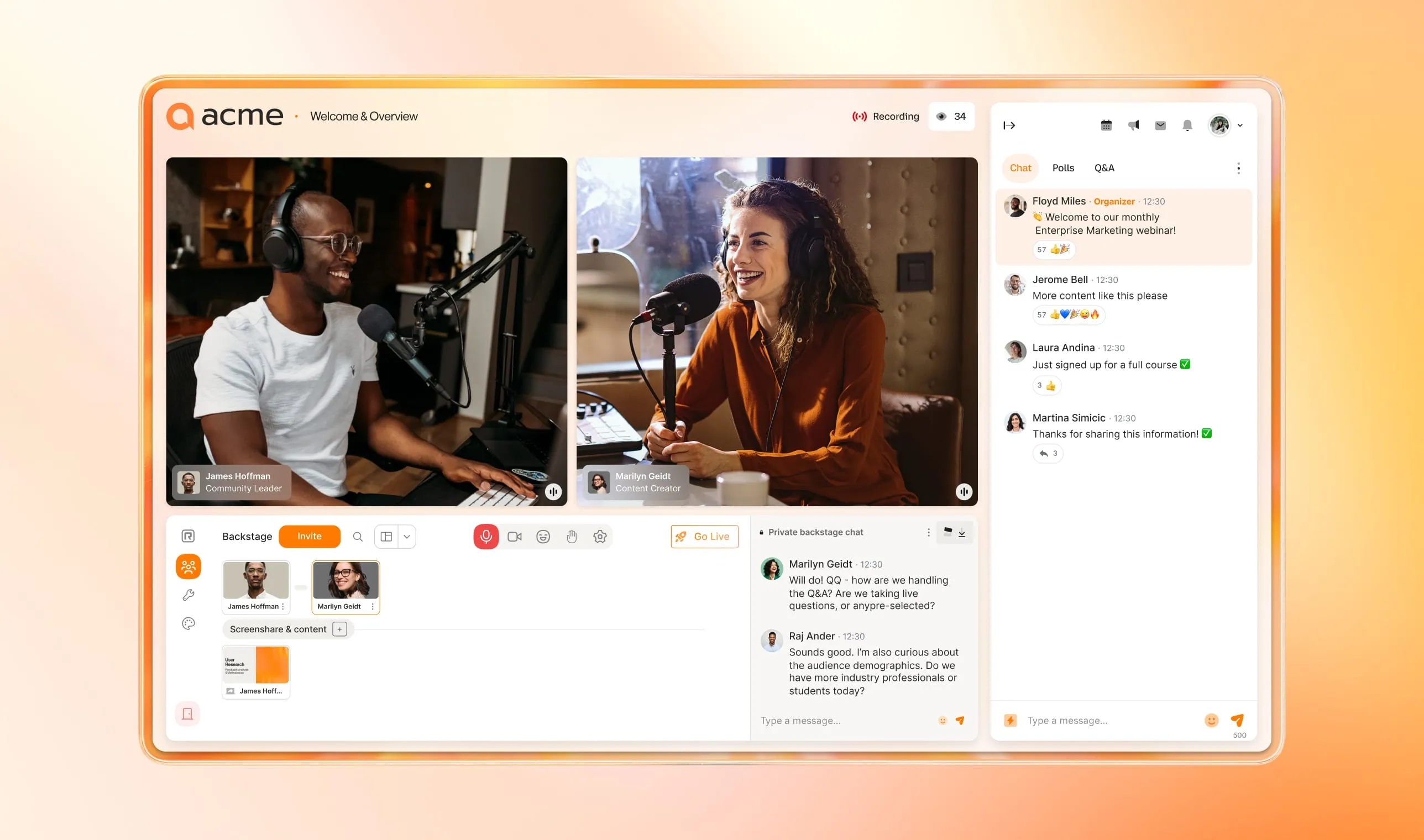
The expertise here is partly in reducing handoffs. August 2026 release notes let producers access the organization’s Content Library directly from Studio, reusing recordings without uploading them again for each session. July brought advance breakout-room assignments. Neither sounds glamorous. Both address familiar moments when a live event can lose its rhythm.
04 / Buy the workflow you will actually use
RingCentral Events competes with Zoom and Webex offerings and broader event platforms such as Cvent and Bizzabo. Its pitch combines customizable venues, native production, and engagement reporting within RingCentral’s portfolio. It is sold independently, so buyers do not need a RingCentral phone plan.
$99per organizer / month
$1,188 for one organizer over 12 months
The old $750 annual entry price belongs to the 2023 launch. Today’s FAQ starts Events Pro at $99 per organizer per month, with unlimited events and registrations. Paying monthly still requires an annual commitment. Pro covers webinars and virtual events; Pro+ adds onsite and hybrid tools, integrations, and Content Composer. Enterprise adds capabilities including APIs and Content Hubs. Unlimited registrations should not be mistaken for identical features across plans.
The product increasingly follows the recording after everyone leaves. AI Clips generates editable highlights. Creator Lab supports repurposing, while Content Hub houses branded libraries and resources. Thryv uses engagement information to shape future topics. The next event can therefore begin with evidence from the last one.
For a simple occasional presentation, this breadth may add work you do not need. For a hybrid conference, software cannot substitute for microphones, a reliable connection, or a production crew. The sensible buying test is a rehearsal: register an attendee, run a session, introduce two people, then inspect the export. If the resulting data cannot guide your follow-up, the room is only half built.