Imagine the toaster has finally given up. You open a shopping site, expecting to replace it before the kettle boils. A dozen models appear. They have similar names, similar stars, and remarkably different prices. One reviewer swears by the bargain. Another reports bread that emerges with the complexion of a chessboard. Soon you are watching a stranger explain crumb trays. Breakfast has become a literature review.
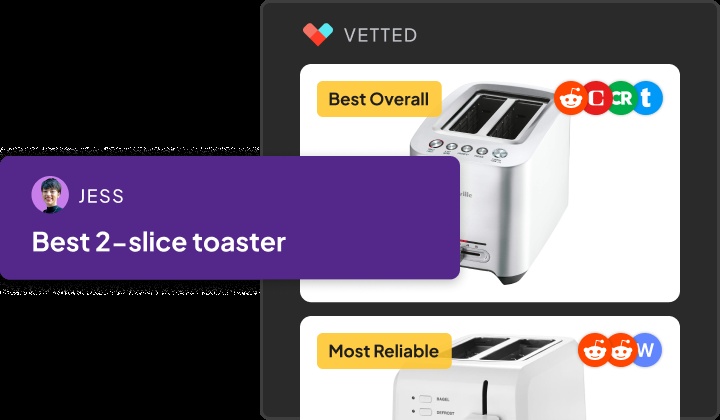
That imaginary shopping trip is the territory Vetted occupies. It is an AI shopping research assistant that helps consumers decide what to buy, drawing together reviews, alternatives, and prices. Its appeal begins with an ordinary irritation: being able to order almost anything has made choosing something a peculiar amount of work.
- The job: turn scattered product evidence into recommendations you can question.
- The tools: web chat, mobile apps, and a browser extension.
- The bill: free access, affiliate commissions, and optional Pro subscriptions.
- The catch: a clear answer still depends on useful evidence and your actual needs.
First choose the toaster. Then hunt the discount.
Vetted’s product starts before the checkout. Its Chrome extension advertises review summaries, brand research, alternatives, price history, and product comparisons. The distinction matters. A coupon service can help reduce the price of the item already in your basket. A research assistant has to establish whether that item belongs in the basket at all.
For the shopper, the useful questions are wonderfully unglamorous. Will this fit? What do owners complain about? Which compromise comes with the cheaper option? Vetted offers a place to ask those questions together. You can begin with a category, narrow the criteria, compare contenders, and follow a merchant link when you have made a decision.
The company’s product page identifies Reddit, YouTube, Wirecutter, CNET, and Tom’s Guide among its research inputs. These represent different kinds of evidence. A professional review may explain a controlled comparison. An owner’s comment may reveal an annoyance after months of use. Putting them beside one another can be useful; treating them as interchangeable would be a mistake.
The recommendation problem had two awkward rehearsals
Stuart Kearney founded Vetted with Tim Etler and Tom Raleigh. In 2022, investor Golden Ventures described the company’s early product as browser extensions that brought recommendations and comparisons onto retailer pages. It also described a distributed team with a California headquarters. The company was then emerging under the Vetted name, having previously been called Lustre. Golden Ventures’ account gives that launch its context.
Kearney’s May 2025 interview supplies the more revealing history. His earlier project, Slant, depended on community curation, which proved difficult to scale. Lustre attempted automation, but older language-processing tools struggled with obscure products and unreliable interpretation. He credits large language models with making unstructured review material much more usable.
“Once LLMs came along, everything changed.”
Stuart Kearney · May 2025
The founder also described a shift toward frequent household purchases, with an average order value around $40. His examples included skincare and bath towels. That is an interesting ambition for a technology company: to become useful often enough that someone returns without needing an expensive electronics purchase as an excuse.
The lesson for a builder is practical. Start by identifying the work that cannot be repeated cheaply or reliably. A charming interface does little good if the underlying system cannot distinguish two similarly named products. Nor does a vast catalogue help if the answer arrives as another wall of reading. Each stage has to earn its place in the customer’s decision.
- 01Your constraintsBudget, use, dealbreakers
- 02Product evidenceReviews, specifications, owners
- 03A shortlistAlternatives and trade-offs
- 04The merchantPrice, delivery, returns
A conceptual workflow. Research can narrow the decision; the final merchant details still matter.
The conversation has to keep moving
There is another obstacle hiding inside this experience: waiting. In a 2025 customer case study, Groq describes Vetted using its inference technology to support several models conducting personalized research. The supplier’s argument is that response speed matters to an interactive conversation, where one answer naturally prompts the next question.
That account explains the relationship without establishing a measured speed advantage. Still, its design implication is sound. If the shopper asks about cleaning a device, then asks whether a cheaper model solves the same problem, the system must keep the exchange moving. A long pause at every turn makes the familiar search box look inviting again.
Vetted’s expertise sits at this junction: retrieving product evidence, interpreting what it says, and presenting enough of it to support a choice. It does not manufacture the toaster or personally live with every towel. Its value depends on how well it assembles other people’s knowledge, and how readily the shopper can inspect and challenge the result.
Free advice has an invoice somewhere
Vetted announced a $14 million Series A on August 2, 2022, led by Insight Partners, with Index Ventures, Bling Capital, Golden Ventures, and angel investor Shiva Rajaraman participating. The company’s announcement tied that financing to expanding product and retailer coverage. That is capital raised, rather than a receipt for what the software cost to build.
August 2022
US iOS listing
The business earns affiliate commissions when shoppers make qualifying purchases through its links. That model makes the advice accessible without charging every visitor, while putting a familiar question on the table: does the commercial reward influence the recommendation? Affiliate-funded research deserves scrutiny even when the interface is pleasant. Vetted’s business profile describes the merchant referral model.
There is also an optional paid tier. The US iPhone listing offers Vetted Pro at $5.99 a month or $59.99 a year. Its version history introduced features including Amazon Price History and Pro Deal Finder. Those figures describe one storefront and market; check the app’s purchase screen for the offer available to you.
For the buyer, the subscription decision should be as specific as the shopping decision. If free research already answers your questions, there is little reason to pay out of gratitude for an attractive interface. If a paid feature repeatedly changes useful buying decisions, compare that benefit with the subscription’s actual cost.
What the public numbers do - and do not - say
The landing page claims more than 370,000 shoppers. The Chrome store lists 50,000 extension users; Google Play lists more than 100,000 downloads. These are different measures, collected on different surfaces. They cannot be added together to produce a customer total, and none establishes how many people are shopping actively this month.
There is a newer corporate chapter, too. Sacra reports that Yahoo entered an agreement to acquire Vetted in November 2025. The iPhone and Android listings now identify Yahoo as developer. That observable change puts Vetted inside a larger consumer internet context; it does not, by itself, tell us where every feature will eventually appear.
The competitive question is therefore sharper than whether a chatbot can recommend a toaster. Shoppers can ask a general assistant, read a buying guide, search a retailer, or consult a forum. Vetted has to make its shopping-specific combination of research and comparison worth opening. A dedicated tool earns attention when its answers save meaningful effort on a real purchase.
A better brief beats another browser tab
Here is a shopping habit worth copying. Begin with the situation, the budget, and the thing that would make you regret the purchase. For example: “I need a two-slice toaster under $80, with room for thick bread and an easy-to-clean crumb tray. Compare three options and explain the recurring complaints.” This is an illustrative prompt, not a tested Vetted result.
Then interrogate the shortlist. Ask which recommendation changes if the budget drops. Ask whether the review refers to the exact model being sold. Ask what evidence supports a claim about durability. Before buying, confirm the seller, current price, delivery terms, and returns. The point of delegating research is to make those final questions easier to answer.
This approach needs enough good evidence to work. A newly released or obscure product may have very little. Fit, texture, and personal taste can resist a tidy summary. Vetted’s Chrome listing also limits supported use to the United States and Canada. Useful advice in one market may lead to an unavailable model or irrelevant price in another.
There is a modest pleasure in arriving at a decision without becoming an amateur crumb-tray scholar. Vetted’s proposition is attractive at that scale: help someone make a considered purchase, then let them get on with the day. Breakfast would be a perfectly respectable place to start.
Take it shopping
Open Vetted · Chrome extension · iPhone app · Android app
LinkedIn · X / Twitter · Facebook
Continue reading: Kearney’s shopping interview · The Groq product walkthrough · The 2022 launch announcement