Haz Hubble's résumé reads less like a ladder than a drawer of adapters. Estate agent. Teenage agency founder. Accountant. Finance manager. CFO. Community host. Designer. Salesman. Engineer. Each role solved the problem immediately in front of him, then waited until a company appeared that needed all of them at once.
That company is Pally, the San Francisco startup Hubble runs with Wyatt Lansford. Its current product is an AI personal assistant reached through a text message, connected to the inboxes, calendars, files and tasks where modern obligations hide. It can help find the unanswered note, remember a promise, prepare a reply or handle an errand. The grand idea arrives through the least grand interface imaginable: send a text.
The route here was messy, public and frequently close to terminal. It also explains Hubble's particular fascination with memory. His career has been a long exercise in collecting useful context, then retrieving the right piece at the right moment.
An education in other people's businesses
Hubble, legally Harry, left high school and started working at 14. His first job involved selling houses as an estate agent. At 15, he started a design agency that did the sort of work a technically inclined teenager could plausibly sell: graphics, websites and social media. He liked entrepreneurship, but decided that being his own boss was a poor substitute for learning from people who knew more.
So he took night classes in accounting and law. Finance caught him. He has described it as a front-row seat to every department in a business, a way to see why the machine succeeds or stalls. He entered full-time finance at 17, qualified as a Chartered Management Accountant at 20 and became CFO of a 200-person company at 22. His own account of that job includes as many as 25 direct reports and $65 million in financing.
It is a strange apprenticeship for consumer software, which is precisely its value. A founder can charm a room and still misunderstand a balance sheet. An engineer can ship quickly and still miss why a buyer hesitates. Hubble learned to follow money through an organization before he learned to follow data through an application.
Five cities and a stubborn problem
Finance moved him through five cities in five years, across countries and continents. The professional acceleration came with social drag. Relationships were harder to maintain when the people who mattered were no longer down the corridor or around the corner. Social platforms offered endless evidence of human activity, but not much help with the modest work of friendship: noticing, remembering and making a plan.
The pandemic sharpened that frustration. Hubble left the CFO track and returned to entrepreneurship at 23. Pally's first public shape was a social operating system. It combined messaging with event planning, an intelligent address book and an AI concierge that could suggest things to do. A London community of roughly 15,000 people tested the idea. Ticketmaster, Sofar Sounds and Viator were among its early commercial partners.
“Our goal with Pally is to create a future where AI improves human connection, rather than replacing it.”Haz Hubble
Two early directions did not take off. The product narrowed toward relationship management: bring together contacts from iMessage, WhatsApp, LinkedIn, email, calendars and X; enrich their profiles; search the network in plain English; prepare for meetings; and notice which connections had begun to cool. In 2026 it shifted again, toward a broader assistant that lives in text messages and works across personal tools.
The pivots share one conviction: software should carry the clerical load around a relationship, not impersonate the relationship itself. Remember the follow-up. Surface the context. Reduce the little taxes that turn goodwill into guilt.
The drive home
There was a point when Pally had run out of money. It had no engineers and no product. Hubble applied for jobs. On a drive back to his mother's home, he cried for much of the journey. She gave him the sort of advice that sounds banal until it is the only thing left: “keep going.”
He did so in the most literal way available. Hubble learned to code and rebuilt the product himself, before coding agents made that path fashionable. The new version reached $12,000 in annual recurring revenue within days of launching. The company raised pre-seed backing from Founders Inc., Slack co-founder Cal Henderson, Hugging Face co-founder Thomas Wolf and others.
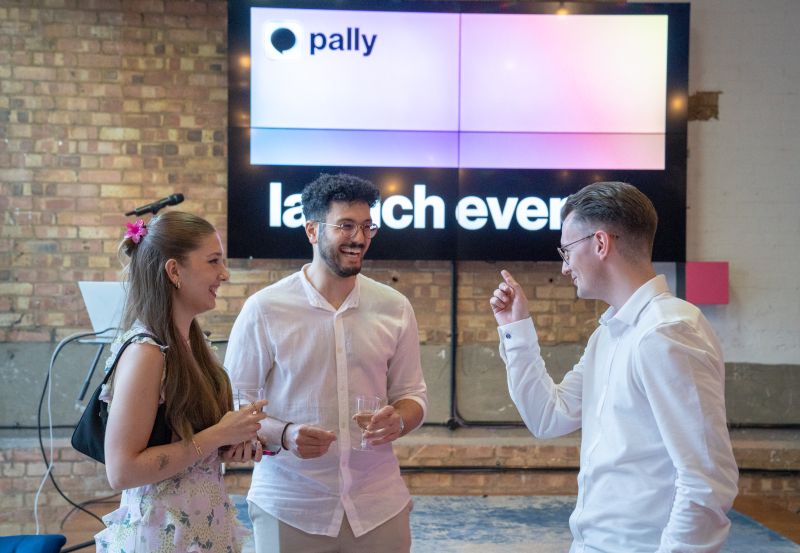
Then came Lansford, an AI and machine-learning engineer whose previous work included autonomous aircraft and robotics. Hubble moved to San Francisco. Together they entered Y Combinator's Summer 2025 batch. Pally became Product of the Week on Product Hunt and announced a $1.1 million pre-seed round.
A launch lesson with the fingerprints left on
Hubble writes unusually practical notes about fundraising and launches. His formula for a first fundraise is blunt: team, traction and market, with two of the three needed before the process has much chance. His Product Hunt advice begins with preparation, a Tuesday launch and a short video that shows the people who built the thing.
The more revealing lesson concerns a mistake. Pally's launch video opened with a line designed to provoke. It worked as a hook, but Hubble later wrote that he regretted the framing. It reached for a reaction at the cost of the brand's actual spirit. Product of the Week did not turn the choice into a good one.
That distinction is rare in founder postmortems. Success tends to varnish every preceding decision. Hubble kept the result and criticized the tactic. His simpler principle survives: “People connect with people.” It explains why builders should appear in their own launch video, and why Pally's automation has to leave the human voice intact.
The portable playbook
- Learn the skill that removes the company's immediate bottleneck.
- Launch where users already behave, with one obvious use case.
- Separate a tactic that performed from a message worth repeating.
- Let software remember the context, then let the person make the connection.
The house before the software
Hubble's interest in networks also became architecture. In 2024 he started London Founder House, a residency and gathering place for company builders. In its first year, he says, residents raised $28 million, the house held more than 50 events and over 1,000 founders came through its doors.
A founder house is a personal CRM made physical. Context travels over breakfast. Someone knows who needs a designer, who just closed a round or who should be in the same room. A good host notices those edges without making every interaction feel arranged. Hubble calls himself a super connector; the house gave that identity a postcode.
It also points to Pally's most delicate challenge. The software becomes more helpful as it learns more, while every additional inbox and calendar raises the price of trust. Relationship tools cannot treat privacy as a footnote because private context is the product's raw material. Convenience gets the first trial. Restraint earns the second month.
A deliberately odd mix
Away from the pitch, Hubble's tastes are cheerful and specific. He loves live music, from festivals to jazz bars and open mics. He travels for local culture but also appreciates a very good hotel. Football, snowboarding, motorcycles, poker and game nights compete for the remaining hours. He prefers sunrise to sunset, hosts friends and family, cooks better for other people than for himself, and has the proper British attachment to cups of tea.
He is also competitive enough to say he always wants to win, yet reflective enough to publish advice with a standing warning that he may change his mind. The accountant writes in rules, then adds that rules are made to be broken. The designer cares about the hook. The engineer removes the wasted milliseconds. The host remembers there is a person on the other side.
In August 2026, Pally announced $5.2 million in financing led by Cyber Fund and Y Combinator at a reported $30 million valuation. Its current test is larger than fundraising: can two founders build an assistant trusted with the neglected messages, loose promises and unfinished errands of daily life?
Hubble's answer has stayed remarkably consistent through the product changes. Relationships are the important part. AI belongs in the supporting role. His company will be judged on whether the machine can be useful without becoming the main character, which may be the most human constraint anyone has yet put on a personal assistant.