Eugenia Kuyda wanted to track her weight. The app she liked had other ambitions. It offered calorie counting, meal tracking and a subscription, when the job she had hired it to do was rather smaller. As she recalled to Fast Company, a useful tool had become a collection of obligations. Software, apparently, could develop the manners of a dinner guest who refuses to leave.
- Wabi began with mini-apps people could create, share and remix without coding.
- Its current product brings an AI assistant and generated interfaces into group conversations.
- A16z led its $20 million pre-seed. The service is currently free.
The app that did too much
That irritation helps explain Wabi, the San Francisco company Kuyda founded after Replika, her AI companion business. Its original proposition was personal software: little applications fitted to a person’s needs, rather than a person adjusting to a product built for millions. The difference sounds modest until you consider how many settings, subscriptions and unused buttons an ordinary phone accumulates.
Wabi’s manifesto makes the complaint plainly: “Made for billions. Not for us.” We choose our clothes and furniture, it argues, while our software remains largely standardized. The suggested remedy is to make creation and modification simple enough that an app can serve a small purpose without acquiring a large business plan.
A weight tracker is a revealing example. Its value need not depend on novelty. It needs to fit the habit of one person who will use it tomorrow. Wabi’s opportunity lies in these overlooked corners: a family routine, a private joke, a task too particular to deserve a polished standalone product.
A little software, a little society
The first Wabi let people describe mini-apps, use them, discover other people’s creations and remix them. Building and distribution belonged to the same platform. In its investment announcement, Andreessen Horowitz pointed to personal CRMs, creative tools and social applications. The proposed audience extended beyond programmers to people who had a reason to make something.
Kuyda’s own examples are more amusing than the category labels. On LinkedIn, she described a Miami user making a weekend planner for a group chat and a UK user proposing to his girlfriend with a mini-app. These are founder-reported anecdotes, but their specificity matters. One is a recurring nuisance. The other is a gesture. Neither requires an enterprise procurement department.
The investor’s thesis was that creation and distribution could reinforce each other: someone makes a useful app, someone else encounters it, then changes it. That is a proposed network effect, rather than evidence that one has already become durable. A gallery can attract visitors; a tool earns its place when those visitors return.
“Made for billions. Not for us.”Wabi’s manifesto, on conventional apps
The conversation moves to the front
In September 2026, Wabi changed the entrance. Its website now presents “A new kind of messenger that gets things done.” The current iPhone release is branded Wabi 3.0. Users begin with a conversation involving an assistant and, when useful, other people. The software can appear within that conversation.
This makes the group trip a sensible showcase. Imagine friends choosing dates and debating dinner. A chat can hold their opinions, but a shared plan gives those opinions somewhere to settle. Wabi’s product pitch combines the discussion with tools for acting on it. The assistant is meant to help with the work; a generated interface gives the group something to use.
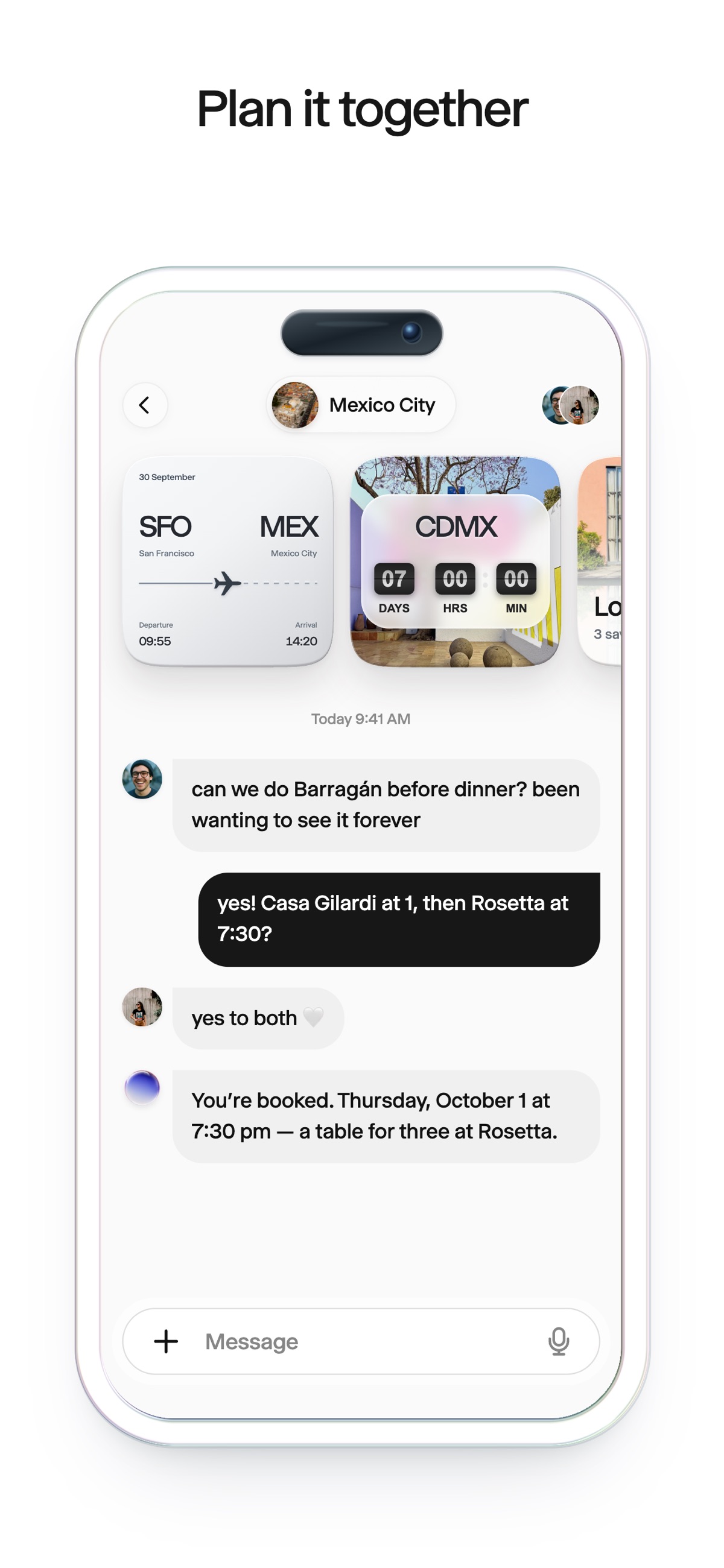
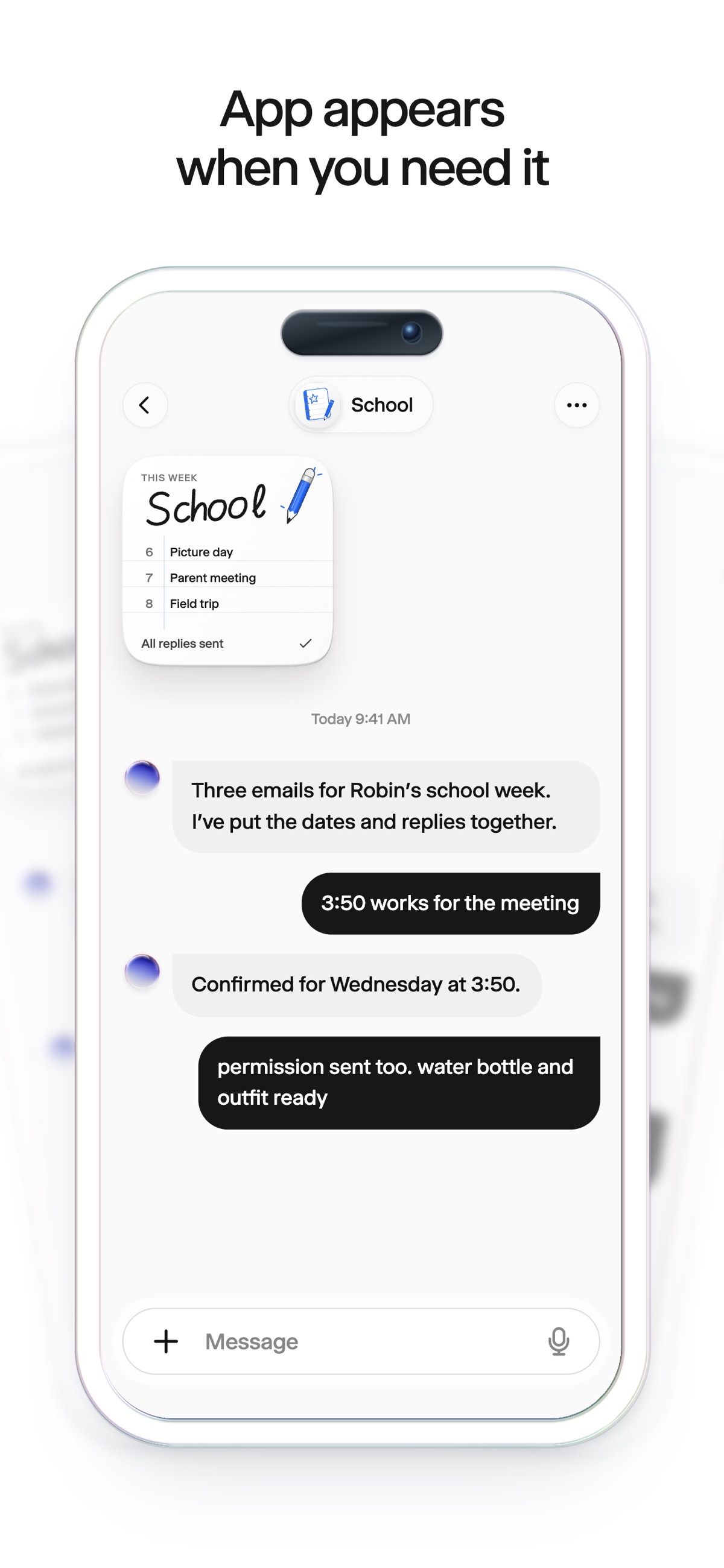
My reading of the shift is that Wabi has moved the burden of invention. The original invitation asked people what app they wanted. The newer one asks what they want to happen. Someone arranging a weekend should not have to decide whether the answer requires a tracker, a list or a miniature application before asking for help.
That changes the competitive question, too. A prompt-built app platform invites comparisons with coding and prototyping tools. A messenger must earn time beside the conversations people already have. The point of difference is the combination of people, task assistance and generated software. Its usefulness depends on how comfortably those pieces work together.
Free for now, someone still pays
Andreessen Horowitz announced its $20 million pre-seed investment in November 2025. That is money raised, rather than the measured cost of building Wabi. It gives the company room to develop a consumer platform before every little app has to carry a price tag.
November 2025 · a16z led
The current terms say the service is free. They also provide for future paid features, subscriptions and credits, with notice before charging. The present business model is therefore a free consumer service with a possible paid layer. Treating those future provisions as today’s subscription menu would be premature.
The platform still incurs work. Hosting, data handling and moderation cannot be wished away by a good prompt. Fast Company identified another trade-off: the convenience of building inside Wabi comes with dependence on its environment. A useful personal tool and an independently deployable software asset are different purchases, even when the first currently costs nothing.
Start with the nuisance
For a reader, the practical experiment is small. Choose one thing that repeatedly gets lost between people: the dinner decision, a weekend plan, a household list. Describe the outcome, involve the people concerned and see whether the resulting tool makes the next conversation shorter. A feature that nobody reopens is a souvenir.
For a builder, the transferable lesson is to keep the interface close to the moment of need. There is no reason to assume Wabi’s earlier product failed commercially simply because its presentation changed. The visible revision is more useful than an invented failure story: conversation now supplies the starting point, and software supplies a shape for the task.
The bargain suits personal coordination better than work demanding independent deployment or guaranteed continuity. Wabi’s terms limit use to personal, non-commercial purposes and allow service changes. Its privacy notice describes optional access to sensitive sources of context. People unwilling to connect those sources should expect a less informed assistant.
Kuyda’s original annoyance remains a fair test. If a tool adds more obligations than it removes, the software has forgotten its manners. Wabi is trying to give it a smaller job, useful company and a reason to stop talking once the plan is made.
Open the conversation
Try Wabi ↗ · iPhone app ↗ · The manifesto ↗
LinkedIn · X · Instagram · TikTok · Discord
Watch: Eugenia Kuyda on Solo Founders
Watch: Wabi’s messenger announcement
Read: the weight-tracker origin
Read: the September messenger shift